Noah and the Generations of Righteousness
Lamplighter | October 19, 2023
Print This Article
View Original PDF

Noah and the Generations of Righteousness

Lamplighter | December 31, 2025

This week we read the second portion of the Torah, Noach (Noah). In describing the virtue of Noah the Torah states: "Noah was a righteous and wholehearted man in his generations." Our Sages emphasize that Noah was considered righteous in comparison to his own morally depraved era, but not in comparison with other generations. The Zohar specifies three generations in which, had Noah lived at that time, "he would have been considered as nothing": the generation of Abraham, of Moses, and of David.

Why were these three particular generations chosen for the comparison?

With each of these generations, a new phase began in the world's development. Abraham, the first Jew, initiated the stage in which the Jewish people started to fulfil its Divine mission. Moses brought the Torah to the world, which marked the beginning of the ability to sanctify and refine physical reality. King David initiated the era of sovereignty, the ultimate objective of which is to establish G-d as King over the entire world.

Noah, too, lived in a time of new beginnings: the world as it exists after the Flood. The Midrash tells us that when Noah went out of the ark "he saw a new world," and began to establish the foundations on which to rebuild it. Nonetheless, because Noah's service was on a very low preliminary level, his contribution is considered "as nothing" in comparison to the service of Abraham, Moses and David.

In truth, Noah's righteousness was mainly in comparison with the wickedness of the generation of the Flood. The people of his time were extremely corrupt in the way they dealt with each other. But righteousness in interpersonal relations is not enough to bring the world to its G-dly perfection. While certainly a prerequisite, it merely allows the world to function the way it should.

For this reason Noah's service is considered "as nothing" in contrast to that of Abraham, Moses and David. Their service went beyond the social realm; they actually connected the world to G-dliness. Abraham disseminated the belief in One G-d; Moses received the Torah at Mount Sinai; and David built the infrastructure for the Holy Temple in which the Divine Presence would rest.

Another difference: Noah's service was primarily motivated by fear; his warning to the people of his generation was connected to the threat of the imminent Flood. The Midrash even states that "Noah was lacking in faith; had the water not reached his ankles, he would not have entered the ark."

By contrast, the service of Abraham, Moses and David stemmed from a deep and inner recognition of G-d's greatness, which enabled them to set the "ground rules" for the world's perfection - a process that will be completed by Moshiach, speedily in our day.
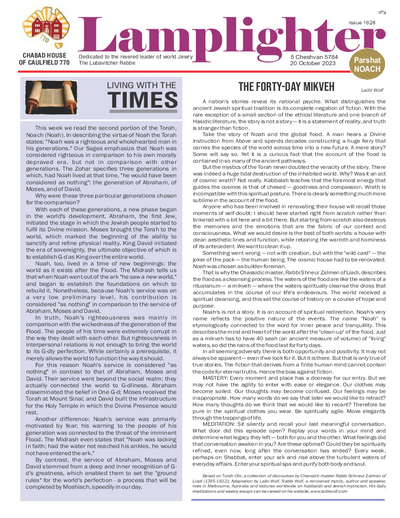

This week we read the second portion of the Torah, Noach (Noah). In describing the virtue of Noah the Torah states: "Noah was a righteous and wholehearted man in his generations." Our Sages emphasize that Noah was considered righteous in comparison to his own morally depraved era, but not in comparison with other generations. The Zohar specifies three generations in which, had Noah lived at that time, "he would have been considered as nothing": the generation of Abraham, of Moses, and of David.

Why were these three particular generations chosen for the comparison?

With each of these generations, a new phase began in the world's development. Abraham, the first Jew, initiated the stage in which the Jewish people started to fulfil its Divine mission. Moses brought the Torah to the world, which marked the beginning of the ability to sanctify and refine physical reality. King David initiated the era of sovereignty, the ultimate objective of which is to establish G-d as King over the entire world.

Noah, too, lived in a time of new beginnings: the world as it exists after the Flood. The Midrash tells us that when Noah went out of the ark "he saw a new world," and began to establish the foundations on which to rebuild it. Nonetheless, because Noah's service was on a very low preliminary level, his contribution is considered "as nothing" in comparison to the service of Abraham, Moses and David.

In truth, Noah's righteousness was mainly in comparison with the wickedness of the generation of the Flood. The people of his time were extremely corrupt in the way they dealt with each other. But righteousness in interpersonal relations is not enough to bring the world to its G-dly perfection. While certainly a prerequisite, it merely allows the world to function the way it should.

For this reason Noah's service is considered "as nothing" in contrast to that of Abraham, Moses and David. Their service went beyond the social realm; they actually connected the world to G-dliness. Abraham disseminated the belief in One G-d; Moses received the Torah at Mount Sinai; and David built the infrastructure for the Holy Temple in which the Divine Presence would rest.

Another difference: Noah's service was primarily motivated by fear; his warning to the people of his generation was connected to the threat of the imminent Flood. The Midrash even states that "Noah was lacking in faith; had the water not reached his ankles, he would not have entered the ark."

By contrast, the service of Abraham, Moses and David stemmed from a deep and inner recognition of G-d's greatness, which enabled them to set the "ground rules" for the world's perfection - a process that will be completed by Moshiach, speedily in our day.

PDF Preview