The Influence of Gezel and Purity on Future Generations
Torah Papers | November 01, 2024
Print This Article
View Original PDF

The Influence of Gezel and Purity on Future Generations

Torah Papers | June 27, 2025

Hakadosh Baruch Hu does not want anything to do with theft! Stealing influences and affects one’s children, and when a child suddenly loses all desire and drive to learn, there is a connection.

Again, I emphasize that this idea is not black-and-white. Yitzchak Avinu was above any suspicion of gezel, yet he had a son, Eisav, who took a sudden left turn at age fifteen. Until that age, both Eisav and his twin brother, Yaacov Avinu, attended the same yeshiva day school and studied the same subjects. But at fifteen, one of them suddenly dropped out of the curriculum. Clearly, there are other factors in play, and this topic goes beyond our full purview and comprehension, but it is worthy of our consideration.

Where do we find a similar case of someone affected at a later age by food consumption? Commentators all point to the story of Elisha ben Avuya – Acher – as found in the Yerushalmi (Chagigah 2:1) and Tosfot (Chagigah 15a). What caused this once great Tannah to stray from the path? Amongst several answers, we find:

וְיֵשׁ אוֹמְרִ ים. אִמּוֹ כְּשׁ ֶהָֽיְתָה מְעוּבֶּרֶ ת בּוֹ הָֽיְתָה עוֹבֶרֶ ת עַל בָּתֵּי עֲבוֹדָה זָרָ ה וְ הֵ רִ יחָ ה מֵ אוֹתוֹ הַ מִּ ין. וְ הָ יָה אוֹתוֹ הָ רֵ יחַ מְ פַעְ פּ ֵעַ בְּ גוּפָהּ כְּ אִ ירְ סָ הּ שׁ ֶלְחֲכִינָה. לְאַחַר יָמִים חָלָה אֱלִישׁ ַע.

Others say, when his mother was pregnant with him, she passed by idolatry, smelled of that kind and ate it. And it was bubbling in her body like the poison of a viper. Later Elisha fell sick.

The commentators all stress the fact that his mother did not perform any horrific act of sin. She was pregnant, in danger, and even permitted to eat on Yom Kippur. All she did was take some food. Nonetheless, even though what entered her body did so amid conditions allowing for it, it also entered her unborn child’s heart and affected him years later. The Gemara (Yoma 82b) also speaks of cases with subsequent negative effects on the child where what was eaten was absolutely Kosher l’Mehadrin but was consumed on a day where eating was not permitted.

With this, we can dive into the question of the Shemen Rosh and see where he’s going with it. The question he asks, and we no doubt ask over and over again, is why Hakadosh Baruch Hu took even children from the world during the flood.

ֶזֶלָּא עַל הַגְּזַר דִּ ינָם אֶלֹּא נֶחְתַּם גְּזַר דִּ ינָם – Their fate was sealed only on account of sin of robbery. Shemen Rosh says, this statement is in reference to the children! Hakadosh Baruch Hu doesn’t punish minors, as children have the potential to be righteous even if their parents are corrupt. We see this in David HaMelech’s decision to delay punishing Shimi ben Geira for his rebellious actions. David waited, or had his son Shlomo wait, until after Shimi’s son was born because David foresaw that from Shimi would come Mordechai:

בֶּן יָאִיר בֶּן־שִׁמְעִימָ רְ דּ ֳ כַ י.

Similarly, the nation of Moav was preserved and safeguarded, and Moshe Rabbeinu did not destroy them, because Ruth would descend from them. Regarding the Dor HaMabul, Shemen Rosh explains that לֹא נֶחְתַּם גְּזַר דִּ ינָם is referring to the fate of the children. If the parents stole and fed their children stolen food, it inevitably corrupted the children, turning them morally rotten. Nothing good could come from children who were fed from gezel. Unlike the cardinal sins of idolatry and giluy arayot, whose punishment can be deferred so that righteous children can emerge in the interim, it’s a dead-end for those who eat from gezel, and therefore it was no longer worth waiting to see what might become of them – their fate was thus sealed.

Thus, to the question of how gezel became the defining sin that justified the entire generation’s destruction, Shemen Rosh clarifies that gezel was only decisive when it came to the children. The adults’ fate was already sealed due to their two cardinal sins, but the entire generation’s fate was finalized, and the flood began, only once gezel entered the bloodstream of the next generation, corrupting them as well.

From here he dives into a marvelous idea. The dove wasn’t being disrespectful to Noach, nor showing ungratefulness. The dove was saying, “Noach, my dear host, it was fantastic with you in the ark. Thank you for the top-notch service, but I would like to teach you a lesson on my way out. Do you know why all the children died in this flood? It is because nothing would have come from them. They were raised eating the food of gezel, and they became corrupt.”

Children as Olive Saplings

How do Chazal refer to children? Sefer Tehillim says (128:3):

א ֶ שׁ ְ תּ ְ ךָ בְּיַרְ כְּתֵי בֵיתֶךָ כְּגֶפֶן פֹּרִ י, כִּשְׁתִלֵי זֵיתִים סָבִיב לְשׁ ֻלְחָנֶךָ בָּנֶיךָ

Your wife shall be like a fruitful vine within your house; your sons, like olive saplings around your table.

Why are other analogies not used? Why are the children not referred to as date saplings around the table? Why is a wife not likened to a pomegranate tree? The Yerushalmi says (Kilayim 1:7:6), just as grape vines and olive trees are not subject to grafting (as there’d be no gain from it), so too in your children you will not find any flaws.

עִנְבֵי הַגֶּפֶן בְּעִנְבֵי הַגֶּפֶן – grapes are not combined with kiwis or mangos, and no greater derivative will come from the grape than when it is a grape with another grape. The same is true for the olive, whose purity is at its peak when kept as olives with olives. No other species is added to olive oil to increase its value. Its purity is its prize. The meaning of the above Pasuk is that Am Yisrael remains alone and pure; it does not mix with the nations of the world. When we remain pure as such, our children will remain pure as well.

Shemen Rosh adds, when we remain pure, our children will be כִּ שׁ ְ תִ לֵ י זֵ יתִ ים – like olive saplings; and listen closely to his explanation. The Gemara teaches that one who eats olives will forget seventy years of learning – a concerning thought. To counteract this, we’re advised to pour some olive oil on top when opening a container of olives, since the Gemara also says that one who drinks olive oil will have seventy years of forgotten learning restored. This shows that the oil of the olive is of greater significance than the olive itself. The child is raised to become greater than the parent!

The Dove’s Message and the Honey Trap

When the dove came to Noach, it conveyed a message: “I don’t want to sound ungrateful after such a remarkable experience, chas v’chalila, but I’ve reached a conclusion. This world was destroyed because people stole from one another and fed their children with the proceeds of gezel. I would rather receive the most minimal amount of food, no matter how bitter or unappealing, as long as my children can be כִּ שׁ ְ תִ לֵ י זֵ יתִ ים. I don’t desire wealth or a rich high-tech exit. I seek only the bare minimum, directly from Hakadosh Baruch Hu, so that my hands remain clean, and my children pure.”

And why does the dove’s message reference (actual) honey for the flip side of the equation? It is because when a bee lands in honey and tries to shake itself free, if its legs break off and remain behind in the honey, we are permitted to eat the honey. In contrast, if a butterfly lands in a jug of milk and loses two of its legs in the process of getting out, we must pour out the milk along with the legs mixed inside. Why the different rulings for two cases of a sheretz in our food? Chazal explain, honey consumes what lands in it, whereas milk does not.

This concept has a deeper lesson for those who work in environments that seem like honey: high salary, excellent pension, modern office space, comprehensive benefits, and exciting perks. Yet, in these places, not everyone dresses or speaks in ways that reflect purity and holiness, nor do all act according to the values we’re meant to live by. Taking a break for Mincha, for example, may not always be welcome. Despite these influences, the honey draws you in, trapping you with its allure. Chazal teach us that one who steps into a honey trap like this risks being consumed by it, drawn into a world that can make it difficult to maintain spiritual priorities. As the balance in the bank account rises, one may not even realize how their spirituality has fallen, how their Shabbat is no longer the same, and how their interests and drives are a weak shadow of their former selves.

We find that after twenty years of working for Lavan and being cheated time and time again, Yaacov Avinu finally picked up and left. Lavan chased after him though, accusing him of fleeing after stealing his idols. Yaacov vehemently denied the accusation and challenged Lavan to search all his belongings: “If you find anything belonging to you, whether a spoon, a baby’s pacifier, a towel, or anything at all, I will return to your house!” After twenty years and raising eleven children there, is it not possible, or even probable, that a small towel would find its way into his bags? We stay at a hotel for twenty hours and a couple of towels unintentionally fall into our suitcase on the way out! Could Yaacov not justify taking what was due to him but not delivered? No! He did not take a single item that did not belong to him. That is נְקִ י כַפַּיִם וּבַר־לֵבָב – leaving this world with clean hands and no cheshbon to settle.

I once walked into a store where they repair tefillin, to ask where I might find a particular item in the neighborhood. I approached a gentleman working at a table toward the back and greeted him with a “Hello.” He didn’t respond or even glance in my direction. Thinking he might not have heard due to having headphones in, I looked more closely – this was before the days of wireless earbuds that hide in your ear – but there was nothing on his ears. So, I said “Hello?” a bit louder. This time, I noticed him press a button before he turned to me and asked how he could help. Curious, I decided to first ask him about that button. He explained that he uses a stopwatch because he works by the hour – 150 shekel per hour, meaning 2.5 shekel per minute. “If I turn around to answer someone without accounting for the time,” he said, “I’m effectively stealing those two shekels from my employer. I want to be clean of gezel and owe nothing at the end of my days.” That is the definition of נְקִ י כַפַּיִם וּבַר־לֵבָב – He who has clean hands and a pure heart.

My father, z”l, until his very last day, remained of clear and sound mind despite any illnesses he faced towards the end of his life. His commitment to shiurim, tefillah, and conversations in limud (learning) remained unwavering. Even at 93, he was like a young panther. After closing his business at age 65, he devoted the rest of his life to learning, like a young avreich in Kollel. One of the rabbanim whose shiur he regularly attended shared at the shiva that he often prepared his shiur solely for my father, knowing he was the only one who would stay fully awake and engaged, asking questions until every detail was clear. Curious about the source of this energy and clarity, I once asked my father about it. His answer was profound. He explained that, during the Shoah, he had received a letter from his father and the town’s rav granting permission to eat whatever food was served – pikuach nefesh made it permissible. But my father told me, “I did not listen. I ate plants, weeds, and whatever else I could find, but I did not touch the ma’achalot asurot – the forbidden foods they served. These foods never entered my mouth, and as a result, I was blessed with a clear mind and the desire to learn until my final days.” We engraved this on his matzeiva as a testament to his unwavering commitment.

The dove wanted to ensure that there would be no questions or doubts regarding its parnassa and the food it provided for its young. In the same way, we must be vigilant with the money we earn and the food we serve, for if they are not kosher in our hands, our olives – i.e., our children – will be corrupted and affected. The children of the generation of the flood ate from gezel, resulting in וַתִּ מָּ לֵא הָ אָ רֶ ץ חָ מָ ס – a world filled with theft and wrongdoing.

The Month of Marcheshvan and the Olive Branch

As we enter the month of Marcheshvan, we’ll conclude with the Midrash (Tanchuma, Tetzaveh 1:3), which comments on our opening Pasuk about Noach opening the window of the ark, linking it to the lighting of the oil in the Mishkan:

וְ אַ תּ ָ ה תְּ צַ וֶּ ה  אֶת־בְּנֵי יִ שְׂ רָ אֵ ל וְ יִ קְ ח וּ אֵ לֶיך שׁ ֶ מ ֶ ן זַיִת זָך כּ ָ תִ ית לַ מּ ָ אוֹ ר לְהַ עֲלֹת נֵר תּ ָ מִ יד׃

You shall command Bnei Yisrael and have them bring you clear olive oil, made from olives that were crushed for lighting, to keep the lamp burning constantly.

The Midrash says that Hakadosh Baruch Hu declared, “Just as the dove brought light to the world, so too you, who are likened to the dove, brought olive oil and burned it before Me.” Because the dove brought the olive branch and made its declaration to Hakadosh Baruch Hu and Noach, Bnei Yisrael merited lighting the Menorah in the Mikdash with olive oil.

Returning to the commentary of the Da’at Zekainim, it is explained that the dove brought the olive branch back on the th of Tammuz, foreshadowing the Churban and the period in which Am Yisrael would have nowhere to rest their weary feet. The Zohar adds that ultimately, it will be the dove that places the crown atop the head of Melech HaMashiach (Zohar, Shelach 16:150):

וּבְשׁ ַעֲתָא דִּ כְתִּיב וְלָא יָסְפָה שׁ וּב אֵלָיו, עוֹד לָא יָדַע בַּר נָשׁ לְאָן אַזְלַת, וְהִיא נִיזַת בְּפִתְחָא דָּא וְאִיהִי תִּטּוֹל עֲטָרָ ה בְּפוּמָהָא, וּתְ שׁ ָוֵי תָּבַת לְאַתְרָ הּ, וְאִתְג עַל רֵ ישׁ ֵיהּ דְּ מַלְכָּא מְשִׁיחָא, מָטֵי וְלָא מָטֵי, וּכְדֵין כְּתִיב, תָּשִׁית לְרֹאשׁ וֹ עֲ טֶ רֶ ת פּ ָ ז . .. . הוּא, דִּ כְתִּיב דָּוִד מַלְכָּא, זַיִת רַ עֲנָן אִקְ רֵ י קַמֵּיהּ קוּדְ שׁ ָא בְּרִ יך וַאֲנִי כְּזַיִת רַ עֲנָן בְּבֵית וְגוֹ.' עֲלֵה זַיִת, דָּא מַלְכָּא מְשִׁיחָא בְּרֵ יהּ דְּ דָוִד. וְדָּא אִיהוּ דְּ רָ מִיז יוֹנָה דָּא בְּיוֹמוֹי דְּ נֹחַ, דִּ כְתִיב וְהִנֵּה עֲלֵה זַיִת טָ רָ ף בְּפִיהָ.

During the time that it says: "Which returned not again to him any more," no person knew where she went. She returned to her assigned place and was stored in this opening. She will take the crown in her mouth and place it on the head of King Messiah, as it is written: "You set a crown of pure gold on his head.”... King David is called a fresh olive in the presence of Hakadosh Baruch Hu, as it is written: "But I am like a green olive tree in the house...". A leaf of an olive tree is King Messiah, son of David. That is what the dove indicated during the time of Noah, as it is written: "And, lo, in her mouth was an olive tree plucked off."

In his commentary, Zohar Chai, the Rebbe of Komarno says the numerical value of טָ רָ ף בְּ פִ יהָ is equal to דָּוִד בֶּן יִשׁ ַי. The Zohar says זַיִת עֲלֵה is Melech HaMashiach, and David HaMelech received the years of his life from Adam HaRishon. אד"ם = א "דם, ד"וד, מ"שיח – that is the order. Adam gave his years to David, and from David will come the Mashiach. The Rebbe of Komarno brilliantly adds, the numerical value of אדם is 45, the numerical value of דוד is 14, and the numerical value of מ שיח is 358, which together equal 417, or זית. The significance of וְ הִ נֵּה עֲלֵה־זַיִת טָ רָ ף בְּ פִ יהָ is that our Parsha hints at matters of Mashiach.

The Month of Marcheshvan and the Beit Hamikdash

The Bnei Yissaschar (Marcheshvan 1) then sheds more light on this idea. In Sefer Melachim it says that Shlomo HaMelech completed the building of the Beit Hamikdash בְּ יֶרַ ח בּ וּל, which is the 8th month – Marcheshvan. It is called this because, amongst other reasons, during that month the מַ בּ וּל came down. Shlomo asked Hakadosh Baruch Hu whether to immediately inaugurate the Beit Hamikdash, but was to wait until the following Tishrei, on the 7th of the month, after which a week of celebration took place, including eating on Yom Kippur. The Bnei Yissaschar says, the month of Marcheshvan brought a complaint to Hakadosh Baruch Hu after not receiving the inauguration of the Beit Hamikdash which was ready during its month. It asked why it deserved such a punishment. And what was the response? Hakadosh Baruch Hu promised the month of Marcheshvan that the Third Beit Hamikdash would be built during its time.

We are in the month during which the Beit Hamikdash will be built. B’ezrat Hashem, the month we now enter will be filled with goodness and blessing, a refuah shleima to all in need of healing, a safe return of our hostages, a return home to all who’ve been displaced, an end to our troubles and suffering, and may it be fulfilled speedily: וְ שׁ ָ בוּ בָנִים לִגְבוּלָם.
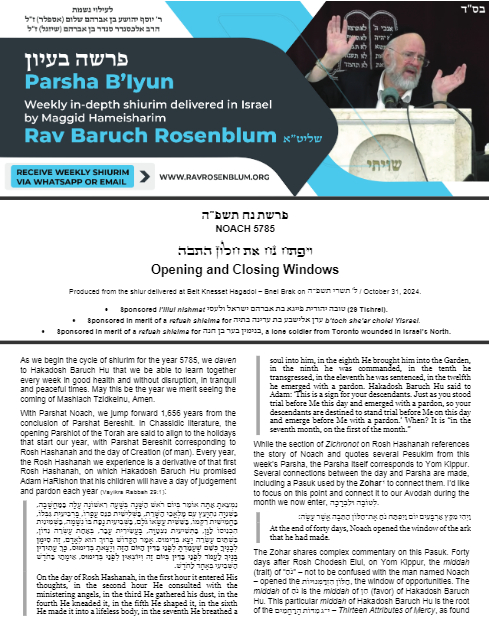
Hakadosh Baruch Hu does not want anything to do with theft! Stealing influences and affects one’s children, and when a child suddenly loses all desire and drive to learn, there is a connection.

Again, I emphasize that this idea is not black-and-white. Yitzchak Avinu was above any suspicion of gezel, yet he had a son, Eisav, who took a sudden left turn at age fifteen. Until that age, both Eisav and his twin brother, Yaacov Avinu, attended the same yeshiva day school and studied the same subjects. But at fifteen, one of them suddenly dropped out of the curriculum. Clearly, there are other factors in play, and this topic goes beyond our full purview and comprehension, but it is worthy of our consideration.

Where do we find a similar case of someone affected at a later age by food consumption? Commentators all point to the story of Elisha ben Avuya – Acher – as found in the Yerushalmi (Chagigah 2:1) and Tosfot (Chagigah 15a). What caused this once great Tannah to stray from the path? Amongst several answers, we find:

וְיֵשׁ אוֹמְרִ ים. אִמּוֹ כְּשׁ ֶהָֽיְתָה מְעוּבֶּרֶ ת בּוֹ הָֽיְתָה עוֹבֶרֶ ת עַל בָּתֵּי עֲבוֹדָה זָרָ ה וְ הֵ רִ יחָ ה מֵ אוֹתוֹ הַ מִּ ין. וְ הָ יָה אוֹתוֹ הָ רֵ יחַ מְ פַעְ פּ ֵעַ בְּ גוּפָהּ כְּ אִ ירְ סָ הּ שׁ ֶלְחֲכִינָה. לְאַחַר יָמִים חָלָה אֱלִישׁ ַע.

Others say, when his mother was pregnant with him, she passed by idolatry, smelled of that kind and ate it. And it was bubbling in her body like the poison of a viper. Later Elisha fell sick.

The commentators all stress the fact that his mother did not perform any horrific act of sin. She was pregnant, in danger, and even permitted to eat on Yom Kippur. All she did was take some food. Nonetheless, even though what entered her body did so amid conditions allowing for it, it also entered her unborn child’s heart and affected him years later. The Gemara (Yoma 82b) also speaks of cases with subsequent negative effects on the child where what was eaten was absolutely Kosher l’Mehadrin but was consumed on a day where eating was not permitted.

With this, we can dive into the question of the Shemen Rosh and see where he’s going with it. The question he asks, and we no doubt ask over and over again, is why Hakadosh Baruch Hu took even children from the world during the flood.

ֶזֶלָּא עַל הַגְּזַר דִּ ינָם אֶלֹּא נֶחְתַּם גְּזַר דִּ ינָם – Their fate was sealed only on account of sin of robbery. Shemen Rosh says, this statement is in reference to the children! Hakadosh Baruch Hu doesn’t punish minors, as children have the potential to be righteous even if their parents are corrupt. We see this in David HaMelech’s decision to delay punishing Shimi ben Geira for his rebellious actions. David waited, or had his son Shlomo wait, until after Shimi’s son was born because David foresaw that from Shimi would come Mordechai:

בֶּן יָאִיר בֶּן־שִׁמְעִימָ רְ דּ ֳ כַ י.

Similarly, the nation of Moav was preserved and safeguarded, and Moshe Rabbeinu did not destroy them, because Ruth would descend from them. Regarding the Dor HaMabul, Shemen Rosh explains that לֹא נֶחְתַּם גְּזַר דִּ ינָם is referring to the fate of the children. If the parents stole and fed their children stolen food, it inevitably corrupted the children, turning them morally rotten. Nothing good could come from children who were fed from gezel. Unlike the cardinal sins of idolatry and giluy arayot, whose punishment can be deferred so that righteous children can emerge in the interim, it’s a dead-end for those who eat from gezel, and therefore it was no longer worth waiting to see what might become of them – their fate was thus sealed.

Thus, to the question of how gezel became the defining sin that justified the entire generation’s destruction, Shemen Rosh clarifies that gezel was only decisive when it came to the children. The adults’ fate was already sealed due to their two cardinal sins, but the entire generation’s fate was finalized, and the flood began, only once gezel entered the bloodstream of the next generation, corrupting them as well.

From here he dives into a marvelous idea. The dove wasn’t being disrespectful to Noach, nor showing ungratefulness. The dove was saying, “Noach, my dear host, it was fantastic with you in the ark. Thank you for the top-notch service, but I would like to teach you a lesson on my way out. Do you know why all the children died in this flood? It is because nothing would have come from them. They were raised eating the food of gezel, and they became corrupt.”

Children as Olive Saplings

How do Chazal refer to children? Sefer Tehillim says (128:3):

א ֶ שׁ ְ תּ ְ ךָ בְּיַרְ כְּתֵי בֵיתֶךָ כְּגֶפֶן פֹּרִ י, כִּשְׁתִלֵי זֵיתִים סָבִיב לְשׁ ֻלְחָנֶךָ בָּנֶיךָ

Your wife shall be like a fruitful vine within your house; your sons, like olive saplings around your table.

Why are other analogies not used? Why are the children not referred to as date saplings around the table? Why is a wife not likened to a pomegranate tree? The Yerushalmi says (Kilayim 1:7:6), just as grape vines and olive trees are not subject to grafting (as there’d be no gain from it), so too in your children you will not find any flaws.

עִנְבֵי הַגֶּפֶן בְּעִנְבֵי הַגֶּפֶן – grapes are not combined with kiwis or mangos, and no greater derivative will come from the grape than when it is a grape with another grape. The same is true for the olive, whose purity is at its peak when kept as olives with olives. No other species is added to olive oil to increase its value. Its purity is its prize. The meaning of the above Pasuk is that Am Yisrael remains alone and pure; it does not mix with the nations of the world. When we remain pure as such, our children will remain pure as well.

Shemen Rosh adds, when we remain pure, our children will be כִּ שׁ ְ תִ לֵ י זֵ יתִ ים – like olive saplings; and listen closely to his explanation. The Gemara teaches that one who eats olives will forget seventy years of learning – a concerning thought. To counteract this, we’re advised to pour some olive oil on top when opening a container of olives, since the Gemara also says that one who drinks olive oil will have seventy years of forgotten learning restored. This shows that the oil of the olive is of greater significance than the olive itself. The child is raised to become greater than the parent!

The Dove’s Message and the Honey Trap

When the dove came to Noach, it conveyed a message: “I don’t want to sound ungrateful after such a remarkable experience, chas v’chalila, but I’ve reached a conclusion. This world was destroyed because people stole from one another and fed their children with the proceeds of gezel. I would rather receive the most minimal amount of food, no matter how bitter or unappealing, as long as my children can be כִּ שׁ ְ תִ לֵ י זֵ יתִ ים. I don’t desire wealth or a rich high-tech exit. I seek only the bare minimum, directly from Hakadosh Baruch Hu, so that my hands remain clean, and my children pure.”

And why does the dove’s message reference (actual) honey for the flip side of the equation? It is because when a bee lands in honey and tries to shake itself free, if its legs break off and remain behind in the honey, we are permitted to eat the honey. In contrast, if a butterfly lands in a jug of milk and loses two of its legs in the process of getting out, we must pour out the milk along with the legs mixed inside. Why the different rulings for two cases of a sheretz in our food? Chazal explain, honey consumes what lands in it, whereas milk does not.

This concept has a deeper lesson for those who work in environments that seem like honey: high salary, excellent pension, modern office space, comprehensive benefits, and exciting perks. Yet, in these places, not everyone dresses or speaks in ways that reflect purity and holiness, nor do all act according to the values we’re meant to live by. Taking a break for Mincha, for example, may not always be welcome. Despite these influences, the honey draws you in, trapping you with its allure. Chazal teach us that one who steps into a honey trap like this risks being consumed by it, drawn into a world that can make it difficult to maintain spiritual priorities. As the balance in the bank account rises, one may not even realize how their spirituality has fallen, how their Shabbat is no longer the same, and how their interests and drives are a weak shadow of their former selves.

We find that after twenty years of working for Lavan and being cheated time and time again, Yaacov Avinu finally picked up and left. Lavan chased after him though, accusing him of fleeing after stealing his idols. Yaacov vehemently denied the accusation and challenged Lavan to search all his belongings: “If you find anything belonging to you, whether a spoon, a baby’s pacifier, a towel, or anything at all, I will return to your house!” After twenty years and raising eleven children there, is it not possible, or even probable, that a small towel would find its way into his bags? We stay at a hotel for twenty hours and a couple of towels unintentionally fall into our suitcase on the way out! Could Yaacov not justify taking what was due to him but not delivered? No! He did not take a single item that did not belong to him. That is נְקִ י כַפַּיִם וּבַר־לֵבָב – leaving this world with clean hands and no cheshbon to settle.

I once walked into a store where they repair tefillin, to ask where I might find a particular item in the neighborhood. I approached a gentleman working at a table toward the back and greeted him with a “Hello.” He didn’t respond or even glance in my direction. Thinking he might not have heard due to having headphones in, I looked more closely – this was before the days of wireless earbuds that hide in your ear – but there was nothing on his ears. So, I said “Hello?” a bit louder. This time, I noticed him press a button before he turned to me and asked how he could help. Curious, I decided to first ask him about that button. He explained that he uses a stopwatch because he works by the hour – 150 shekel per hour, meaning 2.5 shekel per minute. “If I turn around to answer someone without accounting for the time,” he said, “I’m effectively stealing those two shekels from my employer. I want to be clean of gezel and owe nothing at the end of my days.” That is the definition of נְקִ י כַפַּיִם וּבַר־לֵבָב – He who has clean hands and a pure heart.

My father, z”l, until his very last day, remained of clear and sound mind despite any illnesses he faced towards the end of his life. His commitment to shiurim, tefillah, and conversations in limud (learning) remained unwavering. Even at 93, he was like a young panther. After closing his business at age 65, he devoted the rest of his life to learning, like a young avreich in Kollel. One of the rabbanim whose shiur he regularly attended shared at the shiva that he often prepared his shiur solely for my father, knowing he was the only one who would stay fully awake and engaged, asking questions until every detail was clear. Curious about the source of this energy and clarity, I once asked my father about it. His answer was profound. He explained that, during the Shoah, he had received a letter from his father and the town’s rav granting permission to eat whatever food was served – pikuach nefesh made it permissible. But my father told me, “I did not listen. I ate plants, weeds, and whatever else I could find, but I did not touch the ma’achalot asurot – the forbidden foods they served. These foods never entered my mouth, and as a result, I was blessed with a clear mind and the desire to learn until my final days.” We engraved this on his matzeiva as a testament to his unwavering commitment.

The dove wanted to ensure that there would be no questions or doubts regarding its parnassa and the food it provided for its young. In the same way, we must be vigilant with the money we earn and the food we serve, for if they are not kosher in our hands, our olives – i.e., our children – will be corrupted and affected. The children of the generation of the flood ate from gezel, resulting in וַתִּ מָּ לֵא הָ אָ רֶ ץ חָ מָ ס – a world filled with theft and wrongdoing.

The Month of Marcheshvan and the Olive Branch

As we enter the month of Marcheshvan, we’ll conclude with the Midrash (Tanchuma, Tetzaveh 1:3), which comments on our opening Pasuk about Noach opening the window of the ark, linking it to the lighting of the oil in the Mishkan:

וְ אַ תּ ָ ה תְּ צַ וֶּ ה  אֶת־בְּנֵי יִ שְׂ רָ אֵ ל וְ יִ קְ ח וּ אֵ לֶיך שׁ ֶ מ ֶ ן זַיִת זָך כּ ָ תִ ית לַ מּ ָ אוֹ ר לְהַ עֲלֹת נֵר תּ ָ מִ יד׃

You shall command Bnei Yisrael and have them bring you clear olive oil, made from olives that were crushed for lighting, to keep the lamp burning constantly.

The Midrash says that Hakadosh Baruch Hu declared, “Just as the dove brought light to the world, so too you, who are likened to the dove, brought olive oil and burned it before Me.” Because the dove brought the olive branch and made its declaration to Hakadosh Baruch Hu and Noach, Bnei Yisrael merited lighting the Menorah in the Mikdash with olive oil.

Returning to the commentary of the Da’at Zekainim, it is explained that the dove brought the olive branch back on the th of Tammuz, foreshadowing the Churban and the period in which Am Yisrael would have nowhere to rest their weary feet. The Zohar adds that ultimately, it will be the dove that places the crown atop the head of Melech HaMashiach (Zohar, Shelach 16:150):

וּבְשׁ ַעֲתָא דִּ כְתִּיב וְלָא יָסְפָה שׁ וּב אֵלָיו, עוֹד לָא יָדַע בַּר נָשׁ לְאָן אַזְלַת, וְהִיא נִיזַת בְּפִתְחָא דָּא וְאִיהִי תִּטּוֹל עֲטָרָ ה בְּפוּמָהָא, וּתְ שׁ ָוֵי תָּבַת לְאַתְרָ הּ, וְאִתְג עַל רֵ ישׁ ֵיהּ דְּ מַלְכָּא מְשִׁיחָא, מָטֵי וְלָא מָטֵי, וּכְדֵין כְּתִיב, תָּשִׁית לְרֹאשׁ וֹ עֲ טֶ רֶ ת פּ ָ ז . .. . הוּא, דִּ כְתִּיב דָּוִד מַלְכָּא, זַיִת רַ עֲנָן אִקְ רֵ י קַמֵּיהּ קוּדְ שׁ ָא בְּרִ יך וַאֲנִי כְּזַיִת רַ עֲנָן בְּבֵית וְגוֹ.' עֲלֵה זַיִת, דָּא מַלְכָּא מְשִׁיחָא בְּרֵ יהּ דְּ דָוִד. וְדָּא אִיהוּ דְּ רָ מִיז יוֹנָה דָּא בְּיוֹמוֹי דְּ נֹחַ, דִּ כְתִיב וְהִנֵּה עֲלֵה זַיִת טָ רָ ף בְּפִיהָ.

During the time that it says: "Which returned not again to him any more," no person knew where she went. She returned to her assigned place and was stored in this opening. She will take the crown in her mouth and place it on the head of King Messiah, as it is written: "You set a crown of pure gold on his head.”... King David is called a fresh olive in the presence of Hakadosh Baruch Hu, as it is written: "But I am like a green olive tree in the house...". A leaf of an olive tree is King Messiah, son of David. That is what the dove indicated during the time of Noah, as it is written: "And, lo, in her mouth was an olive tree plucked off."

In his commentary, Zohar Chai, the Rebbe of Komarno says the numerical value of טָ רָ ף בְּ פִ יהָ is equal to דָּוִד בֶּן יִשׁ ַי. The Zohar says זַיִת עֲלֵה is Melech HaMashiach, and David HaMelech received the years of his life from Adam HaRishon. אד"ם = א "דם, ד"וד, מ"שיח – that is the order. Adam gave his years to David, and from David will come the Mashiach. The Rebbe of Komarno brilliantly adds, the numerical value of אדם is 45, the numerical value of דוד is 14, and the numerical value of מ שיח is 358, which together equal 417, or זית. The significance of וְ הִ נֵּה עֲלֵה־זַיִת טָ רָ ף בְּ פִ יהָ is that our Parsha hints at matters of Mashiach.

The Month of Marcheshvan and the Beit Hamikdash

The Bnei Yissaschar (Marcheshvan 1) then sheds more light on this idea. In Sefer Melachim it says that Shlomo HaMelech completed the building of the Beit Hamikdash בְּ יֶרַ ח בּ וּל, which is the 8th month – Marcheshvan. It is called this because, amongst other reasons, during that month the מַ בּ וּל came down. Shlomo asked Hakadosh Baruch Hu whether to immediately inaugurate the Beit Hamikdash, but was to wait until the following Tishrei, on the 7th of the month, after which a week of celebration took place, including eating on Yom Kippur. The Bnei Yissaschar says, the month of Marcheshvan brought a complaint to Hakadosh Baruch Hu after not receiving the inauguration of the Beit Hamikdash which was ready during its month. It asked why it deserved such a punishment. And what was the response? Hakadosh Baruch Hu promised the month of Marcheshvan that the Third Beit Hamikdash would be built during its time.

We are in the month during which the Beit Hamikdash will be built. B’ezrat Hashem, the month we now enter will be filled with goodness and blessing, a refuah shleima to all in need of healing, a safe return of our hostages, a return home to all who’ve been displaced, an end to our troubles and suffering, and may it be fulfilled speedily: וְ שׁ ָ בוּ בָנִים לִגְבוּלָם.

PDF Preview