The Pleasant Aroma of Mesiras Nefesh
ליקוטי שמואל | October 24, 2025
Print This Article
View Original PDF

The Pleasant Aroma of Mesiras Nefesh

ליקוטי שמואל | December 08, 2025

I saw the following observation in a sefer called Nachlas Eliezer. The pasuk says: “And Noach build a Altar for Hashem...” [Bereshis 8:20] When Noach emerged from the Teivah, he built an Mizbayach and offered korbonos (sacrifices). The Medrash Rabbah [34:9] comments on the fact that the Torah uses the word VaYiven (he built) rather than Va’Ya’as (he made) in connection with the Altar. The Medrash explains that the reason for the choice of the word VaYiven is because it can also be read as VaYaven, meaning “he understood” (etymologically related to the words binah and havanah, which mean ‘understanding’).

What did Noach understand? He understood why Hashem had commanded him to take more Kosher animals (7 pairs of each) onto the Teivah than non-kosher animals (1 pair of each). He understood that the reason was so that there would be “extra” Kosher animals from which to bring korbonos upon leaving the Teivah. So “VaYaven” (he understood) and “VaYiven” he built an Mizbayach immediately upon exiting from the Teivah. So says the Medrash.

There is a second on the very next pasuk. The pasuk begins “Hashem inhaled the pleasant aroma (Reiach haNichoach)...” [Bereshis 8:21]. The Medrash says that the reference here is to much more that merely smelling the roasted meat.

The Medrash says that Hashem smelled the aroma of Avraham Avinu rising up from the Fiery Furnace into which he was thrown (for having broken his father’s idols).

The Medrash continues that Hashem also smelled in Noach’s offering the aroma of Chananya, Mishael, and Azariah who were also thrown into a Fiery Furnace [Daniel Chapter 3] for refusing to bow down to the idol of Nevuchadnezer, King of Bavel.

Why did the Ribono shel Olam see or smell, as it were, the Mesiras Nefesh aroma of Avraham and the Mesiras Nefesh aroma of Chananya, Mishael, and Azariah in the korbonos of Noach?

The sefer Nachlas Eliezer writes that Noach did something over here that was very significant. The Ribono shel Olam told him to take 7 pairs of Kosher animals and only a single male-female pairing of the non-Kosher animals. Noach asked himself why. For the same money, he could have hypothesized that the purpose of ensuring a surplus of Kosher animals was to allow him to eat. He could have concluded “HaShem wanted me to be able to eat steak every night as a reward for my efforts!” Why then did Noach assume that the reason for the surplus of kosher animals was that the Ribono shel Olam wanted korbanos? It is because when looking at the situation, Noach, rather than seeing his own needs, saw – as it were – Hashem’s “needs”. He put his pleasures and appetite and desires aside. He said, “No! Seven pairs are not for me! They are for the Ribono shel Olam.”

That self-denial, that small act of thinking about the big picture – something beyond oneself – was the first step of Mesiras Nefesh. Given the context of the Dor HaMabul – a generation that was into self-gratification and each person’s own pleasure – Noach took a step in the opposite direction. “No, I am not going to go ahead and enjoy myself. I am going to take those same animals that I could have eaten myself and sacrifice them to the Almighty. The Ribono shel Olam “smelled” in the aroma of that korban the Mesiras Nefesh of later generations: Of Avraham Avinu and of Chananya, Mishael, and Azarya. Their dedication and self-sacrifice grew out of this small act of Noach at the dawn of mankind.

People throw around the expression “Mesiras Nefesh” all the time. “It was raining and I came to the Chassanah – Ah! What Mesiras Nefesh!” “I drove two and a half hours to Lakewood to such and such — What Mesiras Nefesh!” Frankly, I used to be put off by such language, thinking that it was a cheapening of a term reserved for real self-sacrifice and self-deprivation.

Someone corrected me and explained that the expression Nefesh in Tanach can have a secondary meaning as well, as in the phrase “Im Yesh es Nafshechem” [Bereshis 23:8] (if it so be your desire). Mesiras Nefesh means that I put away my desire. I don’t want to get wet at night. I don’t want to schlep out on a cold winter night to attend somebody’s Chassanah. I would rather stay home in my cozy house. Going out requires “Mesiras Nefesh” because I give over my Ratzon, my desires, on behalf of someone else. A person does not need an act of martyrdom or self-sacrifice to be Moser Nefesh. A small act may also be Mesiras Nefesh. That is exactly what Noach did here. “I could have eaten these things, but I gave them to the Ribono shel Olam.”

That act modeled a behavior and had an affect such that ten generations later, Avraham Avinu was truly Moser Nefesh and scores of generations later, Chananya, Mishael, and Azarya, were literally Moser Nefesh, allowing themselves to be cast into a Fiery Furnace rather than bowing down to an idol.

The other offshoot from this lesson is how an act of a human being can have an effect so many generations later. Towards the end of the parsha, the Torah writes “And Kush gave birth to Nimrod, he began to be a mighty man on earth. He was a mighty hunter before Hashem...” [Bereshis 10:8-9]. We would assume that this pasuk is describing a fellow, Nimrod, who was a real mighty individual – a strong and muscular hunter. Rashi says that the pasuk is referring to something entirely different. Rashi describes Nimrod as a rebel – one who led a rebellion against the Master of the Universe. Rashi says that the pasuk is referring to any person (in future generations) who is disrespectful to the Almighty, so to speak, “who recognizes his Master and intends to rebel against Him”. Such a person can be titled “a Nimrod.”

Look at the next pasuk. “From this land came forth Ashur and built Nineveh, Rechovoth-ir, and Calah.” (Bereshis 10:11) A fellow named Ashur, after whom the nation and country is named (Assyria) came forth and built several cities. On the words “From this land came forth Ashur” Rashi writes: Ashur saw that his children were following in the path of Nimrod (rebelling against G-d). His reaction was “I’m out of here!” He left that land because he didn’t want to have anything to do with Nimrod and his influence. “I am not going to let Nimrod corrupt my children.” So, he went to a new land and he built for himself cities – among which was the City of Nineveh. The modern-day city of Mosul, Iraq is the ancient city of Nineveh.

Fast forward dozens of generations. There is a prophet named Yonah who goes to the city of Nineveh and gets on a soapbox. He proclaims, “In forty days, the City of Nineveh will be overturned.” (Yonah 3:4) At Hyde Park in London or to Times Square in New York City there are people on soapboxes speaking to crowds. Many proclaim that the world is about to be destroyed. We usually call such people “Nuts!” No one gives these people a hoot of attention. They are Mishugaim!

Here, Yonah comes to Nineveh; he gets up on a soapbox and announces that the city will be destroyed in less than six weeks. What happens? They listen to him. The whole city does Teshuva. The King of Nineveh repents. The animals repent. How did Yonah pull this off? How did he do it?

He was able to pull this off because it was Ashur who founded Nineveh. Ashur started Nineveh because he said “I am not going to let my sons be influenced by people who rebel against the Ribono shel Olam.” Because of the motivations of its founder, Nineveh was always karov l’Teshuva (having an affinity for repentance). Just like the act of Noach denying himself the pleasure of those steaks had an effect, such that ten generations later, Avraham Avinu was willing to become a martyr for the sake of Hashem, and the same was true hundreds of years later with Chananya, Mishael, and Azarya. So too, the act of Ashur abandoning the wicked Nimrod and building a new city for his children, had an effect on the spiritual DNA of Nineveh’s occupants so many generations later – such that they all did Teshuva upon hearing Yonah’s warning.
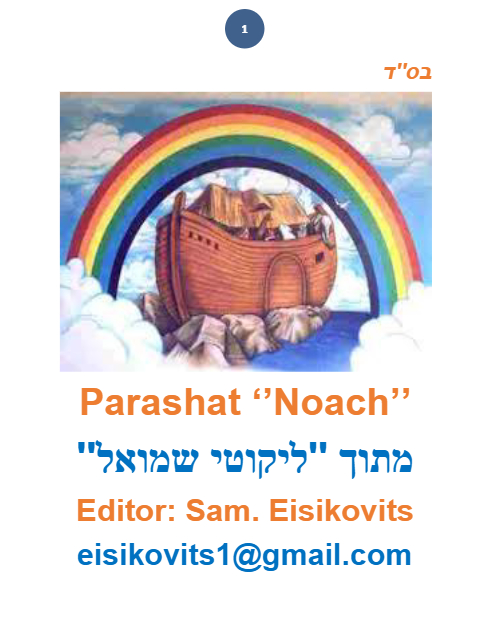
I saw the following observation in a sefer called Nachlas Eliezer. The pasuk says: “And Noach build a Altar for Hashem...” [Bereshis 8:20] When Noach emerged from the Teivah, he built an Mizbayach and offered korbonos (sacrifices). The Medrash Rabbah [34:9] comments on the fact that the Torah uses the word VaYiven (he built) rather than Va’Ya’as (he made) in connection with the Altar. The Medrash explains that the reason for the choice of the word VaYiven is because it can also be read as VaYaven, meaning “he understood” (etymologically related to the words binah and havanah, which mean ‘understanding’).

What did Noach understand? He understood why Hashem had commanded him to take more Kosher animals (7 pairs of each) onto the Teivah than non-kosher animals (1 pair of each). He understood that the reason was so that there would be “extra” Kosher animals from which to bring korbonos upon leaving the Teivah. So “VaYaven” (he understood) and “VaYiven” he built an Mizbayach immediately upon exiting from the Teivah. So says the Medrash.

There is a second on the very next pasuk. The pasuk begins “Hashem inhaled the pleasant aroma (Reiach haNichoach)...” [Bereshis 8:21]. The Medrash says that the reference here is to much more that merely smelling the roasted meat.

The Medrash says that Hashem smelled the aroma of Avraham Avinu rising up from the Fiery Furnace into which he was thrown (for having broken his father’s idols).

The Medrash continues that Hashem also smelled in Noach’s offering the aroma of Chananya, Mishael, and Azariah who were also thrown into a Fiery Furnace [Daniel Chapter 3] for refusing to bow down to the idol of Nevuchadnezer, King of Bavel.

Why did the Ribono shel Olam see or smell, as it were, the Mesiras Nefesh aroma of Avraham and the Mesiras Nefesh aroma of Chananya, Mishael, and Azariah in the korbonos of Noach?

The sefer Nachlas Eliezer writes that Noach did something over here that was very significant. The Ribono shel Olam told him to take 7 pairs of Kosher animals and only a single male-female pairing of the non-Kosher animals. Noach asked himself why. For the same money, he could have hypothesized that the purpose of ensuring a surplus of Kosher animals was to allow him to eat. He could have concluded “HaShem wanted me to be able to eat steak every night as a reward for my efforts!” Why then did Noach assume that the reason for the surplus of kosher animals was that the Ribono shel Olam wanted korbanos? It is because when looking at the situation, Noach, rather than seeing his own needs, saw – as it were – Hashem’s “needs”. He put his pleasures and appetite and desires aside. He said, “No! Seven pairs are not for me! They are for the Ribono shel Olam.”

That self-denial, that small act of thinking about the big picture – something beyond oneself – was the first step of Mesiras Nefesh. Given the context of the Dor HaMabul – a generation that was into self-gratification and each person’s own pleasure – Noach took a step in the opposite direction. “No, I am not going to go ahead and enjoy myself. I am going to take those same animals that I could have eaten myself and sacrifice them to the Almighty. The Ribono shel Olam “smelled” in the aroma of that korban the Mesiras Nefesh of later generations: Of Avraham Avinu and of Chananya, Mishael, and Azarya. Their dedication and self-sacrifice grew out of this small act of Noach at the dawn of mankind.

People throw around the expression “Mesiras Nefesh” all the time. “It was raining and I came to the Chassanah – Ah! What Mesiras Nefesh!” “I drove two and a half hours to Lakewood to such and such — What Mesiras Nefesh!” Frankly, I used to be put off by such language, thinking that it was a cheapening of a term reserved for real self-sacrifice and self-deprivation.

Someone corrected me and explained that the expression Nefesh in Tanach can have a secondary meaning as well, as in the phrase “Im Yesh es Nafshechem” [Bereshis 23:8] (if it so be your desire). Mesiras Nefesh means that I put away my desire. I don’t want to get wet at night. I don’t want to schlep out on a cold winter night to attend somebody’s Chassanah. I would rather stay home in my cozy house. Going out requires “Mesiras Nefesh” because I give over my Ratzon, my desires, on behalf of someone else. A person does not need an act of martyrdom or self-sacrifice to be Moser Nefesh. A small act may also be Mesiras Nefesh. That is exactly what Noach did here. “I could have eaten these things, but I gave them to the Ribono shel Olam.”

That act modeled a behavior and had an affect such that ten generations later, Avraham Avinu was truly Moser Nefesh and scores of generations later, Chananya, Mishael, and Azarya, were literally Moser Nefesh, allowing themselves to be cast into a Fiery Furnace rather than bowing down to an idol.

The other offshoot from this lesson is how an act of a human being can have an effect so many generations later. Towards the end of the parsha, the Torah writes “And Kush gave birth to Nimrod, he began to be a mighty man on earth. He was a mighty hunter before Hashem...” [Bereshis 10:8-9]. We would assume that this pasuk is describing a fellow, Nimrod, who was a real mighty individual – a strong and muscular hunter. Rashi says that the pasuk is referring to something entirely different. Rashi describes Nimrod as a rebel – one who led a rebellion against the Master of the Universe. Rashi says that the pasuk is referring to any person (in future generations) who is disrespectful to the Almighty, so to speak, “who recognizes his Master and intends to rebel against Him”. Such a person can be titled “a Nimrod.”

Look at the next pasuk. “From this land came forth Ashur and built Nineveh, Rechovoth-ir, and Calah.” (Bereshis 10:11) A fellow named Ashur, after whom the nation and country is named (Assyria) came forth and built several cities. On the words “From this land came forth Ashur” Rashi writes: Ashur saw that his children were following in the path of Nimrod (rebelling against G-d). His reaction was “I’m out of here!” He left that land because he didn’t want to have anything to do with Nimrod and his influence. “I am not going to let Nimrod corrupt my children.” So, he went to a new land and he built for himself cities – among which was the City of Nineveh. The modern-day city of Mosul, Iraq is the ancient city of Nineveh.

Fast forward dozens of generations. There is a prophet named Yonah who goes to the city of Nineveh and gets on a soapbox. He proclaims, “In forty days, the City of Nineveh will be overturned.” (Yonah 3:4) At Hyde Park in London or to Times Square in New York City there are people on soapboxes speaking to crowds. Many proclaim that the world is about to be destroyed. We usually call such people “Nuts!” No one gives these people a hoot of attention. They are Mishugaim!

Here, Yonah comes to Nineveh; he gets up on a soapbox and announces that the city will be destroyed in less than six weeks. What happens? They listen to him. The whole city does Teshuva. The King of Nineveh repents. The animals repent. How did Yonah pull this off? How did he do it?

He was able to pull this off because it was Ashur who founded Nineveh. Ashur started Nineveh because he said “I am not going to let my sons be influenced by people who rebel against the Ribono shel Olam.” Because of the motivations of its founder, Nineveh was always karov l’Teshuva (having an affinity for repentance). Just like the act of Noach denying himself the pleasure of those steaks had an effect, such that ten generations later, Avraham Avinu was willing to become a martyr for the sake of Hashem, and the same was true hundreds of years later with Chananya, Mishael, and Azarya. So too, the act of Ashur abandoning the wicked Nimrod and building a new city for his children, had an effect on the spiritual DNA of Nineveh’s occupants so many generations later – such that they all did Teshuva upon hearing Yonah’s warning.

PDF Preview