Thought of the week
מגדל אור | October 23, 2025
Print This Article
View Original PDF

Thought of the week

מגדל אור | December 08, 2025

Love is not only something you feel; it is something you do.

(ZK-WK:U TYwARB) ‰...Ow YLHAB IKwYW TPYL OYQLA TPY ...Ow YQLA ÂH VWRB RMAYW‰
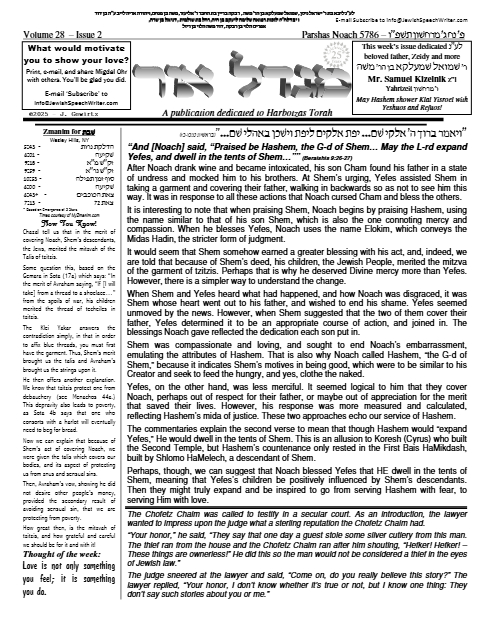
“And [Noach] said, “Praised be Hashem, the G-d of Shem... May the L-rd expand Yefes, and dwell in the tents of Shem...”” (Beraishis 9:26-27)

After Noach drank wine and became intoxicated, his son Cham found his father in a state of undress and mocked him to his brothers. At Shem’s urging, Yefes assisted Shem in taking a garment and covering their father, walking in backwards so as not to see him this way. It was in response to all these actions that Noach cursed Cham and bless the others.

It is interesting to note that when praising Shem, Noach begins by praising Hashem, using the name similar to that of his son Shem, which is also the one connoting mercy and compassion. When he blesses Yefes, Noach uses the name Elokim, which conveys the Midas Hadin, the stricter form of judgment.

It would seem that Shem somehow earned a greater blessing with his act, and, indeed, we are told that because of Shem’s deed, his children, the Jewish People, merited the mitzva of the garment of tzitzis. Perhaps that is why he deserved Divine mercy more than Yefes.

However, there is a simpler way to understand the change.

When Shem and Yefes heard what had happened, and how Noach was disgraced, it was Shem whose heart went out to his father, and wished to end his shame. Yefes seemed unmoved by the news. However, when Shem suggested that the two of them cover their father, Yefes determined it to be an appropriate course of action, and joined in. The blessings Noach gave reflected the dedication each son put in.

Shem was compassionate and loving, and sought to end Noach’s embarrassment, emulating the attributes of Hashem. That is also why Noach called Hashem, “the G-d of Shem,” because it indicates Shem’s motives in being good, which were to be similar to his Creator and seek to feed the hungry, and yes, clothe the naked.

Yefes, on the other hand, was less merciful. It seemed logical to him that they cover Noach, perhaps out of respect for their father, or maybe out of appreciation for the merit that saved their lives. However, his response was more measured and calculated, reflecting Hashem’s mida of justice. These two approaches echo our service of Hashem.

The commentaries explain the second verse to mean that though Hashem would “expand Yefes,” He would dwell in the tents of Shem. This is an allusion to Koresh (Cyrus) who built the Second Temple, but Hashem’s countenance only rested in the First Bais HaMikdash, built by Shlomo HaMelech, a descendant of Shem.

Perhaps, though, we can suggest that Noach blessed Yefes that HE dwell in the tents of Shem, meaning that Yefes’s children be positively influenced by Shem’s descendants. Then they might truly expand and be inspired to go from serving Hashem with fear, to serving Him with love.

The Chofetz Chaim was called to testify in a secular court. As an introduction, the lawyer wanted to impress upon the judge what a sterling reputation the Chofetz Chaim had.
“Your honor,” he said, “They say that one day a guest stole some silver cutlery from this man. The thief ran from the house and the Chofetz Chaim ran after him shouting, “Hefker! Hefker! – These things are ownerless!” He did this so the man would not be considered a thief in the eyes of Jewish law.”
The judge sneered at the lawyer and said, “Come on, do you really believe this story?” The lawyer replied, “Your honor, I don’t know whether it’s true or not, but I know one thing: They don’t say such stories about you or me.”

©2025 – J. Gewirtz
Love is not only something you feel; it is something you do.

(ZK-WK:U TYwARB) ‰...Ow YLHAB IKwYW TPYL OYQLA TPY ...Ow YQLA ÂH VWRB RMAYW‰
“And [Noach] said, “Praised be Hashem, the G-d of Shem... May the L-rd expand Yefes, and dwell in the tents of Shem...”” (Beraishis 9:26-27)

After Noach drank wine and became intoxicated, his son Cham found his father in a state of undress and mocked him to his brothers. At Shem’s urging, Yefes assisted Shem in taking a garment and covering their father, walking in backwards so as not to see him this way. It was in response to all these actions that Noach cursed Cham and bless the others.

It is interesting to note that when praising Shem, Noach begins by praising Hashem, using the name similar to that of his son Shem, which is also the one connoting mercy and compassion. When he blesses Yefes, Noach uses the name Elokim, which conveys the Midas Hadin, the stricter form of judgment.

It would seem that Shem somehow earned a greater blessing with his act, and, indeed, we are told that because of Shem’s deed, his children, the Jewish People, merited the mitzva of the garment of tzitzis. Perhaps that is why he deserved Divine mercy more than Yefes.

However, there is a simpler way to understand the change.

When Shem and Yefes heard what had happened, and how Noach was disgraced, it was Shem whose heart went out to his father, and wished to end his shame. Yefes seemed unmoved by the news. However, when Shem suggested that the two of them cover their father, Yefes determined it to be an appropriate course of action, and joined in. The blessings Noach gave reflected the dedication each son put in.

Shem was compassionate and loving, and sought to end Noach’s embarrassment, emulating the attributes of Hashem. That is also why Noach called Hashem, “the G-d of Shem,” because it indicates Shem’s motives in being good, which were to be similar to his Creator and seek to feed the hungry, and yes, clothe the naked.

Yefes, on the other hand, was less merciful. It seemed logical to him that they cover Noach, perhaps out of respect for their father, or maybe out of appreciation for the merit that saved their lives. However, his response was more measured and calculated, reflecting Hashem’s mida of justice. These two approaches echo our service of Hashem.

The commentaries explain the second verse to mean that though Hashem would “expand Yefes,” He would dwell in the tents of Shem. This is an allusion to Koresh (Cyrus) who built the Second Temple, but Hashem’s countenance only rested in the First Bais HaMikdash, built by Shlomo HaMelech, a descendant of Shem.

Perhaps, though, we can suggest that Noach blessed Yefes that HE dwell in the tents of Shem, meaning that Yefes’s children be positively influenced by Shem’s descendants. Then they might truly expand and be inspired to go from serving Hashem with fear, to serving Him with love.

The Chofetz Chaim was called to testify in a secular court. As an introduction, the lawyer wanted to impress upon the judge what a sterling reputation the Chofetz Chaim had.
“Your honor,” he said, “They say that one day a guest stole some silver cutlery from this man. The thief ran from the house and the Chofetz Chaim ran after him shouting, “Hefker! Hefker! – These things are ownerless!” He did this so the man would not be considered a thief in the eyes of Jewish law.”
The judge sneered at the lawyer and said, “Come on, do you really believe this story?” The lawyer replied, “Your honor, I don’t know whether it’s true or not, but I know one thing: They don’t say such stories about you or me.”

©2025 – J. Gewirtz

PDF Preview