Timeless Wisdom in the Ark's Design
In this week's Parsha, Noach, we read about a world riddled with corruption and wickedness. Yet amid the bleakness, Noach shines as a beacon of righteousness, leading him to be chosen by G-d to construct the Ark that would save humanity and animal life from the imminent deluge.
The specifics of the Ark's construction are laid out with meticulous detail in Bereishis 6:
"וזהאשרתעשהאתהשלשמאותאמהארך התבהחמשיםאמהרחבהושלשיםאמה קומתה"
This is how you shall make it: the length of the ark shall be three hundred cubits, its width fifty cubits, and its height thirty cubits.” - Bereishis 6
On this we have an interesting Midrash (Bereshit Rabbah 31):
ברחטיאאמר)תהליםקיט,טו(:בפקודיך אשיחה,)תהליםקיט,טז(:בחקתיך אשתעשע,למדתךתורהדרךארץשאםיעשה אדםספינהשתהאעומדתבלמין,יעשהרחבה אחדמששהבארכה,וגבההאחדמעשרה בארכה.
Bar Ḥatya said: “I speak about Your edicts” (Psalms 119:15), “I delight in Your statutes” (Psalms 119:16) – the Torah gives you instruction about practical matters. If a person wants to build a ship capable of standing sturdily in port, he should make its width one-sixth of its length and its height one-tenth of its length.
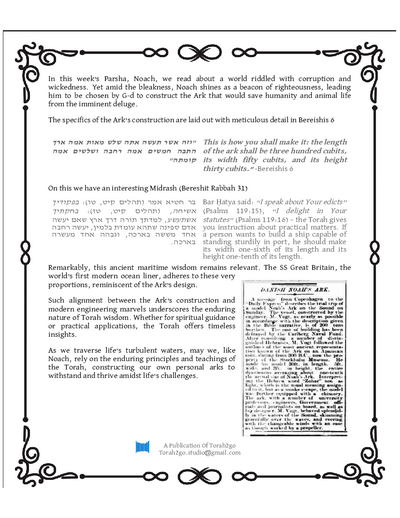
Remarkably, this ancient maritime wisdom remains relevant. The SS Great Britain, the world's first modern ocean liner, adheres to these very proportions, reminiscent of the Ark's design.
Such alignment between the Ark's construction and modern engineering marvels underscores the enduring nature of Torah wisdom. Whether for spiritual guidance or practical applications, the Torah offers timeless insights.
As we traverse life's turbulent waters, may we, like Noach, rely on the enduring principles and teachings of the Torah, constructing our own personal arks to withstand and thrive amidst life's challenges.