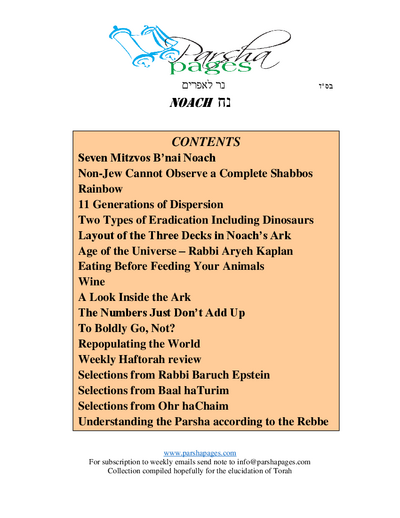
Understanding the Parsha according to the Rebbe
Parsha Pages | October 15, 2023
Print This Article
View Original PDF

Understanding the Parsha according to the Rebbe

Parsha Pages | December 31, 2025

QUESTION:

One faces two types of worries (two types of flood waters - (תהום רבה וארובות השמים in the course of life: detrimental worries and worries that lead to growth. How does one distinguish them from each other?

ANSWER:

The simple method to distinguish is that when the worry prevents one from serving G-d and learning Torah, then such a worry is a detrimental worry. How is one saved from these detrimental worries? One needs to enter the Teivah (Ark) which per the Baal Shem Tov means to enter the words of Torah and prayer.

QUESTION:

How can the name of the Parsha be Noach which means comforter, when the entire Parsha involves destruction? How can the flood waters be called מי נח (the waters of Noach)?

ANSWER:

The main concept inherent in the Parsha is the tranquility and cleansing that followed the destruction of the world by means of the flood. A new world was brought into being and with it, a new potential to fulfill the purpose of creation. And this is the purpose of difficulties and problems of life, to lead to an elevation and securing of one’s true potential.

QUESTION:

In Pirkei Avos (5:2) Avrohom received the reward of the previous 10 generations. Why didn’t Noach receive the reward of the prior ten generations?

ANSWER:

The two generations (of the Flood and of the Dispersion) represented two distinct rebellions against HaShem, and the actions of Avrohom and Noach represented two different approaches to involvement with others lacking Teshuvah. Each generation was punished according to its actions. The generation of the Flood did not deny G-d but sinned in this world against others, and thus, were punished in this world and did not earn reward. Further, Noach did not seek to redeem the individuals but only concentrated on his own being, thus, he was not eligible to receive whatever reward was available from deeds of that generation. The generation of the Dispersion denied G-d and were punished with loss of their future spiritual life. However, they did generate rewards for their deeds of love to other people. Avrohom sought to redeem the generation with acts of kindness, and received their potential rewards.

QUESTION:

Should not the praise of Noach (איש צדיק) been mentioned when Noach was first mentioned in Parshas Bereshis?

ANSWER:

Speech reveals what is previously hidden. Speech has the ability to affect the one spoken about whether for good or for bad. Praise for an individual can affect a positive outcome for that individual. Only in this Parsha does Noach begin his own service, and thus, G-d mentions his praise to further assist Noach with positive. A Jew should see and speak of the good traits and qualities of others. By doing so, one assists in revealing the goodness of the other person.

QUESTION:

The Zohar predicts that in the six hundredth year of the sixth millennium (5600-1840) there will be an opening of the supernal gates of wisdom and of the lower wellsprings of wisdom. Why?

ANSWER:

This revelation of wisdom has the purpose of preparing the world for the seventh millennium. The dual development of Chassidus and of modern technology has brought our senses to be able to envision the time when “all flesh will see that G-d speaks”.

QUESTION:

One faces two types of worries (two types of flood waters - (תהום רבה וארובות השמים in the course of life: detrimental worries and worries that lead to growth. How does one distinguish them from each other?

ANSWER:

The simple method to distinguish is that when the worry prevents one from serving G-d and learning Torah, then such a worry is a detrimental worry. How is one saved from these detrimental worries? One needs to enter the Teivah (Ark) which per the Baal Shem Tov means to enter the words of Torah and prayer.

QUESTION:

How can the name of the Parsha be Noach which means comforter, when the entire Parsha involves destruction? How can the flood waters be called מי נח (the waters of Noach)?

ANSWER:

The main concept inherent in the Parsha is the tranquility and cleansing that followed the destruction of the world by means of the flood. A new world was brought into being and with it, a new potential to fulfill the purpose of creation. And this is the purpose of difficulties and problems of life, to lead to an elevation and securing of one’s true potential.

QUESTION:

In Pirkei Avos (5:2) Avrohom received the reward of the previous 10 generations. Why didn’t Noach receive the reward of the prior ten generations?

ANSWER:

The two generations (of the Flood and of the Dispersion) represented two distinct rebellions against HaShem, and the actions of Avrohom and Noach represented two different approaches to involvement with others lacking Teshuvah. Each generation was punished according to its actions. The generation of the Flood did not deny G-d but sinned in this world against others, and thus, were punished in this world and did not earn reward. Further, Noach did not seek to redeem the individuals but only concentrated on his own being, thus, he was not eligible to receive whatever reward was available from deeds of that generation. The generation of the Dispersion denied G-d and were punished with loss of their future spiritual life. However, they did generate rewards for their deeds of love to other people. Avrohom sought to redeem the generation with acts of kindness, and received their potential rewards.

QUESTION:

Should not the praise of Noach (איש צדיק) been mentioned when Noach was first mentioned in Parshas Bereshis?

ANSWER:

Speech reveals what is previously hidden. Speech has the ability to affect the one spoken about whether for good or for bad. Praise for an individual can affect a positive outcome for that individual. Only in this Parsha does Noach begin his own service, and thus, G-d mentions his praise to further assist Noach with positive. A Jew should see and speak of the good traits and qualities of others. By doing so, one assists in revealing the goodness of the other person.

QUESTION:

The Zohar predicts that in the six hundredth year of the sixth millennium (5600-1840) there will be an opening of the supernal gates of wisdom and of the lower wellsprings of wisdom. Why?

ANSWER:

This revelation of wisdom has the purpose of preparing the world for the seventh millennium. The dual development of Chassidus and of modern technology has brought our senses to be able to envision the time when “all flesh will see that G-d speaks”.

PDF Preview

