Haftorah of Sidra Pekudei
If the two Sidras Vayakhel and Pekudei are read separately and if Parshas Shekalim was read on the previous Shabbos Vayakhel, (and the Haftorah read on Shabbos Vayakhel was therefore for Parshas Shekalim) then that omitted Haftorah of Vayakhel is read now as the Haftorah of Sidra Pekudei. This Haftorah is taken from the first Book of Kings, starting from Chapter 7. Sefaradim read from verse 40 till verse 50 (which is the Haftorah for Vayakhel of the Ashkenazzim) [which see] whereas Ashkenazzim read from the last verse of Chapter 7, that is, verse 51, till Chapter 8 verse 21, and this is the Haftorah explained here.
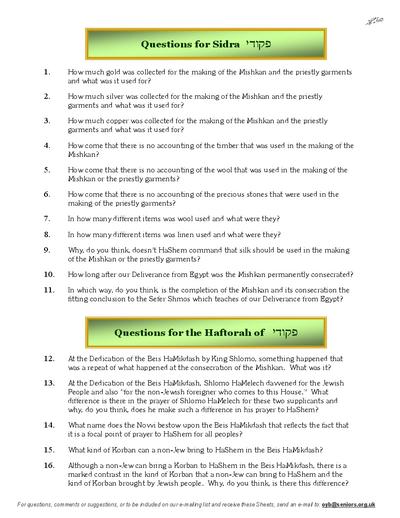
1. The connexion between the Sidra and its Haftorah hardly needs to be explained. The Sidra speaks of the making of the Mishkan and the Haftorah speaks of the building of the Beis HaMikdash by King Shlomo. This Sidra Pekuday marks the end of the report of how the Mishkan was built, the culmination, as it were, of the whole sacred project. Similarly, the Haftorah is the description of the events at the time of the consecration of the Beis HaMikdash by King Shlomo and its culmination, that is, how the Holy Ark was brought into the new Beis HaMikdash.
2. The Mishkan, or “Tent of Meeting,” was constructed by the Jewish People in the Wilderness under the direction of Mosheh our Teacher. At its dedication (in Nissan of the year 2449 after Creation) Mosheh Rabbeinu prayed to HaShem that He should demonstrate that the great efforts of the Jewish People in building this Sanctuary were not in vain and that HaShem would in fact make this “Mikdash” (Sanctuary) His “Mishkan” (Abode) as He had said He would. In immediate response, a holy fire came down from Heaven and consumed the Korbonnos which were on the Mizbayach and everyone saw clearly how HaShem had taken us back again as His Chosen People.
3. In compliance with the Torah’s command that the fire on the Mizbayach shall not be extinguished, that fire from Heaven was maintained and was never allowed to go out. During our forty years in the Wilderness, whenever we set out on our travels to the Promised Land, therefore, the Mizbayach was covered with a copper netting which allowed the sacred fire to smoulder “crouching like a resting lion” until its next stop. And so it continued throughout the following centuries: in all the various places that the Mishkan was set up, the fire on the Mizbayach was an extension of that original sacred fire brought down from Heaven by Mosheh Rabbeinu.
4. After we came into Eretz Yisroel, the Mishkan relocated a number of times. It was first set up at Gilgal and stood there for fourteen years, until the Land had been conquered and divided between the Tribes under the direction of Mosheh Rabbeinu’s successor, Yehoshua bin Noone. After that, it was set up at Shiloh and stood there throughout the era of the Governors (known as “the Judges”). Then, in a sadly misguided move, the leaders of the Jewish People decided to take the Holy Ark on to the battlefield in their fight with the Plishtim. But not being worthy at that time of being helped, HaShem allowed them to be defeated in battle and the Holy Ark was captured by this unholy people. The news of its capture and of the death of his two sons caused the death of the elderly Eli, the Kohen Ga’dol. With the capture of the Ark, Mishkan Shiloh came to an end.
5. But the Ark brought the Plishtim only misfortune and calamity until in desperation they sent it back to the Jewish People. It came unaccompanied (after their experiences, the Plishtim were that frightened that they didn’t dare to have anything more to do with it) and the special cart that they had constructed for it, pulled by two cows, came by itself to a stop in Kiryas Ye’orrim (today’s Telshe Stone, about 17 kilometres outside Yerushalaim) where the Ark was accommodated in a tent. The Mishkan, meantime, was set up in Nov (but without the Ark — there was only a Mizbayach at Nov) and after Nov it removed to Giveon.
6. King Shlomo had the Ark brought from Kiryas Ye’orrim to be kept in Yerushalaim and when the Beis HaMikdash is completed, the Kohannim bring the Holy Ark into the Beis HaMikdash. But there is a last minute drama as the great gates of the Beis HaMikdash stay stuck closed. It looks as if HaShem does not wish His Ark to take its place in Shlomo’s building and that the whole great enterprise has been in vain. But then, when Shlomo invokes the name of his father Dovid, the servant of HaShem, straightaway the great gates roll back and open up, clearly demonstrating Dovid’s great merit in the eyes of HaShem and the Holy Ark is placed in the Holy of Holies of the Beis HaMikdash. After an absence of so many years, the last twenty of them in Yerushalaim in a special tent, the Holy Ark has come home. A great cloud fills the whole grand edifice, signalling the manifest Glory of HaShem in His House, and the Kohannim are forced to withdraw.
7. Then Shlomo steps forward. In front of the throngs of people standing in holy rejoicing at the wondrous events unfolding in front of them, he blesses the people for their work that has built this Holy Abode for the Divine Presence and on behalf of the assembled Jewish People he thanks HaShem for the merit of building this House of G-d, at the same time as acknowledging that “the widest of heavens cannot contain You,” yet “You, HaShem, have graciously agreed to dwell in this House that we have built for Your Glory.”
8. In a long prayer on behalf of his people, Shlomo begs HaShem, Who dwells in the highest heavens yet has agreed to make His Abode down on earth here in this House, to listen to the supplications of the penitent and to the prayers of those who seek atonement from G-d at this House; to always listen to the prayers of those who seek relief from famine and drought, from pest and blight. Indeed, Shlomo prays, let this be a House of Prayer for all those who would direct their hearts to HaShem.
9. At this consecration of the Beis HaMikdash, Shlomo prays too that the miracle of Mosheh should be repeated for the new Mizbayach in the new Beis HaMikdash. Immediately as he ends his prayer to HaShem, the same fire from Heaven blazes upon the new Mizbayach and consumes all the Korbonnos. At this open sign from HaShem that their efforts have found favour in His eyes, the massed people rejoice exceedingly. At last, the Divine Presence has found a permanent Abode.
10. The prayer of King Shlomo is noteworthy for the actual requests that he beseeches of HaShem. But it is remarkable also for its grand universality. For Shlomo beseeches HaShem to hearken to the prayers of the stranger who comes from a strange land who has come to acknowledge HaShem and prays to Him, no less than to the prayers of HaShem’s Own People, for HaShem is truly the One and only G-d of all Mankind and He cares for all His creatures. As Shlomo asked, so it became: the Beis HaMikdash was a House of Prayer for all peoples. In fact, if only the Nations of the world would have known the benefit that the Beis HaMikdash brought upon them, instead of foolishly and wickedly destroying it, they would have surrounded it and guarded it.