How to Become a Great Baal Chesed if You Don’t Have Wealth
Brooklyn Torah Gazette | March 11, 2024
Print This Article
View Original PDF

How to Become a Great Baal Chesed if You Don’t Have Wealth

Brooklyn Torah Gazette | June 27, 2025

By Daniel Keren

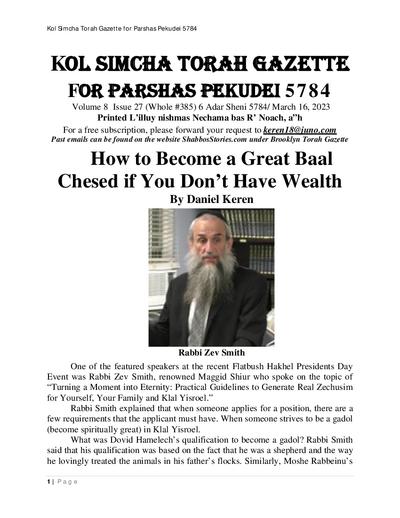
One of the featured speakers at the recent Flatbush Hakhel Presidents Day Event was Rabbi Zev Smith, renowned Maggid Shiur who spoke on the topic of “Turning a Moment into Eternity: Practical Guidelines to Generate Real Zechusim for Yourself, Your Family and Klal Yisroel.”

Rabbi Smith explained that when someone applies for a position, there are a few requirements that the applicant must have. When someone strives to be a gadol (become spiritually great) in Klal Yisroel.

What was Dovid Hamelech’s qualification to become a gadol? Rabbi Smith said that his qualification was based on the fact that he was a shepherd and the way he lovingly treated the animals in his father’s flocks. Similarly, Moshe Rabbeinu’s quality that made him worthy of being the leader of the Jewish nation was also the way in which he treated the small sheep that was running away from his flock because it was thirsty.

Saved by His Kindness to a Simple Fly

Rabbi Smith spoke about a non-Jew who was saved because of his character trait of being of being kind to a fly. Once he was travelling on a bus in which the driver lost control of the vehicle. The front of the bus fell into a river and the driver and most of the passengers drowned. However, this non-Jew was sitting in the back of the bus that was almost ready to completely fall into the river. He was able to open a window and a soldier was able to miraculously rescue him. He later said that he has the custom of when a fly falls into his cup, taking it out and not killing it. This non-Jew thought that because of his mercy to the simple fly, G-d had mercy on him.

How much of our Torah observance is the result of our observing things in our life,? Rabbi Smith asked the Hakhel audience. The Rambam’s first choice of Ahavas Yisroel (love and concern for a fellow Jew) is to give kind words to others. Such words give life-saving confidence to the person whom you speak to. You may never know just how much you have helped that person you gave Chizik (inspiration) to. Do you know how powerful your simple phone call to your parents can be?, allowing them to know that you are there for them.

Don’t Be Shy in Complimenting Others

The government has a program urging that if you see something, say something. Rabbi Smith urged everyone to adopt that program. If you see a shaliach tzibbur (one who leads the Minyan in praying), after the conclusion compliment him on his excellent davening, even if it wasn’t [that good.]

Sometimes a person performs a particular chesed (kindness) and Hashem holds that good deed in store for him when he needs a chesed or even later on for someone else in his family.

The Rambam say that there is no greater joy in the world than to give or help someone else who is need of assistance. Rabbi Smith recalled a story he had heard about Rav Aharon Kotler (1892-1962) the founder of Beth Medrash Govoho in Lakewood, NJ. Rav Kotler was a great Torah scholar who when not fundraising for his and other yeshivas spent all his time in learning Torah. One time, he was seen playing a chess game with a simple Jew who was not a Torah scholar.

When asked about why he spent so much time on such a seemingly mundane activity instead of studying more deeply into Yam HaTorah, Rav Kotler explained that the person he was playing with was a Holocaust survivor who was still struggling with the horrors he endured. He wasn’t able to study Torah but enjoyed playing chess. Therefore, as an act of chesed, Rav Kotler opted to cheer up his friend by playing a game of chess.

You Don’t Need a Lot of Money to be a Great Baal Chesed

Rabbeinu Yonah (Rav Yonah ben Avraham Gerondi, 1200-1263), author of the classic sefer “Shaarei Teshuvah” writes that even if you don’t have a lot of money, you can still be the greatest baal chesed if you generously bestow kind words on those who are lonely and ignored by others.

Rabbi Smith said that just as there is a punishment for saying a bad word to someone, perhaps there could also be a punishment for not having said kind words to someone who could have benefited from those thoughtful words.

Are we careful or thoughtful to give compliments to our own family members? Do we appreciate the small things our spouse constantly do for us? Do we take time to compliment our children and grandchildren? Do you have any idea of how important those compliments are to your children?

The Most Important Thing in the History of the World

The Midrash teaches us that when you do a mitzvah, do it with simcha and know that it is the most important thing in the history of the world! Every one of us can be a One Man or One Woman Chesed Machine in our daled amos with our family and those who we come into contact with on a daily basis.

Rabbi Smith concluded with the message that everyone has a mitzvah to do tzedokah, but that even if you don’t have a lot of money, you can still perform the mitzvah with kindness and sweet words.

Reprinted from the March 7, 2024 edition of The Flatbush Jewish Journal.
By Daniel Keren

One of the featured speakers at the recent Flatbush Hakhel Presidents Day Event was Rabbi Zev Smith, renowned Maggid Shiur who spoke on the topic of “Turning a Moment into Eternity: Practical Guidelines to Generate Real Zechusim for Yourself, Your Family and Klal Yisroel.”

Rabbi Smith explained that when someone applies for a position, there are a few requirements that the applicant must have. When someone strives to be a gadol (become spiritually great) in Klal Yisroel.

What was Dovid Hamelech’s qualification to become a gadol? Rabbi Smith said that his qualification was based on the fact that he was a shepherd and the way he lovingly treated the animals in his father’s flocks. Similarly, Moshe Rabbeinu’s quality that made him worthy of being the leader of the Jewish nation was also the way in which he treated the small sheep that was running away from his flock because it was thirsty.

Saved by His Kindness to a Simple Fly

Rabbi Smith spoke about a non-Jew who was saved because of his character trait of being of being kind to a fly. Once he was travelling on a bus in which the driver lost control of the vehicle. The front of the bus fell into a river and the driver and most of the passengers drowned. However, this non-Jew was sitting in the back of the bus that was almost ready to completely fall into the river. He was able to open a window and a soldier was able to miraculously rescue him. He later said that he has the custom of when a fly falls into his cup, taking it out and not killing it. This non-Jew thought that because of his mercy to the simple fly, G-d had mercy on him.

How much of our Torah observance is the result of our observing things in our life,? Rabbi Smith asked the Hakhel audience. The Rambam’s first choice of Ahavas Yisroel (love and concern for a fellow Jew) is to give kind words to others. Such words give life-saving confidence to the person whom you speak to. You may never know just how much you have helped that person you gave Chizik (inspiration) to. Do you know how powerful your simple phone call to your parents can be?, allowing them to know that you are there for them.

Don’t Be Shy in Complimenting Others

The government has a program urging that if you see something, say something. Rabbi Smith urged everyone to adopt that program. If you see a shaliach tzibbur (one who leads the Minyan in praying), after the conclusion compliment him on his excellent davening, even if it wasn’t [that good.]

Sometimes a person performs a particular chesed (kindness) and Hashem holds that good deed in store for him when he needs a chesed or even later on for someone else in his family.

The Rambam say that there is no greater joy in the world than to give or help someone else who is need of assistance. Rabbi Smith recalled a story he had heard about Rav Aharon Kotler (1892-1962) the founder of Beth Medrash Govoho in Lakewood, NJ. Rav Kotler was a great Torah scholar who when not fundraising for his and other yeshivas spent all his time in learning Torah. One time, he was seen playing a chess game with a simple Jew who was not a Torah scholar.

When asked about why he spent so much time on such a seemingly mundane activity instead of studying more deeply into Yam HaTorah, Rav Kotler explained that the person he was playing with was a Holocaust survivor who was still struggling with the horrors he endured. He wasn’t able to study Torah but enjoyed playing chess. Therefore, as an act of chesed, Rav Kotler opted to cheer up his friend by playing a game of chess.

You Don’t Need a Lot of Money to be a Great Baal Chesed

Rabbeinu Yonah (Rav Yonah ben Avraham Gerondi, 1200-1263), author of the classic sefer “Shaarei Teshuvah” writes that even if you don’t have a lot of money, you can still be the greatest baal chesed if you generously bestow kind words on those who are lonely and ignored by others.

Rabbi Smith said that just as there is a punishment for saying a bad word to someone, perhaps there could also be a punishment for not having said kind words to someone who could have benefited from those thoughtful words.

Are we careful or thoughtful to give compliments to our own family members? Do we appreciate the small things our spouse constantly do for us? Do we take time to compliment our children and grandchildren? Do you have any idea of how important those compliments are to your children?

The Most Important Thing in the History of the World

The Midrash teaches us that when you do a mitzvah, do it with simcha and know that it is the most important thing in the history of the world! Every one of us can be a One Man or One Woman Chesed Machine in our daled amos with our family and those who we come into contact with on a daily basis.

Rabbi Smith concluded with the message that everyone has a mitzvah to do tzedokah, but that even if you don’t have a lot of money, you can still perform the mitzvah with kindness and sweet words.

Reprinted from the March 7, 2024 edition of The Flatbush Jewish Journal.

PDF Preview