Maos Chitim: Pesach Fund
Hama'aseh Hu Haikar | March 28, 2025
Print This Article
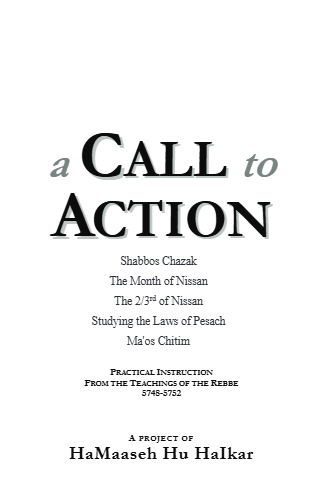
View Original PDF

Maos Chitim: Pesach Fund

Hama'aseh Hu Haikar | December 10, 2025

Introduction

In his Shulchan Aruch, the Alter Rebbe states: “It is a universal Jewish practice for each community to arrange a levy on its people for the sake of providing wheat for Pesach, to purchase and distribute it among the needy, thus enabling them to bake matzos for the Seder nights.”

Nowadays, this practice has been expanded, and Maos Chitim (lit. “money for wheat”) now includes all other Pesach requirements as well. The Rebbe devoted an extraordinary amount of attention to this annual pre-Pesach drive.

Hurry to Pesach

We should begin organizing and publicizing Maos Chitim well in advance, immediately following Purim. Our donations towards providing the Pesach requirements should steadily increase, adding more and more the closer we get to Pesach.

All Pesach Necessities

Maos Chitim includes supplying all Pesach requirements for all seven days of Pesach within the Land of Israel, and eight days in the Diaspora. It includes the needs for the Seder nights—matzos, four cups of wine, and so on—as well as general yom tov requirements, such as new festive clothing, meals, and the like.

With Hiddurim

After providing an individual with all his Pesach requirements, we should strive to raise the person to a higher standard of Torah observance. Then, due to his new and enhanced level of observance, we will need to furnish additional Pesach supplies appropriate to his new level.

Turn Recipients into Donors

We should put immense effort into ensuring that every single Jew—including even the very “smallest” in either a physical or spiritual sense—has all that he or she needs for Pesach.

We should supply not only all they need for themselves, but enough to allow them, in turn, to announce at the start of the Seder: “Kol Dichfin… All who are hungry come in and eat! All who are needy come in and make the Pesach [Seder]!”

Like Your Own Pesach Supplies

In keeping with the Torah’s commandment to “Love your fellow Jew as yourself,” we should make sure that our fellow Jews have all their Pesach needs prepared and set out before them, just as we do.

Furthermore, we should supply the Pesach requirements for our fellow Jews even before we arrange our own.

Best Quality

We should supply “from the best and sweetest foods on our table, since the Torah commands us to give from the best we have to Hashem.” This requirement is reflected in the traditional name for the pre-Pesach drive, Maos Chitim, “money for wheat,” wheat being the choicest of the five species of grain acceptable for baking matzos.

Proactive Donating

We should not wait until the official tzedakah collector comes to you, requesting donations to help provide Pesach needs for others. Rather, we should be proactively running and seeking any possible way to donate Maos Chitim.

Then, when the tzedakah collector comes around, we will give him a donation in addition to those contributions we gave without having to be asked.

Do Even Better Than That

Even if we have actively concerned ourselves with Maos Chitim for some time, we should never consider our obligation complete. Rather, each of us should take time to consider and determine—with an honest self-accounting—whether we have truly given Maos Chitim in a manner that befits our particular position. Quite possibly, there may be room and a need to add yet further in this regard…

Revise Your Balance Repeatedly

Further, even after having provided Maos Chitim in a manner that truly befits our particular position—donating a tenth or even a fifth of our earnings—we should calculate the additional wealth gained as a result of G-d’s blessings in the interim.

Based on this new calculation, we will realize that our earnings have increased, and with it, the “tenth” or “fifth” that we had previously calculated. Naturally, we will then need to provide an additional contribution to Maos Chitim.

Become Wealthy from Giving Tzedakah

According to the principle, “Tithe [your earnings] so that you will become wealthy, via an increase in G-d’s reciprocal blessings,” we are able, and therefore should, increase our donations towards Maos Chitim, doing so even before G-d increases our blessings.

The more we increase our donations, the greater will be G-d’s blessings, even bestowing enormous wealth upon us in “return” for our substantial donations.

Tenth, Fifth, or More

From Rosh Chodesh Nissan—two weeks before Pesach—we should once again consider to give even more.

From Purim and Rosh Chodesh

As explained earlier, there are two opinions as to when we are obliged to begin studying the laws of Pesach and teaching them to the public. According to one view, we begin thirty days in advance; according to the second view, we begin from Rosh Chodesh Nissan, just two weeks before Pesach.

The Rebbe explained that although the law follows the first viewpoint, we should nevertheless take the second opinion into account as well and greatly increase the quantity and quality of our study upon reaching Rosh Chodesh. Just as there are two opinions expressed concerning the time to begin studying the laws of Pesach (and in practice, we should follow both of them), so should we apply both views to our providing Maos Chitim and all the other requirements for Pesach.

Introduction

In his Shulchan Aruch, the Alter Rebbe states: “It is a universal Jewish practice for each community to arrange a levy on its people for the sake of providing wheat for Pesach, to purchase and distribute it among the needy, thus enabling them to bake matzos for the Seder nights.”

Nowadays, this practice has been expanded, and Maos Chitim (lit. “money for wheat”) now includes all other Pesach requirements as well. The Rebbe devoted an extraordinary amount of attention to this annual pre-Pesach drive.

Hurry to Pesach

We should begin organizing and publicizing Maos Chitim well in advance, immediately following Purim. Our donations towards providing the Pesach requirements should steadily increase, adding more and more the closer we get to Pesach.

All Pesach Necessities

Maos Chitim includes supplying all Pesach requirements for all seven days of Pesach within the Land of Israel, and eight days in the Diaspora. It includes the needs for the Seder nights—matzos, four cups of wine, and so on—as well as general yom tov requirements, such as new festive clothing, meals, and the like.

With Hiddurim

After providing an individual with all his Pesach requirements, we should strive to raise the person to a higher standard of Torah observance. Then, due to his new and enhanced level of observance, we will need to furnish additional Pesach supplies appropriate to his new level.

Turn Recipients into Donors

We should put immense effort into ensuring that every single Jew—including even the very “smallest” in either a physical or spiritual sense—has all that he or she needs for Pesach.

We should supply not only all they need for themselves, but enough to allow them, in turn, to announce at the start of the Seder: “Kol Dichfin… All who are hungry come in and eat! All who are needy come in and make the Pesach [Seder]!”

Like Your Own Pesach Supplies

In keeping with the Torah’s commandment to “Love your fellow Jew as yourself,” we should make sure that our fellow Jews have all their Pesach needs prepared and set out before them, just as we do.

Furthermore, we should supply the Pesach requirements for our fellow Jews even before we arrange our own.

Best Quality

We should supply “from the best and sweetest foods on our table, since the Torah commands us to give from the best we have to Hashem.” This requirement is reflected in the traditional name for the pre-Pesach drive, Maos Chitim, “money for wheat,” wheat being the choicest of the five species of grain acceptable for baking matzos.

Proactive Donating

We should not wait until the official tzedakah collector comes to you, requesting donations to help provide Pesach needs for others. Rather, we should be proactively running and seeking any possible way to donate Maos Chitim.

Then, when the tzedakah collector comes around, we will give him a donation in addition to those contributions we gave without having to be asked.

Do Even Better Than That

Even if we have actively concerned ourselves with Maos Chitim for some time, we should never consider our obligation complete. Rather, each of us should take time to consider and determine—with an honest self-accounting—whether we have truly given Maos Chitim in a manner that befits our particular position. Quite possibly, there may be room and a need to add yet further in this regard…

Revise Your Balance Repeatedly

Further, even after having provided Maos Chitim in a manner that truly befits our particular position—donating a tenth or even a fifth of our earnings—we should calculate the additional wealth gained as a result of G-d’s blessings in the interim.

Based on this new calculation, we will realize that our earnings have increased, and with it, the “tenth” or “fifth” that we had previously calculated. Naturally, we will then need to provide an additional contribution to Maos Chitim.

Become Wealthy from Giving Tzedakah

According to the principle, “Tithe [your earnings] so that you will become wealthy, via an increase in G-d’s reciprocal blessings,” we are able, and therefore should, increase our donations towards Maos Chitim, doing so even before G-d increases our blessings.

The more we increase our donations, the greater will be G-d’s blessings, even bestowing enormous wealth upon us in “return” for our substantial donations.

Tenth, Fifth, or More

From Rosh Chodesh Nissan—two weeks before Pesach—we should once again consider to give even more.

From Purim and Rosh Chodesh

As explained earlier, there are two opinions as to when we are obliged to begin studying the laws of Pesach and teaching them to the public. According to one view, we begin thirty days in advance; according to the second view, we begin from Rosh Chodesh Nissan, just two weeks before Pesach.

The Rebbe explained that although the law follows the first viewpoint, we should nevertheless take the second opinion into account as well and greatly increase the quantity and quality of our study upon reaching Rosh Chodesh. Just as there are two opinions expressed concerning the time to begin studying the laws of Pesach (and in practice, we should follow both of them), so should we apply both views to our providing Maos Chitim and all the other requirements for Pesach.

PDF Preview