Thank You For Your Service
Torah Papers | March 15, 2024
Print This Article
View Original PDF

Thank You For Your Service

Torah Papers | June 27, 2025

Parshat Pekudei stands as the culmination of the Mishkan's construction, summarizing the efforts detailed in the previous Parshiot. Terumah introduced the כֵּלִים (vessels), Tetzaveh described the בִּגְדֵי כְּהֻנָּה (priestly garments), and Vayakhel discussed Moshe's instructions to Bnei Yisrael about the construction. This week's Parsha provides a review of all contributions made towards the Mishkan and summarizes its construction. Notably, the term מִשְׁכָּן is repeated twice in the opening pasuk:

הָעֵדֻתהַמִּשְׁכָּן מִשְׁכַּןֶהפְקוּדֵי אֵל. Rashi interprets this duplication as alluding to the Mishkan twice being seized (שֶׁנִּתְמַשְׁכֵּן) for Bnei Yisrael’s repentance, or twice destroyed on account of Bnei Yisrael’s sins. The Siftei Chachamim questions this learning, pointing out that one instance of מִשְׁכָּן is required and only one is extra. It notes the subtle difference between the two instances, however. One is preceded by a "ה" (הַמִּשְׁכָּן), and this distinction denotes reference to the Beit Hamikdash.

The Ba’al HaTurim offers a deeper insight into the repetition of the word מִשְׁכָּן. He notes that the numerical value of מִשְׁכָּן is 410, mirroring the number of years the first Beit Hamikdash stood before its destruction. Hakadosh Baruch Hu took the first Beit Hamikdash as a מַשְׁכּוֹן (collateral) for Bnei Yisrael’s Teshuva, choosing to vent His wrath on inanimate stones and wood rather than on the people themselves.

Reb Zelmaleh of Volozhin delves into the intricacies of collateral as outlined in Parshat Mishpatim through the Pasuk: בֹּא הַשֶּׁמֶשׁ תְּשִׁיבֶנּוּ לוֹ עַד – You must return it to him till sunset. There is a requirement to return an item taken as collateral before it is needed. The Pasuk says a blanket must be returned by nightfall, before it is needed by its owner, and if not, the owner may cry out: יִצְעַק אֵלַי וְשָׁמַעְתִּי כִּי חַנּוּן אָנִי וְהָיָה כִּי – If it happens that he cries out to Me, I will hear for I am gracious. The question then arises: if the Beit Hamikdash was taken as collateral, why hasn't it been returned to us? The answer, he says, lies in whether the Beit Hamikdash is truly considered essential like the garment in the Pasuk. The lack of its return might indicate our failure to demonstrate its necessity or to cry out sufficiently for it.

Rav Yosef Chaim Sonnenfeld, in his work Chochmat Chaim, addresses the topic of taking collateral from the poor. He explains that if the person from whom bedding, as an example, is taken possesses another set to use, there is no immediate obligation to return the collateral. Under such circumstances, the second set is considered a luxury rather than a necessity. Extending this principle to the context of the Beit Hamikdash, he suggests that perhaps the reason for its continued absence is reflective of our attitude towards it – i.e., treating the Beit Hamikdash as a luxury or a nice to have rather than recognizing its essential necessity in our lives.

Our focus today is on the חֹשֶׁן (breastplate), highlighted as the most significant among the בִּגְדֵי כְּהֻנָּה (priestly garments). It is the first one mentioned in the list presented to Moshe Rabbeinu, though its detailed description follows that of the אֵפוֹד due to the אֵפוֹד being positioned underneath and serving as the necessary support for hanging the חֹשֶׁן.

Dimensions and Construction of the Choshen

רָבוּעַ יִהְיֶה כָּפוּל זֶרֶת אָרְכוֹ וְזֶרֶת רָחְבוֹ – this description indicates it was square-shaped, approximately 25 x 25 centimeters (according to the opinion that an ama is ~50cm). This specific dimension pertains to the בַּד (the fabric base), on which were placed the אֲבְנֵי חֹשֶׁן, consisting of twelve stones, each representing one of the twelve tribes.

The construction of the חֹשֶׁן is fascinating, marked by a unique instruction that differentiates it from other garments and vessels. The Torah's usage of the term רָבוּעַ יִהְיֶה – it shall be a doubled square, instead of a directive like יַעֲשׂוּ – they shall make a doubled square, implies, as the Malbim suggests, that the garment did not initially have this form. The Rambam suggests it was 25cm in length but double that in width before being folded in half to achieve its designated square shape. The Rokeach proposes that the entire fabric was double the required size and was folded twice, creating two pockets within the חֹשֶׁן.

The Urim VeTumim

The Urim VeTumim themselves hold a particular intrigue. They were not me’akev, not an obstacle – i.e., they did not invalidate the חֹשֶׁן if not present. While the Choshen was among the garments of the Kohen Gadol, the Urim VeTumim was considered an additional element. This distinction became especially evident in the Second Beit Hamikdash, where, despite the absence of the Urim VeTumim, the Kohen Gadol continued to perform his Avodah. The Gemara (Yoma 21b) lists the items not found in the Second Beit Hamikdash, including the אֲרוֹן, the כְּרוּבִים, the כַּפּוֹרֶת, רוּחַ הַקֹּדֶשׁ (Divine Inspiration), and the אוּרִים וְתֻמִּים. The presence of the Urim VeTumim was exclusive to the Mishkan and the First Beit Hamikdash.

The names of the twelve shevatim were engraved on the stones of the אוּרִים וְתֻמִּים, yet there are differing opinions as to their arrangement – either in three rows of four or four rows of three. Regardless of the configuration, there were a total of twelve stones, each representing a tribe. The names inscribed were not limited to just the names of the tribes. On the two אַבְנֵי שֹׁהַם, positioned on the shoulders of the Kohen Gadol, their names totaled fifty letters. In contrast, on the אוּרִים וְתֻמִּים, the letter count reached seventy-two. This discrepancy arises because the former engraving, and the collective letters of the twelve tribes’ names, lacked four letters – ח, ט, ק, and צ – which alongside the words קֵץ (end) and חֵטְא (sin) hold significance (see Rav Baruch Rosenblum English Shiur – Tetzaveh 5784).

Given the Urim VeTumim’s function in providing divine guidance for decisions and judgments, the inclusion of all letters of the alphabet was required. Therefore, to compensate for the four missing letters, the names of the Avot were added, along with the words שִׁבְטֵי יְשׁוּרוּן (or שִׁבְטֵי יִשְׂרָאֵל or ה-שִׁבְטֵי י according to some opinions). With seventy-two letters to evenly distribute across twelve stones, each received six letters. If a tribe's name consisted of fewer than six letters, the additional letters would be appended to reach the requisite total of six.

The name אוּרִים וְתֻמִּים stems from the words meaning lights and completeness. According to Rashi (Yoma 73b), Urim refers to the way the letters of the stones lit up. The letters of a word did not appear in sequence though, but rather all at once, leaving it ripe for misinterpretation. Tumim indicates that the correct interpretation of the letters was also provided to the Kohen Gadol. The שֵׁם הַמְּפוֹרָשׁ – the explicit name of G-d – was contained in the pockets of the Choshen and enabled the letters to illuminate and be understood correctly. Targum Yonatan ben Uziel states that this Shem HaMeforash is the same one used to create the world and is also engraved in the אֶבֶן הַשְׁתִּיָּה (Foundation Stone), offering miracles and protection to those who invoke it in times of danger.

The Ramban explains the Urim VeTumim’s significance. The unique handling and significance of the שֵׁם הַמְּפוֹרָשׁ in the context of the Urim VeTumim is highlighted by the specific manner in which it is presented to us in the Parsha. There are accounts suggesting that either Moshe wrote the Shem HaMeforash as directed by Hakadosh Baruch Hu, or it was given directly to him by Hakadosh Baruch Hu to be placed in the pocket of the Choshen. This is further emphasized by the usage of the definite article "הָ" (הַיְדִיעָה – the) in the pasuk הָאוּרִים וְאֶת הַתֻּמִּים אֶת, making the Urim VeTumim distinct in this regard. Unlike other garments or vessels of the Mishkan that do not carry this הַיְדִיעָה – except for הַכְּרָשִׁים (planks), which have their own significance tied to Avraham having handed them down generation to generation – this specific designation indicates a special status. Moshe alone undertook this aspect of the Mishkan, not relying on the craftsmen or builders and without using communal donations. It was a סוֹד (secret) entrusted to him. It was then Moshe who dressed Aharon in the Kohen Gadol’s garments, placed the אֵפוֹד upon him, the חֹשֶׁן atop the אֵפוֹד, and within its pockets, the Shem HaMeforash.

The Ramban elaborates further on how the letters of the tribes' names inscribed on the Urim VeTumim answered queries directed by the Kohen Gadol. An example from Sefer Shoftim is provided, where a question was asked about who should lead the battle against the Canaanites. The response appearing via the Urim was: יהודה יעלה – Yehuda shall go. The Tumim enabled the Kohen Gadol to interpret the message accurately, avoiding potential misinterpretations such as הוי הד עליה – the echo of woe upon it, or הי על יהודה – lamentation upon Yehuda. This guidance is described as akin to רוּחַ הַקֹּדֶשׁ (Divine Inspiration), providing the Kohen Gadol with the insight needed to decipher the divine will. We’ll return to this important idea shortly.

The process of consulting the אוּרִים וְתֻמִּים is described in the Gemara. The Kohen Gadol would stand facing the Aron, with the person seeking guidance positioned behind him. Questions posed to the Urim VeTumim were only those of significant national importance, such as decisions about going to war. These inquiries were made not aloud, but in a quiet manner akin to the quiet prayers of an individual engaged in davening, ensuring the words were spoken, but not intended for others to hear. רוּחַ הַקֹּדֶשׁ then set upon the Kohen Gadol, enabling him to discern the response through the illuminated letters on the Choshen. He would then communicate the divine guidance received. Questions were asked sequentially; if multiple inquiries were made simultaneously, only the first would be answered. Furthermore, trivial or personal queries were not deemed appropriate for the Urim VeTumim. Questions of “Should I buy this apartment?” were left to one’s own head to figure out. This tool of divine consultation was reserved for matters affecting the collective of Klal Yisrael, and therefore it was kings, military leaders, and members of the Sanhedrin who did so.

Before delving into the main topic of the shiur, there’s one final aspect of the אוּרִים וְתֻמִּים to review. The Kohen Gadol, upon consulting the Urim VeTumim and receiving divine guidance, would decipher the answer through רוּחַ הַקֹּדֶשׁ. However, if a Kohen Gadol ever found himself asking a question to which he received no response – he immediately went home. His tenure came to an abrupt end. A historical example of this is Evyatar HaKohen, the sole surviving son of the Kohen Gadol Achimelech, who served when the Mishkan was located in Nov. Achimelech had supported David HaMelech by providing him with the לֶחֶם הַפָּנִים (Showbread) to eat and the sword of Goliath. When King Shaul discovered this and saw that David had collaborators in Nov, all the town's priests were killed. Only Achimelech escaped with David, and his son, Evyatar, survived. While David was king, Evyatar utilized the Urim VeTumim to answer inquiries but his ability to receive answers ceased following Avshalom's rebellion against David. After posing an unanswered question, Evyatar's service as Kohen Gadol concluded, a decision, according to Chazal, that was due to his perceived allegiance to Adoniyahu over Shlomo. Tzadok assumed the role of Kohen Gadol (Rashi Berachot 4a).

Purim Connection and the Circle of the Choshen

As we approach Purim, it's worth reflecting on the story involving David HaMelech and שִׁמְעִי בֶן-גֵרָא. Despite Shimi's act of rebellion against the king (מוֹרֶה בְּמַלְכוּת), David chose not to kill him. Instead, he left the matter for his son, Shlomo HaMelech, to handle in due time, specifically after Shimi had grown old. One of the reasons for David's restraint was that he saw through Ruach Hakodesh that Mordechai would be a descendant of Shimi: מָרְדֳּכַי בֶּן יָאִיר בֶּן שִׁמְעִי בֶּן קִישׁ אִישׁ יְמִינִי. David needed to let Shimi have children before any punishment could take place. An interesting piece from the Yalkut Shimoni highlights the connection between Shimi Ben Geira and the Purim story. During Avshalom's rebellion, two loyalists of David, Evyatar and Tzadok, found themselves fleeing Avshalom's forces. Upon reaching the home of Shimi Ben Geira, they noticed the door wide open, so they ducked in, seeking refuge. Shimi's wife took it upon herself to protect them from Avshalom's soldiers. Mimicking the act of the wife of On ben Pelet (see Rav Rosenblum English Shiur – Korach 5783), she distracted the pursuing soldiers by playing with her hair in public, leading them to believe that such righteous individuals as Evyatar and Tzadok could not possibly be holed up in a house with a woman displaying herself in such a manner. The soldiers were misled, and they moved on. This act of protection is said to have merited Shimi's wife the reward of Mordechai and Esther in her lineage.

Let's now close a circle with the בִּגְדֵי כְּהֻנָּה before concluding with חֲזַק חֲזַק וְנִתְחַזֵּק.

Connecting the End to the Beginning

Rav Yechezkel Abramsky offers interesting commentary on the Pasuk from the Shir Shel Yom recited on Rosh Chodesh: יָצַרְתָּ לְשַׂחֶק־בּוֹ לִוְיָתָן זֶה – Leviathan, this You formed to play with. The Gemara (Avodah Zara 4a) says Hakadosh Baruch Hu engages in play with the Leviatan during the fourth hour of the day, a concept that is challenging for the human mind to fully comprehend and rich with sodot. One accessible lesson, as presented by Rav Abramsky, relates to the Leviatan's solitude after its female mate was slain by Hakadosh Baruch Hu just after its creation, and preserved in salt for the tzaddikim in Olam Haba. The Leviatan, alone, finds companionship with Hakadosh Baruch Hu to sustain its spirit. Going deeper, Rav Abramsky draws a parallel between the long Leviatan's testing its dexterity and fitness by spinning around to check if its nose can touch its tail – perhaps akin to a finger-to-nose test in conventional medical examinations to test cerebellar function or sobriety – and the spiritual practice of connecting the end of a text to its beginning.

What does this have to do with Hakadosh Baruch Hu? He answers, in the same way the Leviatan gains pleasure by bringing the sof (end) to the hatchala (start), Hakadosh Baruch Hu takes pleasure when we bring the final text of our sefer – Pekudei – together with the beginning text of Shemot. Similarly, when we connect the death of Yosef in Egypt to the opening words of Sefer Bereshit, or when we close out the learning of a tractate like Bava Kamma with its final words. It is all likened to the Leviatan closing its circle.

I’d like to now give Hakadosh Baruch Hu extra pleasure by connecting our end to our start. If the end of Shemot discusses the אֲבְנֵי חֹשֶׁן and אוּרִים וְתֻמִּים which are from the בִּגְדֵי כְּהֻנָּה of the Kohen Gadol of Shevet Levi, where is the start of that circle? It begins with: וַיִּקַּח אִישׁ מִבֵּית לֵוִי וַיִּקַּח אֶת בַּת לֵוִי, marking the beginning of Moshe's journey. This path led him from his birth and upbringing in Egypt, through his exile to Midian, his marriage, and his time tending Yitro's flock, to the pivotal encounter at the burning bush. This event set him on the course to lead Bnei Yisrael out of slavery. For seven days, Moshe Rabbeinu argued with Hakadosh Baruch Hu as to his merits and chances of success, eventually coming clean as to the root cause of his hesitancy: He did not want to insult his older brother Aharon or diminish his standing. Hakadosh Baruch Hu reassured Moshe that Aharon would not only accept this arrangement but would genuinely rejoice in Moshe's leadership and fully support him, as expressed in וְרָאֲךָ וְשָׂמַח בְּלִבּוֹ – when he sees you, he will rejoice in his heart.

In the merit of being happy deep in his heart, Aharon was rewarded. The Midrash (Tanchuma Shemot 27:3) and Gemara (Shabbat 139a) differ, however, on the exact reward. The Gemara says: עַל לִבּוֹ לְחֹשֶׁן הַמִּשְׁפָּט זָכָה, whereas the Midrash differs slightly: אָמַר רַבִּי שִׁמְעוֹן בַּר יוֹחַאי: הַלֵב שֶׁשָּׂמַח בִּגְדֻלַּת אָחִיו, יָבוֹא וְיִשְׂמַח וְיִלְבַּשׁ אוּרִים וְתֻמִּים, as it is said: And you shall put on the breastplate of judgment, the Urim and Tumim; and they shall be put upon Aharon’s heart.

Whereas the Gemara calls out the חֹשֶׁן, the Midrash points to the אוּרִים וְתֻמִּים as the reward. We noted earlier that the Urim VeTumim was only present in the Mishkan and First Beit Hamikdash, whereas the Choshen was present even in the second Beit Hamikdash. This is an important distinction, and with it I would like to dive into the commentary of the Abarbanel (Shemot).

Midah K'neged Midah and the Choshen

Why did Aharon merit the צִיץ on this head? We don’t know because it’s not written. Why did he merit wearing the מְעִיל dressed up with bells and pomegranates along its hem? We don’t know because it is not written. The same for the אֵפוֹד and the same for the מִצְנֶפֶת. Why is it that only the חֹשֶׁן has a reasoning and incident attached to it? And how does that particular act of Aharon connect to it? If Aharon was not delighted at the sight of his brother assuming leadership, would the Choshen be dropped from the Kohen Gadol’s garb?

Before we look at his answer, I’d like to provide a brief introduction. The Abrabanel maintains that the actions of Hakadosh Baruch Hu in this world adhere to the principle of מִדָּה כְּנֶגֶד מִדָּה – measure for measure, affecting both positive and negative outcomes, creation and destruction. This concept is highlighted in the pasuk: וַיַּרְא אֱ-לֹהִים אֶת־כָּל אֲשֶׁר עָשָׂה וְהִנֵּה טוֹב מְאֹד. And G-d saw everything that He had made, and, behold, it was very good.

The principle and system of Midah K'neged Midah is identified by Chazal as one of the things that achieves this top grade of טוֹב מְאֹד. Why? Because it allows for the tracing back of events to their root causes, offering a method for understanding the outcomes of our actions. However, it’s not always straightforward. Even many of the Tana'im and Amora'im encountered situations whose reasons eluded them.

In the Gemara (Berachot 5b), there's an account of Rav Huna's 400 barrels of wine – an amount rivalling the total output of some modern boutique wineries – fermenting and turning into vinegar, essentially decimating his business since the vinegar was worth merely a fraction of the wine's value. The chachamim all went to console Rav Huna, offering him the bracha of
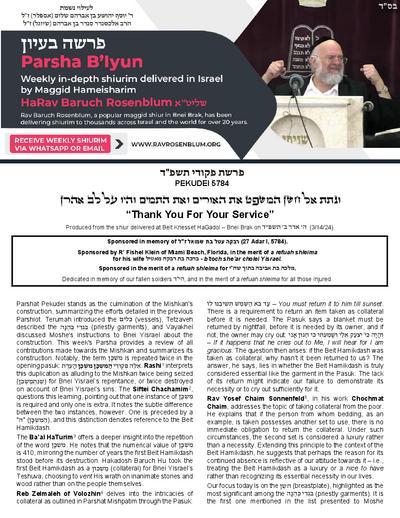

Parshat Pekudei stands as the culmination of the Mishkan's construction, summarizing the efforts detailed in the previous Parshiot. Terumah introduced the כֵּלִים (vessels), Tetzaveh described the בִּגְדֵי כְּהֻנָּה (priestly garments), and Vayakhel discussed Moshe's instructions to Bnei Yisrael about the construction. This week's Parsha provides a review of all contributions made towards the Mishkan and summarizes its construction. Notably, the term מִשְׁכָּן is repeated twice in the opening pasuk:

הָעֵדֻתהַמִּשְׁכָּן מִשְׁכַּןֶהפְקוּדֵי אֵל. Rashi interprets this duplication as alluding to the Mishkan twice being seized (שֶׁנִּתְמַשְׁכֵּן) for Bnei Yisrael’s repentance, or twice destroyed on account of Bnei Yisrael’s sins. The Siftei Chachamim questions this learning, pointing out that one instance of מִשְׁכָּן is required and only one is extra. It notes the subtle difference between the two instances, however. One is preceded by a "ה" (הַמִּשְׁכָּן), and this distinction denotes reference to the Beit Hamikdash.

The Ba’al HaTurim offers a deeper insight into the repetition of the word מִשְׁכָּן. He notes that the numerical value of מִשְׁכָּן is 410, mirroring the number of years the first Beit Hamikdash stood before its destruction. Hakadosh Baruch Hu took the first Beit Hamikdash as a מַשְׁכּוֹן (collateral) for Bnei Yisrael’s Teshuva, choosing to vent His wrath on inanimate stones and wood rather than on the people themselves.

Reb Zelmaleh of Volozhin delves into the intricacies of collateral as outlined in Parshat Mishpatim through the Pasuk: בֹּא הַשֶּׁמֶשׁ תְּשִׁיבֶנּוּ לוֹ עַד – You must return it to him till sunset. There is a requirement to return an item taken as collateral before it is needed. The Pasuk says a blanket must be returned by nightfall, before it is needed by its owner, and if not, the owner may cry out: יִצְעַק אֵלַי וְשָׁמַעְתִּי כִּי חַנּוּן אָנִי וְהָיָה כִּי – If it happens that he cries out to Me, I will hear for I am gracious. The question then arises: if the Beit Hamikdash was taken as collateral, why hasn't it been returned to us? The answer, he says, lies in whether the Beit Hamikdash is truly considered essential like the garment in the Pasuk. The lack of its return might indicate our failure to demonstrate its necessity or to cry out sufficiently for it.

Rav Yosef Chaim Sonnenfeld, in his work Chochmat Chaim, addresses the topic of taking collateral from the poor. He explains that if the person from whom bedding, as an example, is taken possesses another set to use, there is no immediate obligation to return the collateral. Under such circumstances, the second set is considered a luxury rather than a necessity. Extending this principle to the context of the Beit Hamikdash, he suggests that perhaps the reason for its continued absence is reflective of our attitude towards it – i.e., treating the Beit Hamikdash as a luxury or a nice to have rather than recognizing its essential necessity in our lives.

Our focus today is on the חֹשֶׁן (breastplate), highlighted as the most significant among the בִּגְדֵי כְּהֻנָּה (priestly garments). It is the first one mentioned in the list presented to Moshe Rabbeinu, though its detailed description follows that of the אֵפוֹד due to the אֵפוֹד being positioned underneath and serving as the necessary support for hanging the חֹשֶׁן.

Dimensions and Construction of the Choshen

רָבוּעַ יִהְיֶה כָּפוּל זֶרֶת אָרְכוֹ וְזֶרֶת רָחְבוֹ – this description indicates it was square-shaped, approximately 25 x 25 centimeters (according to the opinion that an ama is ~50cm). This specific dimension pertains to the בַּד (the fabric base), on which were placed the אֲבְנֵי חֹשֶׁן, consisting of twelve stones, each representing one of the twelve tribes.

The construction of the חֹשֶׁן is fascinating, marked by a unique instruction that differentiates it from other garments and vessels. The Torah's usage of the term רָבוּעַ יִהְיֶה – it shall be a doubled square, instead of a directive like יַעֲשׂוּ – they shall make a doubled square, implies, as the Malbim suggests, that the garment did not initially have this form. The Rambam suggests it was 25cm in length but double that in width before being folded in half to achieve its designated square shape. The Rokeach proposes that the entire fabric was double the required size and was folded twice, creating two pockets within the חֹשֶׁן.

The Urim VeTumim

The Urim VeTumim themselves hold a particular intrigue. They were not me’akev, not an obstacle – i.e., they did not invalidate the חֹשֶׁן if not present. While the Choshen was among the garments of the Kohen Gadol, the Urim VeTumim was considered an additional element. This distinction became especially evident in the Second Beit Hamikdash, where, despite the absence of the Urim VeTumim, the Kohen Gadol continued to perform his Avodah. The Gemara (Yoma 21b) lists the items not found in the Second Beit Hamikdash, including the אֲרוֹן, the כְּרוּבִים, the כַּפּוֹרֶת, רוּחַ הַקֹּדֶשׁ (Divine Inspiration), and the אוּרִים וְתֻמִּים. The presence of the Urim VeTumim was exclusive to the Mishkan and the First Beit Hamikdash.

The names of the twelve shevatim were engraved on the stones of the אוּרִים וְתֻמִּים, yet there are differing opinions as to their arrangement – either in three rows of four or four rows of three. Regardless of the configuration, there were a total of twelve stones, each representing a tribe. The names inscribed were not limited to just the names of the tribes. On the two אַבְנֵי שֹׁהַם, positioned on the shoulders of the Kohen Gadol, their names totaled fifty letters. In contrast, on the אוּרִים וְתֻמִּים, the letter count reached seventy-two. This discrepancy arises because the former engraving, and the collective letters of the twelve tribes’ names, lacked four letters – ח, ט, ק, and צ – which alongside the words קֵץ (end) and חֵטְא (sin) hold significance (see Rav Baruch Rosenblum English Shiur – Tetzaveh 5784).

Given the Urim VeTumim’s function in providing divine guidance for decisions and judgments, the inclusion of all letters of the alphabet was required. Therefore, to compensate for the four missing letters, the names of the Avot were added, along with the words שִׁבְטֵי יְשׁוּרוּן (or שִׁבְטֵי יִשְׂרָאֵל or ה-שִׁבְטֵי י according to some opinions). With seventy-two letters to evenly distribute across twelve stones, each received six letters. If a tribe's name consisted of fewer than six letters, the additional letters would be appended to reach the requisite total of six.

The name אוּרִים וְתֻמִּים stems from the words meaning lights and completeness. According to Rashi (Yoma 73b), Urim refers to the way the letters of the stones lit up. The letters of a word did not appear in sequence though, but rather all at once, leaving it ripe for misinterpretation. Tumim indicates that the correct interpretation of the letters was also provided to the Kohen Gadol. The שֵׁם הַמְּפוֹרָשׁ – the explicit name of G-d – was contained in the pockets of the Choshen and enabled the letters to illuminate and be understood correctly. Targum Yonatan ben Uziel states that this Shem HaMeforash is the same one used to create the world and is also engraved in the אֶבֶן הַשְׁתִּיָּה (Foundation Stone), offering miracles and protection to those who invoke it in times of danger.

The Ramban explains the Urim VeTumim’s significance. The unique handling and significance of the שֵׁם הַמְּפוֹרָשׁ in the context of the Urim VeTumim is highlighted by the specific manner in which it is presented to us in the Parsha. There are accounts suggesting that either Moshe wrote the Shem HaMeforash as directed by Hakadosh Baruch Hu, or it was given directly to him by Hakadosh Baruch Hu to be placed in the pocket of the Choshen. This is further emphasized by the usage of the definite article "הָ" (הַיְדִיעָה – the) in the pasuk הָאוּרִים וְאֶת הַתֻּמִּים אֶת, making the Urim VeTumim distinct in this regard. Unlike other garments or vessels of the Mishkan that do not carry this הַיְדִיעָה – except for הַכְּרָשִׁים (planks), which have their own significance tied to Avraham having handed them down generation to generation – this specific designation indicates a special status. Moshe alone undertook this aspect of the Mishkan, not relying on the craftsmen or builders and without using communal donations. It was a סוֹד (secret) entrusted to him. It was then Moshe who dressed Aharon in the Kohen Gadol’s garments, placed the אֵפוֹד upon him, the חֹשֶׁן atop the אֵפוֹד, and within its pockets, the Shem HaMeforash.

The Ramban elaborates further on how the letters of the tribes' names inscribed on the Urim VeTumim answered queries directed by the Kohen Gadol. An example from Sefer Shoftim is provided, where a question was asked about who should lead the battle against the Canaanites. The response appearing via the Urim was: יהודה יעלה – Yehuda shall go. The Tumim enabled the Kohen Gadol to interpret the message accurately, avoiding potential misinterpretations such as הוי הד עליה – the echo of woe upon it, or הי על יהודה – lamentation upon Yehuda. This guidance is described as akin to רוּחַ הַקֹּדֶשׁ (Divine Inspiration), providing the Kohen Gadol with the insight needed to decipher the divine will. We’ll return to this important idea shortly.

The process of consulting the אוּרִים וְתֻמִּים is described in the Gemara. The Kohen Gadol would stand facing the Aron, with the person seeking guidance positioned behind him. Questions posed to the Urim VeTumim were only those of significant national importance, such as decisions about going to war. These inquiries were made not aloud, but in a quiet manner akin to the quiet prayers of an individual engaged in davening, ensuring the words were spoken, but not intended for others to hear. רוּחַ הַקֹּדֶשׁ then set upon the Kohen Gadol, enabling him to discern the response through the illuminated letters on the Choshen. He would then communicate the divine guidance received. Questions were asked sequentially; if multiple inquiries were made simultaneously, only the first would be answered. Furthermore, trivial or personal queries were not deemed appropriate for the Urim VeTumim. Questions of “Should I buy this apartment?” were left to one’s own head to figure out. This tool of divine consultation was reserved for matters affecting the collective of Klal Yisrael, and therefore it was kings, military leaders, and members of the Sanhedrin who did so.

Before delving into the main topic of the shiur, there’s one final aspect of the אוּרִים וְתֻמִּים to review. The Kohen Gadol, upon consulting the Urim VeTumim and receiving divine guidance, would decipher the answer through רוּחַ הַקֹּדֶשׁ. However, if a Kohen Gadol ever found himself asking a question to which he received no response – he immediately went home. His tenure came to an abrupt end. A historical example of this is Evyatar HaKohen, the sole surviving son of the Kohen Gadol Achimelech, who served when the Mishkan was located in Nov. Achimelech had supported David HaMelech by providing him with the לֶחֶם הַפָּנִים (Showbread) to eat and the sword of Goliath. When King Shaul discovered this and saw that David had collaborators in Nov, all the town's priests were killed. Only Achimelech escaped with David, and his son, Evyatar, survived. While David was king, Evyatar utilized the Urim VeTumim to answer inquiries but his ability to receive answers ceased following Avshalom's rebellion against David. After posing an unanswered question, Evyatar's service as Kohen Gadol concluded, a decision, according to Chazal, that was due to his perceived allegiance to Adoniyahu over Shlomo. Tzadok assumed the role of Kohen Gadol (Rashi Berachot 4a).

Purim Connection and the Circle of the Choshen

As we approach Purim, it's worth reflecting on the story involving David HaMelech and שִׁמְעִי בֶן-גֵרָא. Despite Shimi's act of rebellion against the king (מוֹרֶה בְּמַלְכוּת), David chose not to kill him. Instead, he left the matter for his son, Shlomo HaMelech, to handle in due time, specifically after Shimi had grown old. One of the reasons for David's restraint was that he saw through Ruach Hakodesh that Mordechai would be a descendant of Shimi: מָרְדֳּכַי בֶּן יָאִיר בֶּן שִׁמְעִי בֶּן קִישׁ אִישׁ יְמִינִי. David needed to let Shimi have children before any punishment could take place. An interesting piece from the Yalkut Shimoni highlights the connection between Shimi Ben Geira and the Purim story. During Avshalom's rebellion, two loyalists of David, Evyatar and Tzadok, found themselves fleeing Avshalom's forces. Upon reaching the home of Shimi Ben Geira, they noticed the door wide open, so they ducked in, seeking refuge. Shimi's wife took it upon herself to protect them from Avshalom's soldiers. Mimicking the act of the wife of On ben Pelet (see Rav Rosenblum English Shiur – Korach 5783), she distracted the pursuing soldiers by playing with her hair in public, leading them to believe that such righteous individuals as Evyatar and Tzadok could not possibly be holed up in a house with a woman displaying herself in such a manner. The soldiers were misled, and they moved on. This act of protection is said to have merited Shimi's wife the reward of Mordechai and Esther in her lineage.

Let's now close a circle with the בִּגְדֵי כְּהֻנָּה before concluding with חֲזַק חֲזַק וְנִתְחַזֵּק.

Connecting the End to the Beginning

Rav Yechezkel Abramsky offers interesting commentary on the Pasuk from the Shir Shel Yom recited on Rosh Chodesh: יָצַרְתָּ לְשַׂחֶק־בּוֹ לִוְיָתָן זֶה – Leviathan, this You formed to play with. The Gemara (Avodah Zara 4a) says Hakadosh Baruch Hu engages in play with the Leviatan during the fourth hour of the day, a concept that is challenging for the human mind to fully comprehend and rich with sodot. One accessible lesson, as presented by Rav Abramsky, relates to the Leviatan's solitude after its female mate was slain by Hakadosh Baruch Hu just after its creation, and preserved in salt for the tzaddikim in Olam Haba. The Leviatan, alone, finds companionship with Hakadosh Baruch Hu to sustain its spirit. Going deeper, Rav Abramsky draws a parallel between the long Leviatan's testing its dexterity and fitness by spinning around to check if its nose can touch its tail – perhaps akin to a finger-to-nose test in conventional medical examinations to test cerebellar function or sobriety – and the spiritual practice of connecting the end of a text to its beginning.

What does this have to do with Hakadosh Baruch Hu? He answers, in the same way the Leviatan gains pleasure by bringing the sof (end) to the hatchala (start), Hakadosh Baruch Hu takes pleasure when we bring the final text of our sefer – Pekudei – together with the beginning text of Shemot. Similarly, when we connect the death of Yosef in Egypt to the opening words of Sefer Bereshit, or when we close out the learning of a tractate like Bava Kamma with its final words. It is all likened to the Leviatan closing its circle.

I’d like to now give Hakadosh Baruch Hu extra pleasure by connecting our end to our start. If the end of Shemot discusses the אֲבְנֵי חֹשֶׁן and אוּרִים וְתֻמִּים which are from the בִּגְדֵי כְּהֻנָּה of the Kohen Gadol of Shevet Levi, where is the start of that circle? It begins with: וַיִּקַּח אִישׁ מִבֵּית לֵוִי וַיִּקַּח אֶת בַּת לֵוִי, marking the beginning of Moshe's journey. This path led him from his birth and upbringing in Egypt, through his exile to Midian, his marriage, and his time tending Yitro's flock, to the pivotal encounter at the burning bush. This event set him on the course to lead Bnei Yisrael out of slavery. For seven days, Moshe Rabbeinu argued with Hakadosh Baruch Hu as to his merits and chances of success, eventually coming clean as to the root cause of his hesitancy: He did not want to insult his older brother Aharon or diminish his standing. Hakadosh Baruch Hu reassured Moshe that Aharon would not only accept this arrangement but would genuinely rejoice in Moshe's leadership and fully support him, as expressed in וְרָאֲךָ וְשָׂמַח בְּלִבּוֹ – when he sees you, he will rejoice in his heart.

In the merit of being happy deep in his heart, Aharon was rewarded. The Midrash (Tanchuma Shemot 27:3) and Gemara (Shabbat 139a) differ, however, on the exact reward. The Gemara says: עַל לִבּוֹ לְחֹשֶׁן הַמִּשְׁפָּט זָכָה, whereas the Midrash differs slightly: אָמַר רַבִּי שִׁמְעוֹן בַּר יוֹחַאי: הַלֵב שֶׁשָּׂמַח בִּגְדֻלַּת אָחִיו, יָבוֹא וְיִשְׂמַח וְיִלְבַּשׁ אוּרִים וְתֻמִּים, as it is said: And you shall put on the breastplate of judgment, the Urim and Tumim; and they shall be put upon Aharon’s heart.

Whereas the Gemara calls out the חֹשֶׁן, the Midrash points to the אוּרִים וְתֻמִּים as the reward. We noted earlier that the Urim VeTumim was only present in the Mishkan and First Beit Hamikdash, whereas the Choshen was present even in the second Beit Hamikdash. This is an important distinction, and with it I would like to dive into the commentary of the Abarbanel (Shemot).

Midah K'neged Midah and the Choshen

Why did Aharon merit the צִיץ on this head? We don’t know because it’s not written. Why did he merit wearing the מְעִיל dressed up with bells and pomegranates along its hem? We don’t know because it is not written. The same for the אֵפוֹד and the same for the מִצְנֶפֶת. Why is it that only the חֹשֶׁן has a reasoning and incident attached to it? And how does that particular act of Aharon connect to it? If Aharon was not delighted at the sight of his brother assuming leadership, would the Choshen be dropped from the Kohen Gadol’s garb?

Before we look at his answer, I’d like to provide a brief introduction. The Abrabanel maintains that the actions of Hakadosh Baruch Hu in this world adhere to the principle of מִדָּה כְּנֶגֶד מִדָּה – measure for measure, affecting both positive and negative outcomes, creation and destruction. This concept is highlighted in the pasuk: וַיַּרְא אֱ-לֹהִים אֶת־כָּל אֲשֶׁר עָשָׂה וְהִנֵּה טוֹב מְאֹד. And G-d saw everything that He had made, and, behold, it was very good.

The principle and system of Midah K'neged Midah is identified by Chazal as one of the things that achieves this top grade of טוֹב מְאֹד. Why? Because it allows for the tracing back of events to their root causes, offering a method for understanding the outcomes of our actions. However, it’s not always straightforward. Even many of the Tana'im and Amora'im encountered situations whose reasons eluded them.

In the Gemara (Berachot 5b), there's an account of Rav Huna's 400 barrels of wine – an amount rivalling the total output of some modern boutique wineries – fermenting and turning into vinegar, essentially decimating his business since the vinegar was worth merely a fraction of the wine's value. The chachamim all went to console Rav Huna, offering him the bracha of

PDF Preview