The Flame Of Shabbos
Pulse of Emunah | March 14, 2024
Print This Article
View Original PDF

The Flame Of Shabbos

Pulse of Emunah | June 27, 2025

By Rabbi Dovid Sapirman, Dean, Ani Maamin Foundation

The mitzvah of Shabbos is mentioned twelve times in the Chumash. Two of them are in the two repetitions of the Aseres Hadibros. The first gives us a reason for the issur melacha: “For in six days Hashem created the heavens, the earth, the sea and all that is in them, and rested on the seventh. Therefore Hashem blessed the seventh day and made it holy.” On Shabbos, we have time to think about the marvels of creation and recognize Who brought them about.

In the second repetition of the Aseres Hadibros, in parshas Va'eschanan, we are given an additional reason for this mitzvah: “And you shall remember that you were slaves in the land of Mitzrayim and Hashem took you out from there with a strong hand and outstretched arm. Therefore, Hashem commanded you to establish the day of Shabbos.”

Yetzias Mitzrayim serves as a testimony to ma’asei Bereishis. No human beings were present at Creation, but we were present in Mitzrayim. There we saw that Hashem is in control of everything in the universe. We only need to remember what our own eyes to know that He is the Almighty Creator.

A beautiful story is told in the Gemara of Rabbi Shimon bar Yochai and his son, Rabbi Elazar, who hid from the Romans in a cave for many years, spending every second learning Torah. When they finally emerged, they were disappointed to find people busy earning a livelihood and not learning Torah constantly. Finally, on erev Shabbos, they saw a man with two bundles of hadasim. He told them that they were l’kavod Shabbos—one for zachor, one for shamor. Rabbi Shimon bar Yochai said to his son, “See, my son! Even though they are busy with their work, they still show affection for mitzvos.”

A certain rav once told a story to his shul: it was reported to the Chofetz Chaim that a bachur in his yeshiva had been mechallel Shabbos. The Chofetz Chaim called him in and spoke to him for about one minute. The bachur remained a strict shomer Shabbos all his life. After davening, an elderly man came over to the rav and told him that the story was true: he was that bachur.

“Tell me,” the rav asked, “what did the Chofetz Chaim say to you in one minute?”

“He didn't say much,” the man answered. “He held my hand with great warmth, while two tears rolled down his cheeks. He said in a pleading voice, ‘Shabbos! Shabbos!’ His tears fell on my hand. Every Friday night I feel like two flames are burning my hand on that spot. I have never, ever been able to bring myself to be mechallel Shabbos again.”

The flame of Shabbos will burn forever!
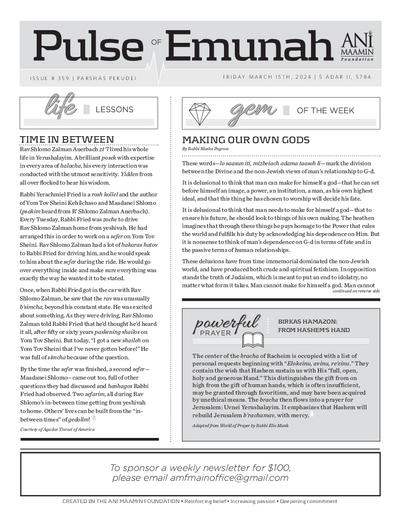
By Rabbi Dovid Sapirman, Dean, Ani Maamin Foundation

The mitzvah of Shabbos is mentioned twelve times in the Chumash. Two of them are in the two repetitions of the Aseres Hadibros. The first gives us a reason for the issur melacha: “For in six days Hashem created the heavens, the earth, the sea and all that is in them, and rested on the seventh. Therefore Hashem blessed the seventh day and made it holy.” On Shabbos, we have time to think about the marvels of creation and recognize Who brought them about.

In the second repetition of the Aseres Hadibros, in parshas Va'eschanan, we are given an additional reason for this mitzvah: “And you shall remember that you were slaves in the land of Mitzrayim and Hashem took you out from there with a strong hand and outstretched arm. Therefore, Hashem commanded you to establish the day of Shabbos.”

Yetzias Mitzrayim serves as a testimony to ma’asei Bereishis. No human beings were present at Creation, but we were present in Mitzrayim. There we saw that Hashem is in control of everything in the universe. We only need to remember what our own eyes to know that He is the Almighty Creator.

A beautiful story is told in the Gemara of Rabbi Shimon bar Yochai and his son, Rabbi Elazar, who hid from the Romans in a cave for many years, spending every second learning Torah. When they finally emerged, they were disappointed to find people busy earning a livelihood and not learning Torah constantly. Finally, on erev Shabbos, they saw a man with two bundles of hadasim. He told them that they were l’kavod Shabbos—one for zachor, one for shamor. Rabbi Shimon bar Yochai said to his son, “See, my son! Even though they are busy with their work, they still show affection for mitzvos.”

A certain rav once told a story to his shul: it was reported to the Chofetz Chaim that a bachur in his yeshiva had been mechallel Shabbos. The Chofetz Chaim called him in and spoke to him for about one minute. The bachur remained a strict shomer Shabbos all his life. After davening, an elderly man came over to the rav and told him that the story was true: he was that bachur.

“Tell me,” the rav asked, “what did the Chofetz Chaim say to you in one minute?”

“He didn't say much,” the man answered. “He held my hand with great warmth, while two tears rolled down his cheeks. He said in a pleading voice, ‘Shabbos! Shabbos!’ His tears fell on my hand. Every Friday night I feel like two flames are burning my hand on that spot. I have never, ever been able to bring myself to be mechallel Shabbos again.”

The flame of Shabbos will burn forever!

PDF Preview