The Merit of Aharon and the Urim VeTumim
הַ מָּ קוֹם יְמַ לֵא חֶ סְ רוֹנְ ך – May the Place fill your deficiency. They also advised Rav Huna to examine his actions: לְעַיֵין מָר בְּמִילֵיהּ. Initially surprised, he asked how they could suspect him of any transgression, only for them to reply: “Is Hakadosh Baruch Hu suspect that He exacts punishment without justice?” Rav Huna then invited them to point out any missteps, and they highlighted that Rav Huna did not give a share of his grapevines to his tenant farmers (who are entitled to a portion of the crop grown on the landlord’s property as well as a share of the vines planted during a given year). Rav Huna had rationalized not giving this benefit, accusing his workers of compensating themselves by taking grapes as they worked. He deemed this justification sufficient but was corrected by the Chachamim, who reminded him such matters are only resolved by a Beit Din. Following their guidance, he committed to reversing his practice and his fortunes returned, either through the miraculous restoration of the wine or a 900% increase in the price of vinegar.
Rav Huna initially didn't identify the root cause of his financial loss, suspecting it might have been due to not giving proper מַ עַ שֵׂ ר (tithe), but after verifying his calculations were correct, he simply considered himself a קָ רְ בַּן צִ בּ וּר – a communal sacrifice, punished for the public's sake. However, the sages clarified that he hadn't lost actual money but only the potential value of his grapes. They thus identified the misconduct as being related directly to the grapes, indicating the situation was indeed Midah K'neged Midah.
If Chazal, in the Gemara, say that Aharon merited the Choshen placed on his heart because he was genuinely delighted for his brother, the Abarbanel says there must be a deeper connection beyond the Choshen, as it is just another of the Kohen Gadol’s clothing, like all the others worn. It must be connected to what was hung from the Choshen. Therefore, he says, the question must be asked like the Midrash reads: Why did Aharon merit the Urim VeTumim through his brotherly act? And why did Aharon merit anything at all?
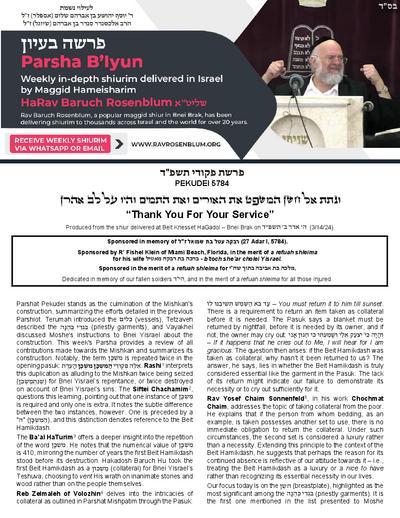
The reason is וְ שָׂ מַ ח בְּ לִ בּ וֹ וְ רָ אֲ ך, but what lies behind that reaction of Aharon’s? Until the moment Aharon met Moshe in the desert, he had served as the Navi in Egypt, communicating messages from Hakadosh Baruch Hu as needed. Upon their meeting, it was as though Hakadosh Baruch Hu conveyed to Aharon, “Thank you for your service. Your younger brother will now take over and lead the nation in every way until they reach Eretz Yisrael.” Despite losing his role, Aharon exhibited no resentment, which led to him being granted a position even higher than that of a Navi – the role associated with the אוּרִ ים וְתֻמִּים. The Gemara explains that while נְבוּאָ ה (prophecy) can be conditional and subject to change – as seen with Ninveh's repentance, preventing its destruction as prophesied to Yonah – messages delivered through the Urim VeTumim always come to fruition. The Abarbanel notes that this distinction might be due to prophecy's potential to speak of events far in the future, while the Urim VeTumim answers immediate, present-day queries.
I would like to take this idea in another direction, Besiyata Dishmaya. Rav Avigdor Nebenzahl questions who wouldn't be overjoyed at their brother's return after 40 or 60 years of separation, especially when bringing news of impending redemption from slavery. Who would not be head over heels upon hearing that hundreds of years of slavery were about to end? Who in their right mind would toss that jubilation aside and lament their personal change in role? Even if it was a complete stranger arriving with the news, there’d be nothing but pure elation. Rav Nebenzahl says, the joy in Aharon’s heart was so great not because his brother had arrived, but because of what it meant for the plight of Bnei Yisrael, and Aharon passed those heartfelt feelings on to his brother. He adds, from the level of joy in Aharon’s heart, we can appreciate the level of pain Am Yisrael were in. To receive the highest level of reward – the Urim VeTumim, which we don’t fully understand – it must mean the tests and tribulations were so great we cannot even begin to understand them.
Rav Chatzkel Levenstein says, Hakadosh Baruch Hu tried convincing Moshe at the burning bush for seven straight days, but Moshe would hear none of it. He refused to go. At the end, Moshe suggested שׁ ְ ל ַ ח נָא בְ יַד תּ ִ שׁ ְ ל ָ ח – Send whomever You may send, pointing out that Aharon was already present and leading the people in Egypt: “What do you need me for? Why is Aharon not good enough? I do not want to step on his toes!” To this, Hakadosh Baruch Hu assured Moshe that Aharon would be supportive and happy for Moshe to assume leadership. If Moshe, upon hearing the first directive, had jumped up and responded, “I’m on my way,” Hakadosh Baruch Hu would not have accepted him for the post. The seven days of negotiations served as a test. Ostensibly, Hakadosh Baruch Hu knows what was in Moshe’s heart, and knows where his genuine concerns lay, but Moshe held onto that detail for seven days before presenting it. For seven days he offered excuses such as his speech impediment and the likelihood of not being understood. Throughout that time, however, Hakadosh Baruch Hu knew the true reason. If the rest of the excuses could be easily mitigated, why was the process dragged out for seven days? Why not pre-empt Moshe and tell him about his brother’s positive reception right away? Rav Levenstein says, this was a seven-day examination of whether Moshe Rabbeinu would agree to step on his brother in order to rescue Bnei Yisrael.
Consider how many people are prepared to step on and disadvantage others as they pursue their own goals and destinations. We don't need to look far for examples; we each have personal experiences to bring to the table. When offered the chance to liberate his people from slavery, Moshe Rabbeinu initially declined, saying, "No thanks." Faced with the prospect of millions escaping harsh labor, he expressed reluctance, stating, "I'm not ready to do that." The ensuing conversation lasted seven days, and ultimately, he protected his brother Aharon. This period was to determine whether Moshe Rabbeinu would, at any moment, forsake his principles, believing it acceptable to diminish his brother's dignity for the sake of the masses, and thinking he could make it up to him in some other way down the road. The descent of Bnei Yisrael into Egypt was precipitated by שִׂ נְאַ ת אַ חִ ים – brotherly hatred. It was imperative that the one to lead them out would not do so by undermining his brother. If the new leader replicated the actions of Yosef's brothers, no lessons would have been learned in Egypt, and no corrections made!
The test presented was twofold: Moshe was assessed on whether he would override his brother's position, and Aharon was evaluated on his capacity to selflessly rejoice in his brother Moshe's assumption of leadership.
From this, we learn that to receive divine answers from the Urim VeTumim, one must complete in both בֵּין אָדָם לַמָּקוֹם and בֵּין אָדָם לְחֲבֵרוֹ – between man and G-d, and between man and his fellow. In Sefer Divrei HaYamim, Aharon is described as: וַיִּבָּדֵל אַהֲרֹן לְהַקְדִּישׁוֹ קֹדֶשׁ קָדָשִׁים – and Aharon was separated, that he should be sanctified as most holy. Shemen Rosh interprets this to reflect these dual aspects. The term קְ ד ֹ שׁ ִ י ם reflects the completeness in one’s relationship with G-d, while ק ֹ דֶ שׁ reflects the completeness in one’s relations with peers. Aharon embodied this dual completeness.
Jealousy is a waste of time. Everyone receives what they deserve and what is coming to them. Wasting time staring at and desiring something belonging to your neighbor is futile, and finding ways to get it is even worse. Hakadosh Baruch Hu has two ways to deal with that – either He takes the item away from you, or He takes you away from the item! There is simply no use in touching something that does not belong to you – if it’s meant to be yours, you’ll receive it. And if not, not.
Sefer B’Yam Derech explains that the act of Kinah – desiring something without possessing it, is futile and easily dismissed, but the longing for something once held and then lost is significantly more intense. A thousand times stronger! When one has experienced the presence of an item or position – almost as if it was divinely intended for them – only to find themselves bereft of it later, the feeling of loss is magnified. This was Aharon's situation. He had held positions of leadership and prophecy, both of which were passed on to his younger brother. Despite this, Aharon's genuine joy upon seeing Moshe was וְ שָׂ מַ ח בְּ לִבּ וֹ וְ רָ אֲ ך. His response, in the face of personal loss, is what defines ק ֹ דֶ שׁ ק ָ דָ שׁ ִ י ם. This is what allowed Aharon to merit the Tumim, and to decipher the letters presented to him. This is something Korach would never be able to achieve, due to his jealousy, and something even Eli HaKohen failed at when he misinterpreted Chana for a drunkard (שׁ ִ כ ּ ֹ רָ ה) vs. being legitimate (כ ּ ְ שׁ ֵ רָ ה), because he lacked empathy for her plight as being childless.
In Ori V’Yishi, a beautiful connection is drawn between אַ הֲ רֹן הַ כּ ֹהֵ ן and פּ ו ּ רִ י ם, noting that both have the same numerical value of 336. Megillat Esther concludes with a Pasuk (כִּ י מׇ רְ דּ ֳ כַ י ְ ה ו ּ דִ י הַ י) that reiterates what we already read. Why do we repeat it? רָ צוּי לְ רֹב אֶ חָ יו – he was accepted but not by all. There were some who blamed him for the whole kerfuffle, saying had he just bowed down to Haman it would have all been over before it even began. This is akin to blaming one of our own for enflaming Hezbollah or Hamas and provoking aggression from them. דֹּרֵ שׁ טוֹב לְעַמּ וֹ – Mordechai said, “Love me or hate me, I will do good for absolutely everyone.” וְ דֹבֵר שׁ ָ לוֹם לְכׇל־זַרְ עוֹ – Everyone was like a child to him. With that, if Mordechai cared for every single member of the people as a child, his trait was just like that of Aharon: אוֹהֵב שׁ ָלוֹם וְרוֹדֵ ף שׁ ָלוֹם, and this is why Mordechai established that we give Mishloach Manot, to foster peace and mend division among the Jewish people. This tradition fixes the strife that existed – including the underlying trait of שִׂ נְאַ ת אַ חִ ים that led to Mechirat Yosef, an original root cause for the evil decree of Haman and Achashverosh. This is why אַ הֲ רֹן הַ כּ ֹהֵ ן and פּ ו ּ רִ י ם are one and the same.
On the upcoming Motzei Shabbat, the 7th of Adar, we commemorate the yahrzeit of Moshe Rabbeinu, known as the עַ מּ וּ דָ א דִּ צְ לוֹ תָ א – the Pillar of Prayer for Bnei Yisrael. Described by Hakadosh Baruch Hu as רָ עֲ יָ א מְ הֵ ימָ נָ א – the Faithful Shepherd, he epitomized the essence of prayer, standing in Tefillah on behalf of the people until he was physically ill and unable to any longer: וַיֵחַל מֹשֶׁה. Throughout his life, Moshe bore the weight of Bnei Yisrael's prayers.
When Yitro inquired how Moshe could bear the burden of the people's constant demands, Moshe Rabbeinu explained their needs: ל ֹהִ ים-יָבֹא אֵלַי הָעָם לִדְ רֹשׁ אֱ כִּ י. This is classically interpreted as inquiries about Torah and Halachot, however, the Ramban (Yitro) says it was far more than that: Because the people come unto me to inquire of G-d, that is, to pray for their sick, and to inform them of the whereabouts of what they have lost,” this being “the inquiring of G-d.” Moshe's role was to intercede with Hakadosh Baruch Hu on behalf of all those in need, and he could not delegate this responsibility to lower judges. This emphasized Moshe as the רָ עֲ יָ א מְ הֵ ימָ נָ א and עַ מּ וּד הַ תְּ פִ לָה – Pillar of Prayer. Even during the grave crisis of Mordechai and Esther's time, when Eliyahu HaNavi sought the Avot’s intercession, it was Moshe who agreed to overlook their transgressions and daven alongside Mordechai to annul the decree against Bnei Yisrael.
We need to know that Moshe Rabbeinu continues to pray for us. During these difficult times we are in, in the South and the North and everywhere in the world where our enemies, yimach shemam, want to לְ הַ שׁ ְ מִ יד לְ הָ רֹג וּלְאַ בֵּ ד אֶ ת כָּל הַ יְה וּ דִ י ם. The only way out is to daven. That is our power to overcome. אִ ם בְּחֻקֹתַי תֵּלֵכוּ – the three redeemers can be found in that first word. מ -א are Aharon and Moshe, who took Bnei Yisrael out of Egypt; Esther and Mordechai, who saved Bnei Yisrael in the time of Purim; and Eliyahu and Mashiach, who will very soon come to redeem us.
As we finish Chumash Shemot and close our circle of learning about the building of the Mishkan, may the complete Beit Hamikdash descend to us from Heaven, and may it be fulfilled in us: חֲזַק חֲזַק וְ נִתְ חַ זֵּק. ◊