The Significance of Moshe Not Entering the Ohel Moed
BET Journal | March 14, 2024
Print This Article
View Original PDF

The Significance of Moshe Not Entering the Ohel Moed

BET Journal | June 27, 2025

ולא יכל משה לבוא אל אהל מועד כי שכן עליו הענן, וכבוד ד' מלא את המשכן (40:35)

“Moshe could not enter the Ohel Moed, for the cloud rested upon it, and the glory of Hashem filled the Mishkan.” What is the significance of the Torah telling us that Moshe could not enter the Ohel Moed?

The Midrash Hagadol says that Moshe was able to go into the Ohel Moed, through the cloud, yet chose not to. If so, why does the Posuk use the words, “לא יכול” – which means that he was not able to?

When one completely accustoms himself to act in a certain way, it becomes part of his nature. So much so, that if he then tries to go against that nature, he is not able to. Moshe Rabbeinu accustomed himself to have complete honor for the Shechinah, and to humble himself, to the extent that as the words say, “He was not able to go in,” for that would have been a lack of Kavod for the Shechinah.

With this understanding, we can explain the words that we have a Minhag to say at a Bris Milah – “כשם שנכנס לברית כן יכנס לתורה ולחופה ולמעשים טובים” – “Just as he entered the Bris, so should he enter Torah, Chuppah, and good deeds (Shabbos 137b)”. Just as one enters the Bris Milah without reservations, for he is a baby, and does it completely Lishmah, so too one should do these without any reservations. The question is – why do we say, “מעשים טובים” – “good deeds”, as opposed to saying Mitzvos?

Before one has a Bris Milah, and after one has a Bris Milah, he is a different person – he is called a Mahul, and entered into the Bris with Hakodosh Boruch Hu and Klal Yisroel. Before one marries, and after he marries, he is a different person – before marriage, he is only considered a half person, and marriage completes him. Before Torah and after Torah, one is a different person – for one who truly learns Torah, makes the Torah his, he as well becomes a part of the Torah. Before good deeds and after good deeds, one is a different person – the one who always does good deeds becomes a Ba’al Chesed – it becomes who he is. We say that just as this boy just became a different person, he became a Mahul, so too he should become a different person through Torah, Chuppah, and Ma’asim Tovim. Mitzvos are different. One must do Mitzvos each time anew – with a new freshness, as opposed to Ma’asim Tovim that are to become the very essence of the person.

The Torah is extolling the true greatness of Moshe Rabbeinu. Moshe Rabbeinu had achieved the highest level a human being could achieve in Ruchniyos. The Shechinah rested upon him. Nonetheless, Moshe still remained humble. He was the leader of Klal Yisroel par excellence, yet remained humble. May we be Zoche to have the Shechinah reside with us once again, with the coming of Moshiach, במהרה בימינו אמן!
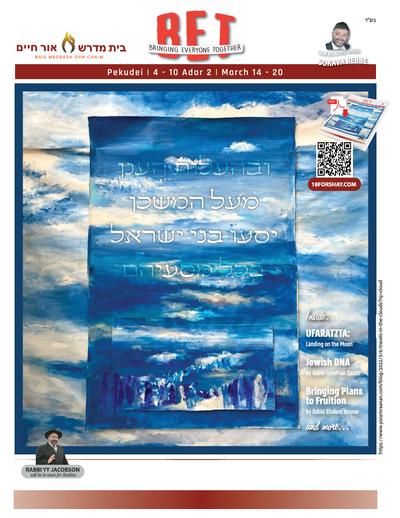
ולא יכל משה לבוא אל אהל מועד כי שכן עליו הענן, וכבוד ד' מלא את המשכן (40:35)

“Moshe could not enter the Ohel Moed, for the cloud rested upon it, and the glory of Hashem filled the Mishkan.” What is the significance of the Torah telling us that Moshe could not enter the Ohel Moed?

The Midrash Hagadol says that Moshe was able to go into the Ohel Moed, through the cloud, yet chose not to. If so, why does the Posuk use the words, “לא יכול” – which means that he was not able to?

When one completely accustoms himself to act in a certain way, it becomes part of his nature. So much so, that if he then tries to go against that nature, he is not able to. Moshe Rabbeinu accustomed himself to have complete honor for the Shechinah, and to humble himself, to the extent that as the words say, “He was not able to go in,” for that would have been a lack of Kavod for the Shechinah.

With this understanding, we can explain the words that we have a Minhag to say at a Bris Milah – “כשם שנכנס לברית כן יכנס לתורה ולחופה ולמעשים טובים” – “Just as he entered the Bris, so should he enter Torah, Chuppah, and good deeds (Shabbos 137b)”. Just as one enters the Bris Milah without reservations, for he is a baby, and does it completely Lishmah, so too one should do these without any reservations. The question is – why do we say, “מעשים טובים” – “good deeds”, as opposed to saying Mitzvos?

Before one has a Bris Milah, and after one has a Bris Milah, he is a different person – he is called a Mahul, and entered into the Bris with Hakodosh Boruch Hu and Klal Yisroel. Before one marries, and after he marries, he is a different person – before marriage, he is only considered a half person, and marriage completes him. Before Torah and after Torah, one is a different person – for one who truly learns Torah, makes the Torah his, he as well becomes a part of the Torah. Before good deeds and after good deeds, one is a different person – the one who always does good deeds becomes a Ba’al Chesed – it becomes who he is. We say that just as this boy just became a different person, he became a Mahul, so too he should become a different person through Torah, Chuppah, and Ma’asim Tovim. Mitzvos are different. One must do Mitzvos each time anew – with a new freshness, as opposed to Ma’asim Tovim that are to become the very essence of the person.

The Torah is extolling the true greatness of Moshe Rabbeinu. Moshe Rabbeinu had achieved the highest level a human being could achieve in Ruchniyos. The Shechinah rested upon him. Nonetheless, Moshe still remained humble. He was the leader of Klal Yisroel par excellence, yet remained humble. May we be Zoche to have the Shechinah reside with us once again, with the coming of Moshiach, במהרה בימינו אמן!

PDF Preview