Introduction
Questions on the Sidra | April 21, 2024
Print This Article
View Original PDF

Introduction

Questions on the Sidra | June 27, 2025

One of the first commandments we received as a People was to celebrate the Festival of Pessach (Passover) so called because Hashem “passed over” (in Hebrew, פסח) our houses when we were in Egypt and spared us whilst in every other house throughout the whole of the land of Egypt there was at least one person killed. This happened on the dot of midnight of the 14th / 15th of Nissan in the year 2448 after Creation, in the dreaded tenth plague, the Smiting of the Firstborn (מכת בכורות) which Hashem brought upon the Egyptians for defying His command to them to let us go free. Since then and through the ages, this night has been for us the symbol of HaShem’s protection of us — throughout the generations many miracles were wrought for us on this night in the month of Nissan, which the Torah itself calls “the night of protective watchfulness.”

But besides being a punishment for the Egyptians, this plague was also a lesson to us to trust in Hashem for we had been commanded to stay indoors and eat the קרבן פסח (the Pascal Lamb) despite the horrible death shrieks of the Egyptians which terrified all.

The next day, in the brightness and openness of midday, we left Egypt. The Egyptians and their king had urged us to go already the night before when they experienced the terrible Plague of the Firstborn, but, as Mosheh our Teacher asked Par’o, “Are we then thieves, to steal out at night?” — in broad daylight and in the sight of all did we leave Egypt.

Urged on by the Egyptians so that we could not even wait till our dough for the journey was risen, all our belongings with us, we left Egypt, a free people. It was on Pessach that we became an independent people. “And it came to pass, at midday of that very day, that Hashem brought out the Children of Israel from the land of Egypt in their ordered groups.”

The Festival of Pessach is the first of the three Pilgrimage Festivals (שלוש רגלים) and its laws and customs are many and intricate. Each law and precept, every symbolism, has its own great and inspiring message; they all add up to the meaning and lesson of the Festival of Pessach, clear to us through all time, namely, that we were delivered by Hashem from slavery and misery and taken to Him in lovingkindness and for all time to be to Him as “a treasure more than all Peoples, a kingdom of princes and a holy Nation.” Our deliverance from Egypt signifies that point in our history when we were dedicated to be the bearers of the Message of Hashem to the world, when we became the People of G-d, the עם ה'. And because it was through this deliverance from Egypt that the Jewish Nation was born, therefore at the start of every Shabbos and Yom Tov which represents our steps forward in our national spiritual life-story, therefore do we make special mention of our great and wonderful beginnings with the words, "זכר ליציאת מצרים", that this Shabbos or Yom Tov is a “remembrance of our going out of Egypt.”
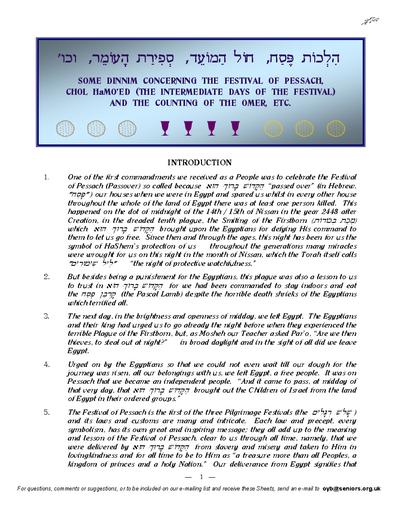
One of the first commandments we received as a People was to celebrate the Festival of Pessach (Passover) so called because Hashem “passed over” (in Hebrew, פסח) our houses when we were in Egypt and spared us whilst in every other house throughout the whole of the land of Egypt there was at least one person killed. This happened on the dot of midnight of the 14th / 15th of Nissan in the year 2448 after Creation, in the dreaded tenth plague, the Smiting of the Firstborn (מכת בכורות) which Hashem brought upon the Egyptians for defying His command to them to let us go free. Since then and through the ages, this night has been for us the symbol of HaShem’s protection of us — throughout the generations many miracles were wrought for us on this night in the month of Nissan, which the Torah itself calls “the night of protective watchfulness.”

But besides being a punishment for the Egyptians, this plague was also a lesson to us to trust in Hashem for we had been commanded to stay indoors and eat the קרבן פסח (the Pascal Lamb) despite the horrible death shrieks of the Egyptians which terrified all.

The next day, in the brightness and openness of midday, we left Egypt. The Egyptians and their king had urged us to go already the night before when they experienced the terrible Plague of the Firstborn, but, as Mosheh our Teacher asked Par’o, “Are we then thieves, to steal out at night?” — in broad daylight and in the sight of all did we leave Egypt.

Urged on by the Egyptians so that we could not even wait till our dough for the journey was risen, all our belongings with us, we left Egypt, a free people. It was on Pessach that we became an independent people. “And it came to pass, at midday of that very day, that Hashem brought out the Children of Israel from the land of Egypt in their ordered groups.”

The Festival of Pessach is the first of the three Pilgrimage Festivals (שלוש רגלים) and its laws and customs are many and intricate. Each law and precept, every symbolism, has its own great and inspiring message; they all add up to the meaning and lesson of the Festival of Pessach, clear to us through all time, namely, that we were delivered by Hashem from slavery and misery and taken to Him in lovingkindness and for all time to be to Him as “a treasure more than all Peoples, a kingdom of princes and a holy Nation.” Our deliverance from Egypt signifies that point in our history when we were dedicated to be the bearers of the Message of Hashem to the world, when we became the People of G-d, the עם ה'. And because it was through this deliverance from Egypt that the Jewish Nation was born, therefore at the start of every Shabbos and Yom Tov which represents our steps forward in our national spiritual life-story, therefore do we make special mention of our great and wonderful beginnings with the words, "זכר ליציאת מצרים", that this Shabbos or Yom Tov is a “remembrance of our going out of Egypt.”
PDF Preview