Leaning All Together
A kindergarten teacher was teaching her students about the Israelites finally being freed from slavery from Miztrayim, re-enacting the Exodus by leading them out of the room. Turning to them, she said, “Let’s go! Don’t you all want to be free?”
A little girl raised her hand and, with a sad face, said, “I don’t want to be free.”
Concerned, the teacher asked the little girl, “Why don’t you want to be free?”
The girl replied, “I don’t want to be free 'cause I just turned four.”
(True story, as heard from the teacher)
In the early 90s, while teaching 1st grade in Pittsburgh, I had the unique challenge of teaching the Passover “Ma Nishtana”—commonly known as “The 4 Questions”—to students of various backgrounds in both Hebrew and Yiddish. This made it quite challenging. All four questions ask, “On all other nights we ______, but on this night, we ______.”
As there are two customs for the order of these four questions, this required me to print out 2 versions of the Ma Nishtana, furthering this challenge.
The Ashkenaz version order of the Ma Nishtana is:
- Matzah
- Maror
- Dipping
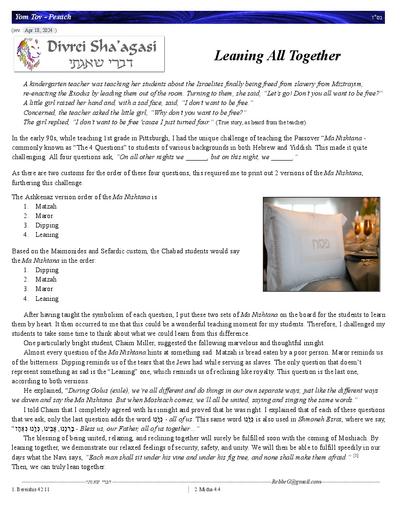
- Leaning
Based on the Maimonides and Sefardic custom, the Chabad students would say the Ma Nishtana in the order:
- Dipping
- Matzah
- Maror
- Leaning
After having taught the symbolism of each question, I put these two sets of Ma Nishtana on the board for the students to learn them by heart. It then occurred to me that this could be a wonderful teaching moment for my students. Therefore, I challenged my students to take some time to think about what we could learn from this difference.
One particularly bright student, Chaim Miller, suggested the following marvelous and thoughtful insight.
Almost every question of the Ma Nishtana hints at something sad. Matzah is bread eaten by a poor person. Maror reminds us of the bitterness. Dipping reminds us of the tears that the Jews had while serving as slaves. The only question that doesn’t represent something as sad is the “Leaning” one, which reminds us of reclining like royalty. This question is the last one, according to both versions.
He explained, “During Golus (exile), we’re all different and do things in our own separate ways, just like the different ways we daven and say the Ma Nishtana. But when Moshiach comes, we’ll all be united, saying and singing the same words.”
I told Chaim that I completely agreed with his insight and proved that he was right. I explained that of each of these questions that we ask, only the last question adds the word ָֽנוֻּלּכּ—all of us. This same word ָֽנוֻּלּכּ is also used in Shmoneh Esrai, where we say, “ֵֽנוּ,ְ כָרבִּֽינוּ,אָבָֽנוֻּלּכָּדֶחְאכּ—Bless us, our Father, all of us together...”
The blessing of being united, relaxing, and reclining together will surely be fulfilled soon with the coming of Moshiach. By leaning together, we demonstrate our relaxed feelings of security, safety, and unity. We will then be able to fulfill speedily in our days what the Navi says, “Each man shall sit under his vine and under his fig tree, and none shall make them afraid.”[1]
Then, we can truly lean together.
1. Bereishis 42:11 2. Micha 4:4
Related Articles