Yemei HaSefirah A Period of Religious Mourning
Questions on the Sidra | April 21, 2024
Print This Article
View Original PDF

Yemei HaSefirah A Period of Religious Mourning

Questions on the Sidra | June 27, 2025

Although in reality the period after Pessach leading up to Shovuos should be a time of joy when we relive the happy anticipation for the Receiving of the Torah, nevertheless this joy is for us somewhat dimmed and indeed this period has been transformed, to a degree, into a sad time for it was between Pessach and Shovuos that many thousands of Rabbi Akiva’s pupils died in an epidemic. Because the death of a Tzaddik is considered by us to be a catastrophe and all the more so is the death of many, many Tzaddikim, therefore during the time of the Sefiras Ha’Omer we observe certain forms of mourning. Exactly on which days they died is not known: what is known is that the epidemic lasted thirty-three days and also that on Lag b’Omer (that is, the thirty-third day of the Omer) the terrible plague was suspended. For this reason, the period of public mourning that we observe varies with the custom of the community to which one belongs. In addition, events in our history have unfortunately reinforced this time of year as a time of calamity and mourning. For instance, many of the massacres of the Middle Ages, when hundreds of Jewish communities were cruelly wiped out by the Christians in their Crusades, happened in the time between Pessach and Shovuos. Some observe as this period of religious mourning the first thirty-three days of the Omer. Others observe the period from Rosh Chodesh Iyyar until three days before Shovuos. And yet others observe from after Rosh Chodesh Iyyar until Erev Shovuos. In any case, in those places where there is a recognized tradition and the people are particular about keeping those traditions faithfully, it is important that everyone complies with the custom of the community and avoids any kind of strife.

Marriages do not take place during this sad time and hair-cutting and shaving are not allowed, as for a mourner. (Only in certain special circumstances might it be allowed to shave, but a Rav must be consulted to ascertain whether or not one falls into the category of people who are permitted to shave. Contrary to common belief and practice, shaving during Sefirah time is not allowed ordinarily.) Various other manifestations of joy are also suspended during this time, but a סְ ילָ מִ יתרִ בְּ תדַ עוה and a סְ דַעוְ ת תיםאִ נָ etc., are allowed. In any case we do not generally allow the original happiness of this time of year to be completely eclipsed by the sad events of a later time.

And then, with the approach of the Festival of Shovuos we prepare ourselves to meet this Yom Tov with serene happiness, and we make ready to rejoice on this wonderful Yom Tov, when at once with quiet, inner joy and awe we received, and do receive every year anew, from ָ דוֹ שׁ הַ ק בָּ רו ך הו א that most precious and beautiful gift, the Holy Torah, through which by His grace and lovingkindness He sanctifies us, His People Yisroel.
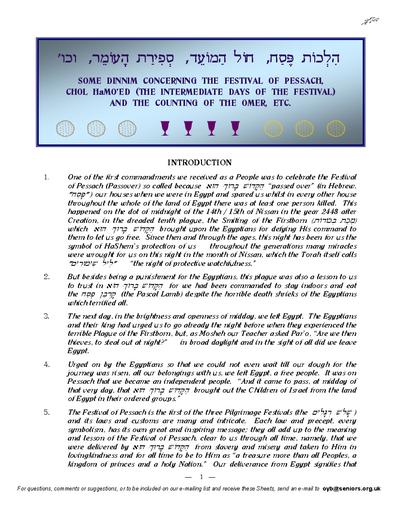

Although in reality the period after Pessach leading up to Shovuos should be a time of joy when we relive the happy anticipation for the Receiving of the Torah, nevertheless this joy is for us somewhat dimmed and indeed this period has been transformed, to a degree, into a sad time for it was between Pessach and Shovuos that many thousands of Rabbi Akiva’s pupils died in an epidemic. Because the death of a Tzaddik is considered by us to be a catastrophe and all the more so is the death of many, many Tzaddikim, therefore during the time of the Sefiras Ha’Omer we observe certain forms of mourning. Exactly on which days they died is not known: what is known is that the epidemic lasted thirty-three days and also that on Lag b’Omer (that is, the thirty-third day of the Omer) the terrible plague was suspended. For this reason, the period of public mourning that we observe varies with the custom of the community to which one belongs. In addition, events in our history have unfortunately reinforced this time of year as a time of calamity and mourning. For instance, many of the massacres of the Middle Ages, when hundreds of Jewish communities were cruelly wiped out by the Christians in their Crusades, happened in the time between Pessach and Shovuos. Some observe as this period of religious mourning the first thirty-three days of the Omer. Others observe the period from Rosh Chodesh Iyyar until three days before Shovuos. And yet others observe from after Rosh Chodesh Iyyar until Erev Shovuos. In any case, in those places where there is a recognized tradition and the people are particular about keeping those traditions faithfully, it is important that everyone complies with the custom of the community and avoids any kind of strife.

Marriages do not take place during this sad time and hair-cutting and shaving are not allowed, as for a mourner. (Only in certain special circumstances might it be allowed to shave, but a Rav must be consulted to ascertain whether or not one falls into the category of people who are permitted to shave. Contrary to common belief and practice, shaving during Sefirah time is not allowed ordinarily.) Various other manifestations of joy are also suspended during this time, but a סְ ילָ מִ יתרִ בְּ תדַ עוה and a סְ דַעוְ ת תיםאִ נָ etc., are allowed. In any case we do not generally allow the original happiness of this time of year to be completely eclipsed by the sad events of a later time.

And then, with the approach of the Festival of Shovuos we prepare ourselves to meet this Yom Tov with serene happiness, and we make ready to rejoice on this wonderful Yom Tov, when at once with quiet, inner joy and awe we received, and do receive every year anew, from ָ דוֹ שׁ הַ ק בָּ רו ך הו א that most precious and beautiful gift, the Holy Torah, through which by His grace and lovingkindness He sanctifies us, His People Yisroel.

PDF Preview