And the sons of Korach did not die
מגדל אור | July 24, 2024
Print This Article
View Original PDF

And the sons of Korach did not die

מגדל אור | June 25, 2025

(AY:WK RBDMB) ‰.WTM AL XRQ YNBW‰
“And the sons of Korach did not die. (Bamidbar 26:11)”

After the plague that killed twenty-four thousand Jews, which was stopped by Pinchas’s zealotry in defending the honor of Hashem by killing Zimri who publicly sinned, Hashem issued the command for Moshe and Elazar the Kohain to take a count of the Jews from the age of twenty and above.

Chazal give two reasons for the counting, as Rashi tells us. The first was because after so many died, there was a need to see how many were left. He likens this to a shepherd whose sheep have been attacked by a wolf. He counts them afterwards to take stock of his losses and what remains.

The second reason is, again likened to a shepherd, that the Jews were entrusted to Moshe with a precise number, so, when he is about to return the flock to its master, Hashem, they are counted to see how good of a job he has done in caring for them. He returns them with a number as well.

If the purpose was purely to see how many people there were, then it is curious that the Torah seems to go on numerous tangents. For example, when counting the children of Reuven, it goes into detail that Dasan and Aviram and all their descendants died. Why is that relevant if they’re not here anymore? Further, immediately afterwards, it tells us the sons of Korach did not die - but being Levites, they were not included in this count anyway! The sons of Yehuda, Er and Onan, are mentioned, but it follows through to say they died in Canaan. Why are they mentioned if they were never part of those who left Egypt at all?

(The Ohr HaChaim does expound upon this posuk, and offers symbolism about the destruction of the Bais HaMikdash, quite relevant to this period of the year. See there for more.)

The daughters of Tzelophchad and Serach bas Asher are also singled out for mention, once again, seemingly not germane to either of the reasons Rashi quoted for the census.

Perhaps, though, we can understand that the idea of this counting of the Jews was not merely to know how many were alive at that moment. It was not simply a matter of WHO was there, but HOW. The Torah wanted us to reflect on why we are here, and what is expected of us.

Dasan and Aviram were quarrel mongers who destroyed everything they had. However, the children of Korach, who had thoughts of repentance, did not die. Had they done more, they would have “lived.” Er and Onan were wicked in Hashem’s eyes. They died early, and left no remnant. In contrast, the daughters of Tzelophchad loved the land of Israel so much that they spoke up and asked for a share. Serach was kind and tactful.

It may be that while knowing how many Jews were left was crucial, and how they had been cared for by Moshe, understanding what made up the character of the Jews Moshe returned to Hashem’s guidance teaches us how we are to live our lives – by making positive improvements in our relationships with Hashem and with our fellow Jews.

A delegation was sent from Brisk to convince the Bais HaLevi to become their new Rav. After making their presentation, the Bais HaLevi refused to accept the position. No argument would persuade him, until one member of the delegation said that 20,000 Jews are waiting for him in Brisk. When the Bais HaLevi heard this, he said he cannot disappoint 20,000 Jews and immediately accepted the position.

The Chofetz Chaim, upon hearing this story, burst into tears. He said if this is how a Tzaddik like the Bais HaLevi feels, certainly Moshiach would also come if 20,000 Jews were waiting for him. Apparently, there aren't that many.

©2024 – J. Gewirtz
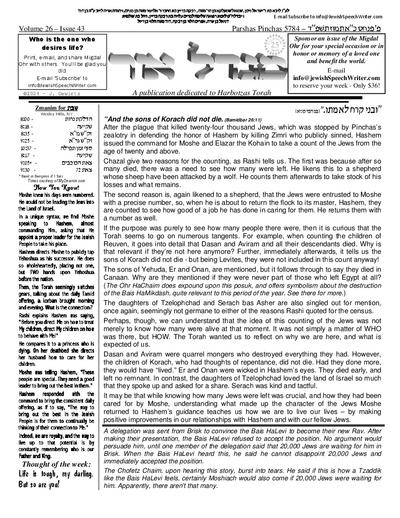
(AY:WK RBDMB) ‰.WTM AL XRQ YNBW‰
“And the sons of Korach did not die. (Bamidbar 26:11)”

After the plague that killed twenty-four thousand Jews, which was stopped by Pinchas’s zealotry in defending the honor of Hashem by killing Zimri who publicly sinned, Hashem issued the command for Moshe and Elazar the Kohain to take a count of the Jews from the age of twenty and above.

Chazal give two reasons for the counting, as Rashi tells us. The first was because after so many died, there was a need to see how many were left. He likens this to a shepherd whose sheep have been attacked by a wolf. He counts them afterwards to take stock of his losses and what remains.

The second reason is, again likened to a shepherd, that the Jews were entrusted to Moshe with a precise number, so, when he is about to return the flock to its master, Hashem, they are counted to see how good of a job he has done in caring for them. He returns them with a number as well.

If the purpose was purely to see how many people there were, then it is curious that the Torah seems to go on numerous tangents. For example, when counting the children of Reuven, it goes into detail that Dasan and Aviram and all their descendants died. Why is that relevant if they’re not here anymore? Further, immediately afterwards, it tells us the sons of Korach did not die - but being Levites, they were not included in this count anyway! The sons of Yehuda, Er and Onan, are mentioned, but it follows through to say they died in Canaan. Why are they mentioned if they were never part of those who left Egypt at all?

(The Ohr HaChaim does expound upon this posuk, and offers symbolism about the destruction of the Bais HaMikdash, quite relevant to this period of the year. See there for more.)

The daughters of Tzelophchad and Serach bas Asher are also singled out for mention, once again, seemingly not germane to either of the reasons Rashi quoted for the census.

Perhaps, though, we can understand that the idea of this counting of the Jews was not merely to know how many were alive at that moment. It was not simply a matter of WHO was there, but HOW. The Torah wanted us to reflect on why we are here, and what is expected of us.

Dasan and Aviram were quarrel mongers who destroyed everything they had. However, the children of Korach, who had thoughts of repentance, did not die. Had they done more, they would have “lived.” Er and Onan were wicked in Hashem’s eyes. They died early, and left no remnant. In contrast, the daughters of Tzelophchad loved the land of Israel so much that they spoke up and asked for a share. Serach was kind and tactful.

It may be that while knowing how many Jews were left was crucial, and how they had been cared for by Moshe, understanding what made up the character of the Jews Moshe returned to Hashem’s guidance teaches us how we are to live our lives – by making positive improvements in our relationships with Hashem and with our fellow Jews.

A delegation was sent from Brisk to convince the Bais HaLevi to become their new Rav. After making their presentation, the Bais HaLevi refused to accept the position. No argument would persuade him, until one member of the delegation said that 20,000 Jews are waiting for him in Brisk. When the Bais HaLevi heard this, he said he cannot disappoint 20,000 Jews and immediately accepted the position.

The Chofetz Chaim, upon hearing this story, burst into tears. He said if this is how a Tzaddik like the Bais HaLevi feels, certainly Moshiach would also come if 20,000 Jews were waiting for him. Apparently, there aren't that many.

©2024 – J. Gewirtz

PDF Preview