Halachos of Inheritance
חוקי חיים | July 01, 2026
Print This Article
View Original PDF

Halachos of Inheritance

חוקי חיים | June 28, 2026

Knowing the Basics of the Halachos of Inheritance

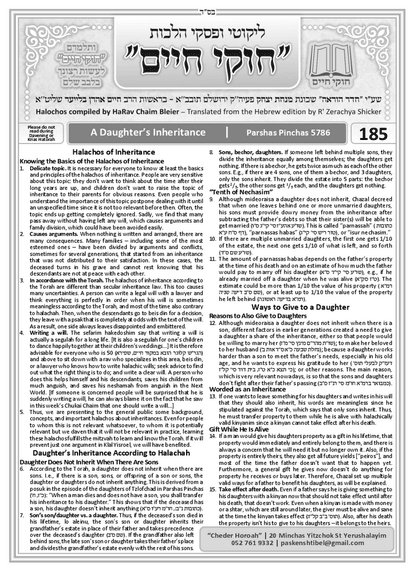
1. Delicate topic. It is necessary for everyone to know at least the basics and principles of the halachos of inheritance. People are very sensitive about this topic: they don’t want to think about the time after their long years are up, and children don’t want to raise the topic of inheritance to their parents for obvious reasons. Even people who understand the importance of this topic postpone dealing with it until an unspecified time since it is not too relevant before then. Often, the topic ends up getting completely ignored. Sadly, we find that many pass away without having left any will, which causes arguments and family division, which could have been avoided easily.

2. Causes arguments. When nothing is written and arranged, there are many consequences. Many families – including some of the most esteemed ones – have been divided by arguments and conflicts, sometimes for several generations, that started from an inheritance that was not distributed to their satisfaction. In these cases, the deceased turns in his grave and cannot rest knowing that his descendants are not at peace with each other.

3. In accordance with the Torah. The halachos of inheritance according to the Torah are different than secular inheritance law. This too causes many uncertainties. A person can write a legal will with a lawyer and think everything is perfectly in order when his will is sometimes meaningless according to the Torah, and most of the time also contrary to halachah. Then, when the descendants go to beis din for a decision, they leave with a psak that is completely at odds with the text of the will. As a result, one side always leaves disappointed and embittered.

4. Writing a will. The sefarim hakedoshim say that writing a will is actually a segulah for a long life. [It is also a segulah for one’s children to dance happily together at their children’s weddings…] It is therefore advisable for everyone who is 50 and above to sit down with a rav who specializes in this area, beis din, or a lawyer who knows how to write halachic wills; seek advice to find out what the right thing is to do; and write a clear will. A person who does this helps himself and his descendants, saves his children from much anguish, and saves his neshamah from anguish in the Next World. [If someone is concerned people will be surprised that he is suddenly writing a will, he can always blame it on the fact that he saw in this week’s Chukai Chaim that one should write a will…]

5. Thus, we are presenting to the general public some background, concepts, and important halachos about inheritances. Even for people to whom this is not relevant whatsoever, to whom it is potentially relevant but we daven that it will not be relevant in practice, learning these halachos fulfills the mitzvah to learn and know the Torah. If it will prevent just one argument in Klal Yisroel, we will have benefited.
Knowing the Basics of the Halachos of Inheritance

1. Delicate topic. It is necessary for everyone to know at least the basics and principles of the halachos of inheritance. People are very sensitive about this topic: they don’t want to think about the time after their long years are up, and children don’t want to raise the topic of inheritance to their parents for obvious reasons. Even people who understand the importance of this topic postpone dealing with it until an unspecified time since it is not too relevant before then. Often, the topic ends up getting completely ignored. Sadly, we find that many pass away without having left any will, which causes arguments and family division, which could have been avoided easily.

2. Causes arguments. When nothing is written and arranged, there are many consequences. Many families – including some of the most esteemed ones – have been divided by arguments and conflicts, sometimes for several generations, that started from an inheritance that was not distributed to their satisfaction. In these cases, the deceased turns in his grave and cannot rest knowing that his descendants are not at peace with each other.

3. In accordance with the Torah. The halachos of inheritance according to the Torah are different than secular inheritance law. This too causes many uncertainties. A person can write a legal will with a lawyer and think everything is perfectly in order when his will is sometimes meaningless according to the Torah, and most of the time also contrary to halachah. Then, when the descendants go to beis din for a decision, they leave with a psak that is completely at odds with the text of the will. As a result, one side always leaves disappointed and embittered.

4. Writing a will. The sefarim hakedoshim say that writing a will is actually a segulah for a long life. [It is also a segulah for one’s children to dance happily together at their children’s weddings…] It is therefore advisable for everyone who is 50 and above to sit down with a rav who specializes in this area, beis din, or a lawyer who knows how to write halachic wills; seek advice to find out what the right thing is to do; and write a clear will. A person who does this helps himself and his descendants, saves his children from much anguish, and saves his neshamah from anguish in the Next World. [If someone is concerned people will be surprised that he is suddenly writing a will, he can always blame it on the fact that he saw in this week’s Chukai Chaim that one should write a will…]

5. Thus, we are presenting to the general public some background, concepts, and important halachos about inheritances. Even for people to whom this is not relevant whatsoever, to whom it is potentially relevant but we daven that it will not be relevant in practice, learning these halachos fulfills the mitzvah to learn and know the Torah. If it will prevent just one argument in Klal Yisroel, we will have benefited.

PDF Preview