Inheritance According to Halachah or the Courts?
חוקי חיים | July 01, 2026
Print This Article
View Original PDF

Inheritance According to Halachah or the Courts?

חוקי חיים | June 28, 2026

Only According to Halachah

26. The halachos of inheritance are determined by the Torah, not the courts. Dina demalchusa dina does not apply, whether with respect to a husband’s inheritance (Rema 281), a bechor’s double share, or a daughter’s inheritance (Minchas Yitzchok 2:95; Teshuvos Chashev HaEphod 3:50).

Daughters’ Obligation to Sign a Waiver for the Sons’ Benefit

27. It often happens that a father did not write a will, in which case the sons and daughters really have to divide the estate according to halachah. According to secular law, however, a daughter inherits just like a son. In order to register the properties in the sons’ names or to unfreeze the estate, bank accounts, and the like, they need to get an order of inheritance [or “probate/succession order”] signed by the courts. To get this, the daughters need to sign a statement that they legally forgo their share of the inheritance for the sons’ benefit. The poskim discuss whether or not the daughters must sign this waiver.

28. They must sign. Some say the daughters must sign this waiver without any monetary claim due to the obligation of hashavas aveidah (Maharit; Chasam Sofer Choshen Mishpat 142) or because of the principle of “kofin al midas Sedom” (Maharia HaLevi 2:127).

29. They do not need to sign. Others say they do not need to sign a waiver for their brothers without monetary compensation (Mahari Bassan; Panei Moshe 2:66; Divrei Chaim Choshen Mishpat 2:3).

30. Bank vs. property. Some poskim differentiate between a bank account and property. A bank account cannot be utilized by the sons at all without the daughters’ signatures, so they must sign due to the halachos of hashavas aveidah. However, the daughters can keep properties in their names while allowing the sons to utilize them by collecting rent or even selling them. In this way, there is no loss that they need to return. However, a property is not worth as much when it is in someone else’s name. If the sons want the daughters to sign a waiver to increase the property’s value, the daughters can demand some money as a compromise (Teshuvos VeHanhagos 1:854).

31. “Kim li.” Several poskim hold that the daughters can say “Kim li” [“We hold”] like the poskim who say daughters have the right to demand money in exchange for their signatures and cannot be forced to sign without a monetary settlement (Minchas Yitzchok 2:95).

32. Compromise. Due to all the above, many poskim suggest that the sons should concede something to the daughters to get their signatures (Pischi Choshen 1:4; Rav Pe’alim 2:15), but this is not something that is strictly followed; sometimes they only give something small. They should consult a dayan. This is another reason to write an organized will: to avoid all the uncertainty, fights, and unpleasantness that these matters cause between brothers and sisters (Sedeh Elchanan 32).

33. A claim in court. It should be noted that all the above is only when the authorities freeze the estate until the daughters release it with their signatures. If, however, the properties are not frozen and do not need the daughters’ signatures, it is completely assur for the daughters to submit a claim in court for the rights to a share of the estate or to use such a threat as leverage to force the sons to compromise.

34. Even if the courts notify the daughters that they have until a certain time to claim the estate, and if they do not claim it by then, it will automatically go to the sons, they may not submit a claim for their right to the inheritance (Minchas Yitzchok 2:85).
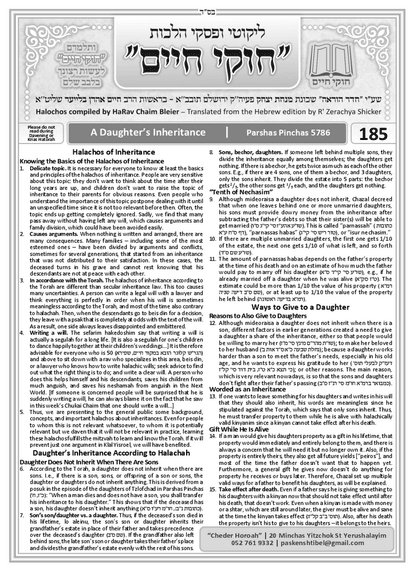
Only According to Halachah

26. The halachos of inheritance are determined by the Torah, not the courts. Dina demalchusa dina does not apply, whether with respect to a husband’s inheritance (Rema 281), a bechor’s double share, or a daughter’s inheritance (Minchas Yitzchok 2:95; Teshuvos Chashev HaEphod 3:50).

Daughters’ Obligation to Sign a Waiver for the Sons’ Benefit

27. It often happens that a father did not write a will, in which case the sons and daughters really have to divide the estate according to halachah. According to secular law, however, a daughter inherits just like a son. In order to register the properties in the sons’ names or to unfreeze the estate, bank accounts, and the like, they need to get an order of inheritance [or “probate/succession order”] signed by the courts. To get this, the daughters need to sign a statement that they legally forgo their share of the inheritance for the sons’ benefit. The poskim discuss whether or not the daughters must sign this waiver.

28. They must sign. Some say the daughters must sign this waiver without any monetary claim due to the obligation of hashavas aveidah (Maharit; Chasam Sofer Choshen Mishpat 142) or because of the principle of “kofin al midas Sedom” (Maharia HaLevi 2:127).

29. They do not need to sign. Others say they do not need to sign a waiver for their brothers without monetary compensation (Mahari Bassan; Panei Moshe 2:66; Divrei Chaim Choshen Mishpat 2:3).

30. Bank vs. property. Some poskim differentiate between a bank account and property. A bank account cannot be utilized by the sons at all without the daughters’ signatures, so they must sign due to the halachos of hashavas aveidah. However, the daughters can keep properties in their names while allowing the sons to utilize them by collecting rent or even selling them. In this way, there is no loss that they need to return. However, a property is not worth as much when it is in someone else’s name. If the sons want the daughters to sign a waiver to increase the property’s value, the daughters can demand some money as a compromise (Teshuvos VeHanhagos 1:854).

31. “Kim li.” Several poskim hold that the daughters can say “Kim li” [“We hold”] like the poskim who say daughters have the right to demand money in exchange for their signatures and cannot be forced to sign without a monetary settlement (Minchas Yitzchok 2:95).

32. Compromise. Due to all the above, many poskim suggest that the sons should concede something to the daughters to get their signatures (Pischi Choshen 1:4; Rav Pe’alim 2:15), but this is not something that is strictly followed; sometimes they only give something small. They should consult a dayan. This is another reason to write an organized will: to avoid all the uncertainty, fights, and unpleasantness that these matters cause between brothers and sisters (Sedeh Elchanan 32).

33. A claim in court. It should be noted that all the above is only when the authorities freeze the estate until the daughters release it with their signatures. If, however, the properties are not frozen and do not need the daughters’ signatures, it is completely assur for the daughters to submit a claim in court for the rights to a share of the estate or to use such a threat as leverage to force the sons to compromise.

34. Even if the courts notify the daughters that they have until a certain time to claim the estate, and if they do not claim it by then, it will automatically go to the sons, they may not submit a claim for their right to the inheritance (Minchas Yitzchok 2:85).

PDF Preview