The name of the Israelite man, who was smitten with the Midianite woman
מגדל אור | June 30, 2026
Print This Article
View Original PDF

The name of the Israelite man, who was smitten with the Midianite woman

מגדל אור | July 13, 2025

“The name of the Israelite man, who was smitten with the Midianite woman, was Zimri ben Solu, chief of a father’s house of the Tribe of Shimon.” (Bamidbar 25:14)

A careful reading of this and the next verse will yield an anomaly, in that there is a distinctive change in syntax when the Torah discusses the male and female participants in the horrific sin which Pinchas ended. Here it refers first to the nationality, then the gender, and then gives the name of Zimri. In the next posuk, it says her gender, then her nationality, then gives the name Cozbi.

It also repeats the word smitten twice by Zimri, but only once by Cozbi. The meforshim, including the Ohr HaChaim and the Kli Yakar discuss these differences, and explain they are not random or without meaning.

In essence, everyone has both a personal and a national identity. However, for the Jew, the national identity takes precedence. Their existence as a part of the Jewish People is overriding to their existence as an individual. Their behavior, therefore, must reflect this basic difference. Being true to yourself means being true to who you are as part of the Jewish People, and only then following what you believe to be your personal “truth.”

Zimri’s sin was categorically different than Cozbi’s. She had the right to choose her own behavior. The fact that she came from an aristocratic family only highlighted the hatred Midian had for the Jews, that they would allow an individual of lofty status to be the catalyst to bring the Jews to sin. But she was a solitary woman, doing what she wanted.

Zimri, however, defied his own status with his act. He did not act as a Jewish man, thereby denying his essence, a product of his proximity to Cozbi. But though he did this, he was not able to completely eradicate his status. After the sin was over and atoned for by his death, the Torah tells us, “He was an Israelite man.” Chazal tell us, (Sanhedrin 44a) “Chata Yisrael: af al pi she’chata, Yisrael hu – a Jew, though he sins, is still a Jew.”

The Jewish soul remains pure and untouched, even when it is caked with sin like so much mud. One cannot remove himself from his Jewish connection even though he makes bad choices. At the end, his soul, once cleansed through whatever means are necessary, will remain part of the Jewish People and of Hashem.

Even Zimri, who publicly desecrated Hashem’s name, could not sever his connection with Klal Yisrael. His personal identity still took a backseat to his national one. So it is with each of us. We should try to live up to our roles as members of Klal Yisrael, because at the end of the day, that will never go away. We will remain beloved and necessary members of the royal family of Hashem, no matter how hard we try to abdicate.

Rabbi Y.Y. Jacobson tells the moving story of the Seret-Vizhnitzer Rebbe, whose Friday-night tisch (a communal meal) was attended by a struggling young man. The boy had strayed from his Chasidic roots, but still returned on this Friday night to the table of the Rebbe.

When the Rebbe wished him, “Good Shabbos,” the boy told him, “I drove here tonight, in a car.” He did not expect what happened next. The Rebbe grabbed him and held him in a warm embrace. He said, (in Yiddish,) “My child, you can come here whenever you want, and however you want!”

People nearby were surprised that he didn’t at least ask the boy not to drive there next time. But the Rebbe saw what they didn’t see. He saw the boy was looking for proof that he didn’t belong. “I was sure he would tell me I was too far gone; that I’d cut myself off. Instead, he made me aware that it wasn’t possible, and that I would always have a place at his tisch.”
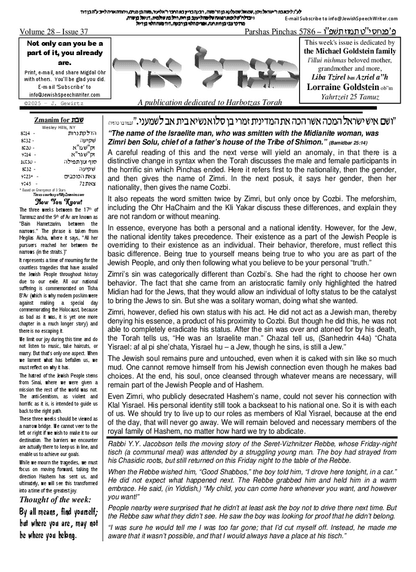
“The name of the Israelite man, who was smitten with the Midianite woman, was Zimri ben Solu, chief of a father’s house of the Tribe of Shimon.” (Bamidbar 25:14)

A careful reading of this and the next verse will yield an anomaly, in that there is a distinctive change in syntax when the Torah discusses the male and female participants in the horrific sin which Pinchas ended. Here it refers first to the nationality, then the gender, and then gives the name of Zimri. In the next posuk, it says her gender, then her nationality, then gives the name Cozbi.

It also repeats the word smitten twice by Zimri, but only once by Cozbi. The meforshim, including the Ohr HaChaim and the Kli Yakar discuss these differences, and explain they are not random or without meaning.

In essence, everyone has both a personal and a national identity. However, for the Jew, the national identity takes precedence. Their existence as a part of the Jewish People is overriding to their existence as an individual. Their behavior, therefore, must reflect this basic difference. Being true to yourself means being true to who you are as part of the Jewish People, and only then following what you believe to be your personal “truth.”

Zimri’s sin was categorically different than Cozbi’s. She had the right to choose her own behavior. The fact that she came from an aristocratic family only highlighted the hatred Midian had for the Jews, that they would allow an individual of lofty status to be the catalyst to bring the Jews to sin. But she was a solitary woman, doing what she wanted.

Zimri, however, defied his own status with his act. He did not act as a Jewish man, thereby denying his essence, a product of his proximity to Cozbi. But though he did this, he was not able to completely eradicate his status. After the sin was over and atoned for by his death, the Torah tells us, “He was an Israelite man.” Chazal tell us, (Sanhedrin 44a) “Chata Yisrael: af al pi she’chata, Yisrael hu – a Jew, though he sins, is still a Jew.”

The Jewish soul remains pure and untouched, even when it is caked with sin like so much mud. One cannot remove himself from his Jewish connection even though he makes bad choices. At the end, his soul, once cleansed through whatever means are necessary, will remain part of the Jewish People and of Hashem.

Even Zimri, who publicly desecrated Hashem’s name, could not sever his connection with Klal Yisrael. His personal identity still took a backseat to his national one. So it is with each of us. We should try to live up to our roles as members of Klal Yisrael, because at the end of the day, that will never go away. We will remain beloved and necessary members of the royal family of Hashem, no matter how hard we try to abdicate.

Rabbi Y.Y. Jacobson tells the moving story of the Seret-Vizhnitzer Rebbe, whose Friday-night tisch (a communal meal) was attended by a struggling young man. The boy had strayed from his Chasidic roots, but still returned on this Friday night to the table of the Rebbe.

When the Rebbe wished him, “Good Shabbos,” the boy told him, “I drove here tonight, in a car.” He did not expect what happened next. The Rebbe grabbed him and held him in a warm embrace. He said, (in Yiddish,) “My child, you can come here whenever you want, and however you want!”

People nearby were surprised that he didn’t at least ask the boy not to drive there next time. But the Rebbe saw what they didn’t see. He saw the boy was looking for proof that he didn’t belong. “I was sure he would tell me I was too far gone; that I’d cut myself off. Instead, he made me aware that it wasn’t possible, and that I would always have a place at his tisch.”

PDF Preview