The Whole Picture
זכרו תורת משה | July 01, 2026
Print This Article
View Original PDF

The Whole Picture

זכרו תורת משה | July 21, 2024

On Sunday of Parshas Tzav, 5786, shortly before Pesach, Rabbi Yitzchak Kaufman, editor of the Spring Hill Times, received a request from a ger tzedek in Eretz Yisrael, requesting help for his Yom Tov expenses.

At the time, Rabbi Kaufman was facing a significant personal financial strain — over $14,000 in expenses, with $3,000 due imminently. His initial instinct was to decline the ger tzedek’s plea for help. But something held Rabbi Kaufman from immediately doing so. He had just finished editing a story for the Spring Hill Times, and its message lingered.

The story was that two years earlier, a boy in his shul, Moshe Friedman, had shared a simple but powerful experience. His brother had been collecting on behalf of Yeshiva Bais Dovid in Monsey and asked him for a donation. Moshe thought to himself, “It says ‘U’vichanuni na b’zos,’ that Hashem promises repayment for tzedakah. So, I’ll give a dollar, and Hashem will send it back.” Moshe therefore gave his brother a dollar.

The very next morning, Moshe put on tefillin for the first time. A bochur approached him and handed him a dollar in honor of his hanachas tefillin.

That story of simple reliance on Hashem had stayed with Rabbi Kaufman. Drawing strength from it, he decided to send the ger tzedek $1,000 for his Yom Tov expenses, and in an act of quiet bitachon, Rabbi Kaufman wrote “Hashem” across the invoice, as if placing the burden of repayment directly in His hands.

The following Sunday, Rabbi Kaufman received two $1,000 checks, each from two completely unexpected sources — double what he had given.

Yet, he still needed much more to get out of the red. He turned to Hashem again, this time invoking the words: “ad bli dai.”

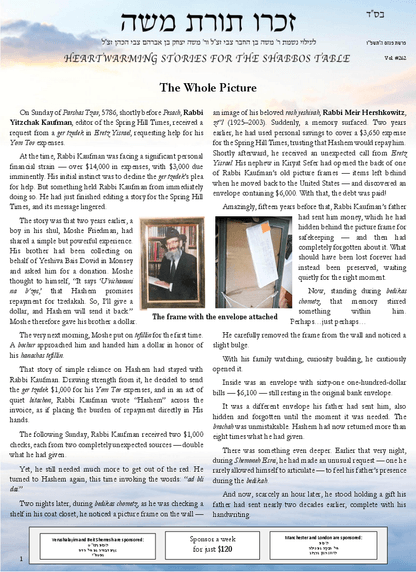
Two nights later, during bedikas chometz, as he was checking a shelf in his coat closet, he noticed a picture frame on the wall — an image of his beloved rosh yeshivah, Rabbi Meir Hershkowitz, zt”l (1925–2003). Suddenly, a memory surfaced. Two years earlier, he had used personal savings to cover a $3,650 expense for the Spring Hill Times, trusting that Hashem would repay him. Shortly afterward, he received an unexpected call from Eretz Yisrael. His nephew in Kiryat Sefer had opened the back of one of Rabbi Kaufman’s old picture frames — items left behind when he moved back to the United States — and discovered an envelope containing $6,000. With that, the debt was paid!

Amazingly, fifteen years before that, Rabbi Kaufman’s father had sent him money, which he had hidden behind the picture frame for safekeeping — and then had completely forgotten about it. What should have been lost forever had instead been preserved, waiting quietly for the right moment.

Now, standing during bedikas chometz, that memory stirred something within him. Perhaps…just perhaps…

He carefully removed the frame from the wall and noticed a slight bulge. With his family watching, curiosity building, he cautiously opened it. Inside was an envelope with sixty-one one-hundred-dollar bills — $6,100 — still resting in the original bank envelope.

It was a different envelope his father had sent him, also hidden and forgotten until the moment it was needed. The brachah was unmistakable. Hashem had now returned more than eight times what he had given.

There was something even deeper. Earlier that very night, during Shemoneh Esrei, he had made an unusual request — one he rarely allowed himself to articulate — to feel his father’s presence during the bedikah.

And now, scarcely an hour later, he stood holding a gift his father had sent nearly two decades earlier, complete with his handwriting.

Seeing Hashem’s hand so clearly, Rabbi Kaufman sent additional funds to the ger tzedek. The response came back filled with emotion. The ger tzedek wrote that he had rarely encountered such generosity, and that because of this support, his family was able to experience Pesach “like kings.” He added one poignant line: “Your father must have been very special.”

Could he overlook his father’s experience throughout the bedikah?

As if to echo the moment, Rabbi Kaufman’s brother later shared that on the final night of Pesach, he dreamed their father was distributing money to the family for Yom Tov — a dream that only made sense after everything that had unfolded.

The hashgachah is striking. Had the first envelope never been discovered years earlier, the thought of checking the picture frame would never have crossed his mind — especially in a place no one would reasonably search for chometz.

Hashem’s message was unmistakable: When a person gives with trust, nothing is ever lost. Sometimes the return comes immediately. Sometimes it is hidden away for years. But it is always there, waiting patiently for the exact moment.
On Sunday of Parshas Tzav, 5786, shortly before Pesach, Rabbi Yitzchak Kaufman, editor of the Spring Hill Times, received a request from a ger tzedek in Eretz Yisrael, requesting help for his Yom Tov expenses.

At the time, Rabbi Kaufman was facing a significant personal financial strain — over $14,000 in expenses, with $3,000 due imminently. His initial instinct was to decline the ger tzedek’s plea for help. But something held Rabbi Kaufman from immediately doing so. He had just finished editing a story for the Spring Hill Times, and its message lingered.

The story was that two years earlier, a boy in his shul, Moshe Friedman, had shared a simple but powerful experience. His brother had been collecting on behalf of Yeshiva Bais Dovid in Monsey and asked him for a donation. Moshe thought to himself, “It says ‘U’vichanuni na b’zos,’ that Hashem promises repayment for tzedakah. So, I’ll give a dollar, and Hashem will send it back.” Moshe therefore gave his brother a dollar.

The very next morning, Moshe put on tefillin for the first time. A bochur approached him and handed him a dollar in honor of his hanachas tefillin.

That story of simple reliance on Hashem had stayed with Rabbi Kaufman. Drawing strength from it, he decided to send the ger tzedek $1,000 for his Yom Tov expenses, and in an act of quiet bitachon, Rabbi Kaufman wrote “Hashem” across the invoice, as if placing the burden of repayment directly in His hands.

The following Sunday, Rabbi Kaufman received two $1,000 checks, each from two completely unexpected sources — double what he had given.

Yet, he still needed much more to get out of the red. He turned to Hashem again, this time invoking the words: “ad bli dai.”

Two nights later, during bedikas chometz, as he was checking a shelf in his coat closet, he noticed a picture frame on the wall — an image of his beloved rosh yeshivah, Rabbi Meir Hershkowitz, zt”l (1925–2003). Suddenly, a memory surfaced. Two years earlier, he had used personal savings to cover a $3,650 expense for the Spring Hill Times, trusting that Hashem would repay him. Shortly afterward, he received an unexpected call from Eretz Yisrael. His nephew in Kiryat Sefer had opened the back of one of Rabbi Kaufman’s old picture frames — items left behind when he moved back to the United States — and discovered an envelope containing $6,000. With that, the debt was paid!

Amazingly, fifteen years before that, Rabbi Kaufman’s father had sent him money, which he had hidden behind the picture frame for safekeeping — and then had completely forgotten about it. What should have been lost forever had instead been preserved, waiting quietly for the right moment.

Now, standing during bedikas chometz, that memory stirred something within him. Perhaps…just perhaps…

He carefully removed the frame from the wall and noticed a slight bulge. With his family watching, curiosity building, he cautiously opened it. Inside was an envelope with sixty-one one-hundred-dollar bills — $6,100 — still resting in the original bank envelope.

It was a different envelope his father had sent him, also hidden and forgotten until the moment it was needed. The brachah was unmistakable. Hashem had now returned more than eight times what he had given.

There was something even deeper. Earlier that very night, during Shemoneh Esrei, he had made an unusual request — one he rarely allowed himself to articulate — to feel his father’s presence during the bedikah.

And now, scarcely an hour later, he stood holding a gift his father had sent nearly two decades earlier, complete with his handwriting.

Seeing Hashem’s hand so clearly, Rabbi Kaufman sent additional funds to the ger tzedek. The response came back filled with emotion. The ger tzedek wrote that he had rarely encountered such generosity, and that because of this support, his family was able to experience Pesach “like kings.” He added one poignant line: “Your father must have been very special.”

Could he overlook his father’s experience throughout the bedikah?

As if to echo the moment, Rabbi Kaufman’s brother later shared that on the final night of Pesach, he dreamed their father was distributing money to the family for Yom Tov — a dream that only made sense after everything that had unfolded.

The hashgachah is striking. Had the first envelope never been discovered years earlier, the thought of checking the picture frame would never have crossed his mind — especially in a place no one would reasonably search for chometz.

Hashem’s message was unmistakable: When a person gives with trust, nothing is ever lost. Sometimes the return comes immediately. Sometimes it is hidden away for years. But it is always there, waiting patiently for the exact moment.

PDF Preview