A Bloody Good Question
Print This Article
View Original PDF

A Bloody Good Question

Facebuker Shabbos Table Talk | December 31, 2025

I hope our British readers won’t be offended by this phrase, but as an American, the word means “very.” And the question here is why the Torah tells us, “Just be strong and don’t eat the blood of an animal that you slaughter,”? Do we need to be strong not to eat blood? Does the Torah imply that we’re vampires?

The Talmud has two positions offered. Rabbi Yehuda says that indeed, at one time it was prevalent to eat blood (some considered it to imbue the consumer with the strength and life force of the animal.) Rabbi Shimon ben Azai says this is to teach us a great lesson.

If blood, which is disgusting to most of us, and therefore an easy prohibition to avoid, requires us to strengthen ourselves, then how much more so do we need to strengthen ourselves for other mitzvos.

There is a recurring theme in the Torah that is summed up by the words of Isaiah, “For My thoughts are not your thoughts, nor are your ways My ways.” While we feel we have an innate ability to identify what is important or not and what is holy or not, this is untrue. Rather, only by studying the Torah and coming to an understanding of what Hashem considers important and holy, can we begin to see the world through His perspective and start to become better judges of reality.
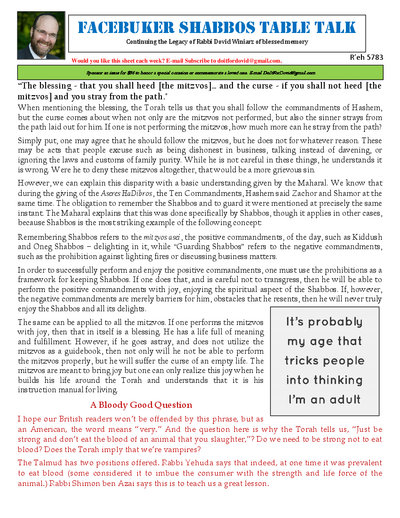

I hope our British readers won’t be offended by this phrase, but as an American, the word means “very.” And the question here is why the Torah tells us, “Just be strong and don’t eat the blood of an animal that you slaughter,”? Do we need to be strong not to eat blood? Does the Torah imply that we’re vampires?

The Talmud has two positions offered. Rabbi Yehuda says that indeed, at one time it was prevalent to eat blood (some considered it to imbue the consumer with the strength and life force of the animal.) Rabbi Shimon ben Azai says this is to teach us a great lesson.

If blood, which is disgusting to most of us, and therefore an easy prohibition to avoid, requires us to strengthen ourselves, then how much more so do we need to strengthen ourselves for other mitzvos.

There is a recurring theme in the Torah that is summed up by the words of Isaiah, “For My thoughts are not your thoughts, nor are your ways My ways.” While we feel we have an innate ability to identify what is important or not and what is holy or not, this is untrue. Rather, only by studying the Torah and coming to an understanding of what Hashem considers important and holy, can we begin to see the world through His perspective and start to become better judges of reality.

PDF Preview

