Behold I Set Before You This Day a Blessing and a Curse
Ohr Hachaim Hakadosh | August 11, 2023
Print This Article
View Original PDF

Behold I Set Before You This Day a Blessing and a Curse

Ohr Hachaim Hakadosh | December 31, 2025

Behold, I set before you this day a blessing and a curse,

The Ohr Hachaim asks why the Torah repeats itself in this possuk and the next. The next possuk tells us את הברכה אשר תשמעו וגו' ואת הקללה, why could the Torah not continue immediately with the ראה אנכי נותן לפניכם היום את הברכה אשר תשמעו וגו' ואת הקללה? Why does it introduce the blessing and curses and thereafter expound on them?

The Ohr Hachaim quotes the Sifrei on this possuk, which explains the blessing and curse – Moshe was telling Klal Yisroel that although we sometimes see wicked people in this world as they are successful for a number of days, that is a temporary matter, and leads to their destruction in the World to Come.

The possuk is telling us that Hashem is placing a Beracha that is really a Kelalah before us – a blessing that does not eventually live up to its name. It is only this day that it is considered a blessing, referring to this world. Chazal tell us that this world is considered today, and that is when the wicked may see a blessing in their work. But that blessing quickly converts to its opposite when the wicked person dies and finds himself punished for all that he has done to anger his Creator during his lifetime.

The Ohr Hachaim offers another explanation. The Sifrei on this possuk quotes a Mashal of a person who sits at a crossroads. There are two paths ahead of the traveler, and it is impossible for anyone to know which one is the preferred road that will lead to town. One road begins smoothly but, after a few twists and turns, becomes filled with thorns and ditches. The other path begins with difficulty, with thorns and other obstacles. But shortly afterward, the troubles are over, and the road becomes smooth and clear. The person at the crossroads warned everyone that was willing to listen not to be too impressed with the road that began smoothly because it would end up being a greater bother than the other road.

The Sifrei means to tell us that Hashem is granting us the option of doing aveiros, but He is also warning us that the path of aveiros may seem enjoyable, but its ending is filled with pain and difficulty.

The Ohr Hachaim offers a deeper explanation of this example. The possuk is telling us that we always have two paths in front of us. Each path has a blessing and its opposite. Hashem is placing before us roads filled with blessings and their opposite, in different proportions. Some begin with life and ease and continue with difficulty, others begin with discomfort and pain, but end up with happiness.

The possuk then tells us that the Beracha is when a person hearkens to Hashem’s commands. When a person is considering actually doing the Mitzvos, the difficulties become negligible and irrelevant. When performing Mitzvos, a person should consider the efforts worthwhile and everything he is undergoing is a Beracha. The converse is true when considering aveiros. A person who sees the cursed path as the successful one will only see his ease in this world, ignoring the future world. The lesson to him is that even though it may seem that he is living on an easy street and enjoying life to its fullest, his path is only a Kelalah – a curse. Its downsides outweigh its pleasures by such a great factor as to render the benefits immaterial and almost non-existent.
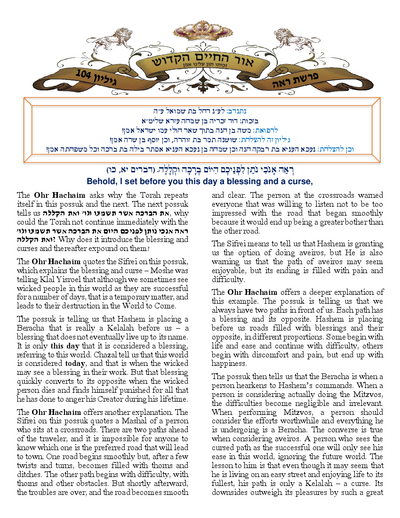

Behold, I set before you this day a blessing and a curse,

The Ohr Hachaim asks why the Torah repeats itself in this possuk and the next. The next possuk tells us את הברכה אשר תשמעו וגו' ואת הקללה, why could the Torah not continue immediately with the ראה אנכי נותן לפניכם היום את הברכה אשר תשמעו וגו' ואת הקללה? Why does it introduce the blessing and curses and thereafter expound on them?

The Ohr Hachaim quotes the Sifrei on this possuk, which explains the blessing and curse – Moshe was telling Klal Yisroel that although we sometimes see wicked people in this world as they are successful for a number of days, that is a temporary matter, and leads to their destruction in the World to Come.

The possuk is telling us that Hashem is placing a Beracha that is really a Kelalah before us – a blessing that does not eventually live up to its name. It is only this day that it is considered a blessing, referring to this world. Chazal tell us that this world is considered today, and that is when the wicked may see a blessing in their work. But that blessing quickly converts to its opposite when the wicked person dies and finds himself punished for all that he has done to anger his Creator during his lifetime.

The Ohr Hachaim offers another explanation. The Sifrei on this possuk quotes a Mashal of a person who sits at a crossroads. There are two paths ahead of the traveler, and it is impossible for anyone to know which one is the preferred road that will lead to town. One road begins smoothly but, after a few twists and turns, becomes filled with thorns and ditches. The other path begins with difficulty, with thorns and other obstacles. But shortly afterward, the troubles are over, and the road becomes smooth and clear. The person at the crossroads warned everyone that was willing to listen not to be too impressed with the road that began smoothly because it would end up being a greater bother than the other road.

The Sifrei means to tell us that Hashem is granting us the option of doing aveiros, but He is also warning us that the path of aveiros may seem enjoyable, but its ending is filled with pain and difficulty.

The Ohr Hachaim offers a deeper explanation of this example. The possuk is telling us that we always have two paths in front of us. Each path has a blessing and its opposite. Hashem is placing before us roads filled with blessings and their opposite, in different proportions. Some begin with life and ease and continue with difficulty, others begin with discomfort and pain, but end up with happiness.

The possuk then tells us that the Beracha is when a person hearkens to Hashem’s commands. When a person is considering actually doing the Mitzvos, the difficulties become negligible and irrelevant. When performing Mitzvos, a person should consider the efforts worthwhile and everything he is undergoing is a Beracha. The converse is true when considering aveiros. A person who sees the cursed path as the successful one will only see his ease in this world, ignoring the future world. The lesson to him is that even though it may seem that he is living on an easy street and enjoying life to its fullest, his path is only a Kelalah – a curse. Its downsides outweigh its pleasures by such a great factor as to render the benefits immaterial and almost non-existent.

PDF Preview