How to Become Rich
BET Journal | August 21, 2025
Print This Article
View Original PDF

How to Become Rich

BET Journal | December 10, 2025

Based on Meor Einayim, by Rav Menachem Nochum zt”l of Chernobyl

You shall tithe – surely tithe – all the produce of your planting. (Devarim 14:22)

The doubling of the verb עשר leads to the famous comment by Chazal (Shabbos 119a), “Tithe so that you will become rich.” One of the difficult things to understand about this Midrash is that it seems to clash with a maxim of Chazal elsewhere: “A person does not die without half of his longings still intact and unfulfilled.” The quest for money seems to be an endless road. Not even death gets a person to his destination in this regard. If, then, no one truly arrives in his own eyes to the place called “richness,” what do Chazal mean in their promise? Even giving charity won’t make a person rich in this lifetime!

Furthermore, is it really so that no one escapes the drive for acquisition? Don’t we know people who enjoy the serenity of sufficiency? People who take real pleasure in what they have and do not clamor for more?

Take a careful look at Chazal’s choice of words. “Ein adam meis, ve’chatzi taavoso b’yado.” There is no adam meis who frees himself from the rat race. It is the living dead man who is imprisoned by his desires. He is the one trapped on the lowest spiritual level. All others have recourse to the midah of histapkus, of sufficiency.

How to get there? It can start with giving ma’aser, with giving a significant amount of what one earns to others. The feeling of sufficiency, freedom from the need to always acquire more and more, is the richness that Chazal say comes from giving ma’aser. They certainly do not mean that a person’s intention when giving should be to achieve monetary wealth. They hardly would champion performing a mitzvah for such lo-lishmah reasons. (Besides, empirically, it doesn’t work. We can easily note people who are generous in their giving but never become wealthy.)

The continuation of the Midrash directly supports this. “Give ma’aser shelo tischaser/so that you should not be lacking.” The richness that Chazal promise means that you will not find yourselves lacking anything. You will find sufficiency and joy in what you have. You will acquire the midah of histapkus.

This, too, is what Chazal meant in their comment (Shabbos 32b) on the passuk (Malachai 3:10) “Bring the tithe to the treasure house...Test me in this...I will shower upon you blessings without end/beli dai.” They say that the blessing will be so abundant that your lips will weary from saying, “Dai/enough.” Are there really such people who respond to Hashem’s berachah with, “That’s enough already?” Rather, Chazal mean that you will internalize the midah of histapkus. Through it, everything that Hashem sends will seem sufficient to bring you joy.

Tithing Properly

The passuk in Malachi says (3:10) that the Jewish people should bring all of their ma’aser to the beis ha'otzar, and if they do so, they can test Hashem to see if He will pay them back.

The Zera Shimshon asks why the passuk has to say that they should bring all of their ma’aser. Is there someone who brings half of what he is obligated to bring and expects to get rewarded? In fact, not only doesn't a person get rewarded for short-changing ma’aser, he loses what he already has. The Zera Shimshon culls this from a midrash brought in Tosafos (Ta'anis 9a) about a wealthy person who always gave ma’aser meticulously. After he died, his son did not wish to part with all the ma’aser he was supposed to, and he gave less and less. Slowly, he ended up with only one-tenth of what the fields used to produce. From here we see that if someone does not give everything he is obligated to give to ma’aser, not only is he not rewarded, but he ends up losing. If so, why does the aforementioned passuk specify that one should bring all of his ma’aser and expect reward from Hashem? It is self-understood. The passuk should have simply said that one must bring his ma’aser, and it would have been understood that it means all of it.

The Zera Shimshon asks as well why ma’aser is the only mitzvah that one may test Hashem to see that He actually pays back.

The Zera Shimshon explains that halachically, there are certain ways that a person can cut corners and relieve himself of the obligation to tithe his produce (see Brachos 31a). For this reason, the Zera Shimshon says that technically, a person can bring ma’aser on only part of his produce, and it would still not be considered that he short-changed ma’aser. On this, the passuk in Malachi says that the blessing of wealth is only if you bring all of the ma’aser that is supposed to be given without cutting corners.

To explain why one is allowed to test Hashem with his giving ma’aser, something that is forbidden in other instances, the Zera Shimshon explains as follows.

When Moshe Rabbeinu wanted to enter Eretz Yisrael, he davened that he should be allowed to enter in order to fulfill the mitzvos associated with Eretz Yisrael and to be rewarded for doing them. The Maharsha (Sota 14a) asks: How could Moshe Rabbeinu include in his prayer to be allowed into Eretz Yisrael because he wanted to do mitzvos and get reward for them when the Mishnah says (Avos 1:3) that one should not serve Hashem in order to receive reward?

The Maharsha differentiates between one who is already obligated to fulfill a mitzvah and one who is not yet obligated. Once obligated, one must serve Hashem not in order to receive a reward. However, before one is obligated, one is allowed to desire the reward that comes from performing the mitzvah.

Based on this Maharsha, the Zera Shimshon says that since one can get out of his obligation of giving ma’aser as mentioned, he essentially has the status of one who is not obligated. This being the case, one can expect reward from Hashem for fulfilling the mitzvah of ma’aser properly.

RABBI YITZCHAK ADLERSTEIN
ZERA SHIMSHON
ZERA SHIMSHON SHIUR BY RABBI SIMCHA BUNIM BURGER
THURSDAY 8:15 PM - 9:15 PM (20 Upstairs)
Please scan to join Zera Shimshon Whatsapp Group
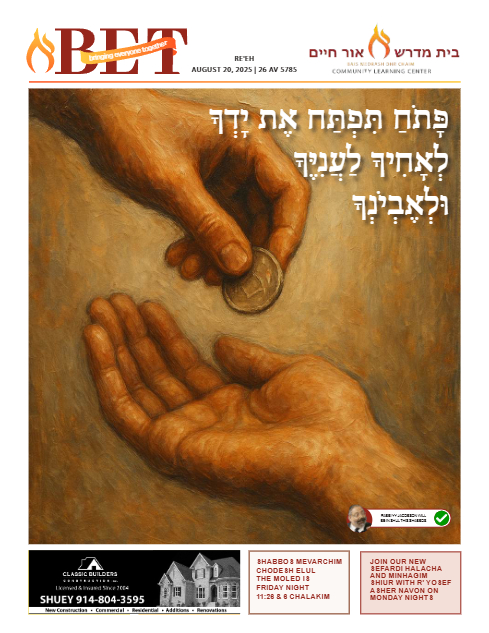
Based on Meor Einayim, by Rav Menachem Nochum zt”l of Chernobyl

You shall tithe – surely tithe – all the produce of your planting. (Devarim 14:22)

The doubling of the verb עשר leads to the famous comment by Chazal (Shabbos 119a), “Tithe so that you will become rich.” One of the difficult things to understand about this Midrash is that it seems to clash with a maxim of Chazal elsewhere: “A person does not die without half of his longings still intact and unfulfilled.” The quest for money seems to be an endless road. Not even death gets a person to his destination in this regard. If, then, no one truly arrives in his own eyes to the place called “richness,” what do Chazal mean in their promise? Even giving charity won’t make a person rich in this lifetime!

Furthermore, is it really so that no one escapes the drive for acquisition? Don’t we know people who enjoy the serenity of sufficiency? People who take real pleasure in what they have and do not clamor for more?

Take a careful look at Chazal’s choice of words. “Ein adam meis, ve’chatzi taavoso b’yado.” There is no adam meis who frees himself from the rat race. It is the living dead man who is imprisoned by his desires. He is the one trapped on the lowest spiritual level. All others have recourse to the midah of histapkus, of sufficiency.

How to get there? It can start with giving ma’aser, with giving a significant amount of what one earns to others. The feeling of sufficiency, freedom from the need to always acquire more and more, is the richness that Chazal say comes from giving ma’aser. They certainly do not mean that a person’s intention when giving should be to achieve monetary wealth. They hardly would champion performing a mitzvah for such lo-lishmah reasons. (Besides, empirically, it doesn’t work. We can easily note people who are generous in their giving but never become wealthy.)

The continuation of the Midrash directly supports this. “Give ma’aser shelo tischaser/so that you should not be lacking.” The richness that Chazal promise means that you will not find yourselves lacking anything. You will find sufficiency and joy in what you have. You will acquire the midah of histapkus.

This, too, is what Chazal meant in their comment (Shabbos 32b) on the passuk (Malachai 3:10) “Bring the tithe to the treasure house...Test me in this...I will shower upon you blessings without end/beli dai.” They say that the blessing will be so abundant that your lips will weary from saying, “Dai/enough.” Are there really such people who respond to Hashem’s berachah with, “That’s enough already?” Rather, Chazal mean that you will internalize the midah of histapkus. Through it, everything that Hashem sends will seem sufficient to bring you joy.

Tithing Properly

The passuk in Malachi says (3:10) that the Jewish people should bring all of their ma’aser to the beis ha'otzar, and if they do so, they can test Hashem to see if He will pay them back.

The Zera Shimshon asks why the passuk has to say that they should bring all of their ma’aser. Is there someone who brings half of what he is obligated to bring and expects to get rewarded? In fact, not only doesn't a person get rewarded for short-changing ma’aser, he loses what he already has. The Zera Shimshon culls this from a midrash brought in Tosafos (Ta'anis 9a) about a wealthy person who always gave ma’aser meticulously. After he died, his son did not wish to part with all the ma’aser he was supposed to, and he gave less and less. Slowly, he ended up with only one-tenth of what the fields used to produce. From here we see that if someone does not give everything he is obligated to give to ma’aser, not only is he not rewarded, but he ends up losing. If so, why does the aforementioned passuk specify that one should bring all of his ma’aser and expect reward from Hashem? It is self-understood. The passuk should have simply said that one must bring his ma’aser, and it would have been understood that it means all of it.

The Zera Shimshon asks as well why ma’aser is the only mitzvah that one may test Hashem to see that He actually pays back.

The Zera Shimshon explains that halachically, there are certain ways that a person can cut corners and relieve himself of the obligation to tithe his produce (see Brachos 31a). For this reason, the Zera Shimshon says that technically, a person can bring ma’aser on only part of his produce, and it would still not be considered that he short-changed ma’aser. On this, the passuk in Malachi says that the blessing of wealth is only if you bring all of the ma’aser that is supposed to be given without cutting corners.

To explain why one is allowed to test Hashem with his giving ma’aser, something that is forbidden in other instances, the Zera Shimshon explains as follows.

When Moshe Rabbeinu wanted to enter Eretz Yisrael, he davened that he should be allowed to enter in order to fulfill the mitzvos associated with Eretz Yisrael and to be rewarded for doing them. The Maharsha (Sota 14a) asks: How could Moshe Rabbeinu include in his prayer to be allowed into Eretz Yisrael because he wanted to do mitzvos and get reward for them when the Mishnah says (Avos 1:3) that one should not serve Hashem in order to receive reward?

The Maharsha differentiates between one who is already obligated to fulfill a mitzvah and one who is not yet obligated. Once obligated, one must serve Hashem not in order to receive a reward. However, before one is obligated, one is allowed to desire the reward that comes from performing the mitzvah.

Based on this Maharsha, the Zera Shimshon says that since one can get out of his obligation of giving ma’aser as mentioned, he essentially has the status of one who is not obligated. This being the case, one can expect reward from Hashem for fulfilling the mitzvah of ma’aser properly.

RABBI YITZCHAK ADLERSTEIN
ZERA SHIMSHON
ZERA SHIMSHON SHIUR BY RABBI SIMCHA BUNIM BURGER
THURSDAY 8:15 PM - 9:15 PM (20 Upstairs)
Please scan to join Zera Shimshon Whatsapp Group

PDF Preview