Ir HaNidachat and the Power of a Mezuzah
Shabbos Sippets | August 11, 2023
Print This Article
View Original PDF

Ir HaNidachat and the Power of a Mezuzah

Shabbos Sippets | December 31, 2025

The Gemara (Sanhedrin 71b) presents an opinion that an Ir HaNidachat would never occur. The Gemara explains that since the Torah requires that everything in an Ir HaNidachat be burned, an Ir HaNidachat cannot be destroyed, so long as it contains even a single Mezuzah. Since a Mezuzah contains Hashem’s name, it cannot be destroyed; its destruction would violate the prohibition of erasing Hashem’s name (Devarim 12:4, with Rashi’s comments).

This idea has profound implications. One tiny Mezuzah can spare an entire city from the status of an Ir HaNidachat! This teaches that a drop of positive energy has the power and potential to counter much negativity. The Kabbalah expresses this idea in its statement that a little bit of light can dispel much darkness. One may ask, though, what would happen if a city met the requirements of an Ir HaNidachat and contained not a single Mezuzah. How can the opinion presented by the Gemara claim that an Ir HaNidachat is an impossibility if there is a distinct possibility that the Jews in the city have strayed so far from Judaism to the extent that there remains not even a single Mezuzah?

We may answer based on Rashi (Devarim 31:21 s.v. Ki Lo Tishachach MiPi Zar’o), who states that “the Torah has promised that the Torah will never be completely forgotten by the Jewish People.” Thus, asserting that an Ir HaNidachat is an impossibility affirms faith in the Jewish People and in the belief that there will never be a city among our people where the inhabitants have strayed to the extent that there is not even one Mezuzah in the town.

Another answer is based on a story told about the Lubavitcher Rebbe. The Lubavitcher Rebbe is reported to have remarked that if he heard that a city was about to be declared an Ir HaNidachat, he would arise at two in the morning and affix a Mezuzah to a home in that city. In other words, were a city to be devoid of any authentic Jewish influence and presence, the Lubavitcher Rebbe would create an authentic center of Jewish life. As is well known, this was not a passing sentiment of the Lubavitcher Rebbe, but rather a life’s mission for himself and his followers. An examination of www.chabad.org leads one to marvel at the hundreds of centres of Jewish life established by followers of the Lubavitcher Rebbe in almost every corner of the globe, especially in areas which had a dearth of Jewish life.

These efforts are part of the happy story of the resurgence and revitalization of Orthodox Judaism in the late twentieth and early twenty-first centuries.
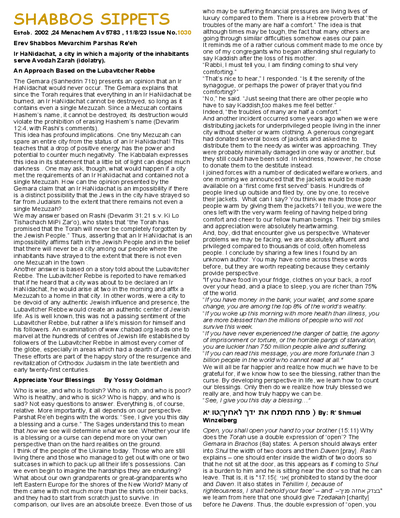
The Gemara (Sanhedrin 71b) presents an opinion that an Ir HaNidachat would never occur. The Gemara explains that since the Torah requires that everything in an Ir HaNidachat be burned, an Ir HaNidachat cannot be destroyed, so long as it contains even a single Mezuzah. Since a Mezuzah contains Hashem’s name, it cannot be destroyed; its destruction would violate the prohibition of erasing Hashem’s name (Devarim 12:4, with Rashi’s comments).

This idea has profound implications. One tiny Mezuzah can spare an entire city from the status of an Ir HaNidachat! This teaches that a drop of positive energy has the power and potential to counter much negativity. The Kabbalah expresses this idea in its statement that a little bit of light can dispel much darkness. One may ask, though, what would happen if a city met the requirements of an Ir HaNidachat and contained not a single Mezuzah. How can the opinion presented by the Gemara claim that an Ir HaNidachat is an impossibility if there is a distinct possibility that the Jews in the city have strayed so far from Judaism to the extent that there remains not even a single Mezuzah?

We may answer based on Rashi (Devarim 31:21 s.v. Ki Lo Tishachach MiPi Zar’o), who states that “the Torah has promised that the Torah will never be completely forgotten by the Jewish People.” Thus, asserting that an Ir HaNidachat is an impossibility affirms faith in the Jewish People and in the belief that there will never be a city among our people where the inhabitants have strayed to the extent that there is not even one Mezuzah in the town.

Another answer is based on a story told about the Lubavitcher Rebbe. The Lubavitcher Rebbe is reported to have remarked that if he heard that a city was about to be declared an Ir HaNidachat, he would arise at two in the morning and affix a Mezuzah to a home in that city. In other words, were a city to be devoid of any authentic Jewish influence and presence, the Lubavitcher Rebbe would create an authentic center of Jewish life. As is well known, this was not a passing sentiment of the Lubavitcher Rebbe, but rather a life’s mission for himself and his followers. An examination of www.chabad.org leads one to marvel at the hundreds of centres of Jewish life established by followers of the Lubavitcher Rebbe in almost every corner of the globe, especially in areas which had a dearth of Jewish life.

These efforts are part of the happy story of the resurgence and revitalization of Orthodox Judaism in the late twentieth and early twenty-first centuries.

PDF Preview