Kabbalah Red String Bracelets Are They Jewish
Brooklyn Torah Gazette | August 17, 2025
Print This Article
View Original PDF

Kabbalah Red String Bracelets Are They Jewish

Brooklyn Torah Gazette | December 10, 2025

Evil Eye Jewelry and Kabbalah Bracelets
By Yehuda Shurpin

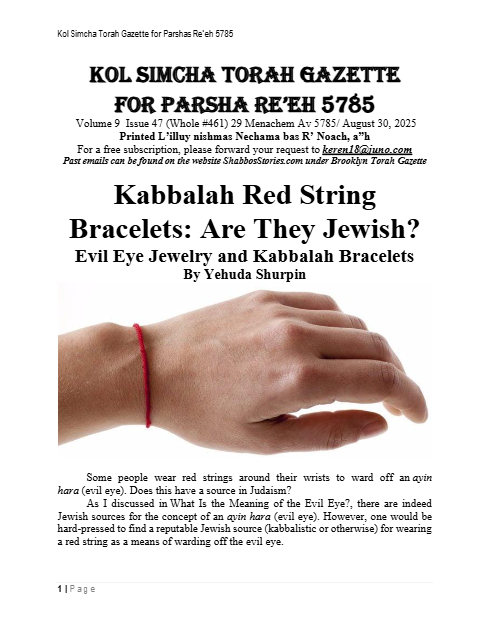
Some people wear red strings around their wrists to ward off an ayin hara (evil eye). Does this have a source in Judaism?

As I discussed in What Is the Meaning of the Evil Eye?, there are indeed Jewish sources for the concept of an ayin hara (evil eye). However, one would be hard-pressed to find a reputable Jewish source (kabbalistic or otherwise) for wearing a red string as a means of warding off the evil eye.

The Color Red

Rabbi Chaim Elazar Spira of Munkács, known as the Minchat Elazar (b. 1868), records a custom to carry a red cloth or similar red item to ward off ayin hara. He explains that different colors represent different Divine attributes, and red represents gevurah (stringency and judgment), which is sometimes linked with negative spiritual energy. Thus, by having the red item, one can overcome an ayin hara, beating evil at its own game.

Note that he makes no mention of bracelets or strings, and there’s good reason for that.

Pagan Ways

There are certain foreign, superstitious practices that, although not idol worship in the strict sense, are nevertheless forbidden due to their pagan origins. These are referred to as darkei Amori (“the ways of the Amorites”). In a list of such practices found in the Tosefta (an extra-Mishnaic work), “tying a red string on one's finger,” is listed.

This implies that wearing a red string falls under the rubric of a forbidden pagan practice.

Now, there are some who explain that despite the Tosefta, the red string is not a violation of darkei Amori (see footnote).

Others, however, maintain that it is indeed problematic.

It is said that the Lubavitcher Rebbe, Rabbi Menachem M. Schneerson, of righteous memory, was once asked about this in a private audience. He was initially hesitant to express his view on the red string bracelets, but then cautioned against them due to the issue of darkei Amori.

Red or Blue?

On the topic of which colors can ward off the evil eye, I would venture to say that blue, or more specifically techelet (indigo), is a much better candidate. The Zohar states that if someone looks at you with an evil eye, look at something the color of techelet and the evil eye will have no power over you.

This is perhaps connected to the Talmudic teaching that techelet resembles the sea, which reflects the sky, which is reminiscent of G-d’s “throne.”

The True Remedy

When discussing spiritual remedies or charms, even those with an authentic source, the Lubavitcher Rebbe would caution that not all people or situations are the same. Since these charms require very specific intention and know-how, it is unlikely for even the legitimate ones to have a serious effect.

With regard to charmers and soothsayers, the Torah enjoins us to “be wholehearted with the L-rd, your G-d.”

Ultimately, connecting to G-d through meditating on His greatness, learning His Torah and adding in mitzvahs is the “true and tried remedy.” There is no reason to fear an evil eye or try any of these other means of protection.

Footnotes

1. Divrei Torah, Mahadura Tinyana 71.
2. Tosefta, Shabbat, ch. 7; also quoted in Reishit Chochmah, Perek Derech Eretz.
3. See, for example, responsa Rivivot Ephraim 8:51:3 where he explains that: a) according to one version of the Tosefta, the prohibition is limited to putting the string on a wound; b) some hold that only pagan practices codified in the Talmud itself are prohibited (see Beit Yosef, Yoreh Deah 178). Since the red string is listed in the Tosefta but not in in the Talmud, it may indicate that the final halachah does not view it as problematic; c) the Tosefta only mentions tying the string on the finger, but may not include wearing it as a bracelet; d) some hold that once a pagan practice is no longer in use, it becomes permissible (see Minhag Yisrael Torah, vol. 6, 179). It has been suggested that since pagans no longer wear the red strings, there may be no issue with it. However, it is very questionable whether this practice has indeed “fallen into disuse.”
4. See, for example, responsa Rivivot Ephraim 8:51:3 and Be’er Moshe 8:36.
5. See, for example, Darkei Teshuvah, Yoreh Deah 179:21 (quoting the Reishit Chachmah), where he specifically lists wearing a red string as darkei Amori.
6. Heard from Rabbi Leibel Schapiro, dean of the Yeshivah Gedolah of Greater Miami; see account in Hitkashrut 857.
7. Zohar 3:163b.
8. Talmud Sotah 17a.
9. Deuteronomy 18:13.
10. See Igrot Kodesh, vol. 12, p. 184, and vol. 14, p. 394.

Reprinted from the current website of Chabad.org
Evil Eye Jewelry and Kabbalah Bracelets
By Yehuda Shurpin

Some people wear red strings around their wrists to ward off an ayin hara (evil eye). Does this have a source in Judaism?

As I discussed in What Is the Meaning of the Evil Eye?, there are indeed Jewish sources for the concept of an ayin hara (evil eye). However, one would be hard-pressed to find a reputable Jewish source (kabbalistic or otherwise) for wearing a red string as a means of warding off the evil eye.

The Color Red

Rabbi Chaim Elazar Spira of Munkács, known as the Minchat Elazar (b. 1868), records a custom to carry a red cloth or similar red item to ward off ayin hara. He explains that different colors represent different Divine attributes, and red represents gevurah (stringency and judgment), which is sometimes linked with negative spiritual energy. Thus, by having the red item, one can overcome an ayin hara, beating evil at its own game.

Note that he makes no mention of bracelets or strings, and there’s good reason for that.

Pagan Ways

There are certain foreign, superstitious practices that, although not idol worship in the strict sense, are nevertheless forbidden due to their pagan origins. These are referred to as darkei Amori (“the ways of the Amorites”). In a list of such practices found in the Tosefta (an extra-Mishnaic work), “tying a red string on one's finger,” is listed.

This implies that wearing a red string falls under the rubric of a forbidden pagan practice.

Now, there are some who explain that despite the Tosefta, the red string is not a violation of darkei Amori (see footnote).

Others, however, maintain that it is indeed problematic.

It is said that the Lubavitcher Rebbe, Rabbi Menachem M. Schneerson, of righteous memory, was once asked about this in a private audience. He was initially hesitant to express his view on the red string bracelets, but then cautioned against them due to the issue of darkei Amori.

Red or Blue?

On the topic of which colors can ward off the evil eye, I would venture to say that blue, or more specifically techelet (indigo), is a much better candidate. The Zohar states that if someone looks at you with an evil eye, look at something the color of techelet and the evil eye will have no power over you.

This is perhaps connected to the Talmudic teaching that techelet resembles the sea, which reflects the sky, which is reminiscent of G-d’s “throne.”

The True Remedy

When discussing spiritual remedies or charms, even those with an authentic source, the Lubavitcher Rebbe would caution that not all people or situations are the same. Since these charms require very specific intention and know-how, it is unlikely for even the legitimate ones to have a serious effect.

With regard to charmers and soothsayers, the Torah enjoins us to “be wholehearted with the L-rd, your G-d.”

Ultimately, connecting to G-d through meditating on His greatness, learning His Torah and adding in mitzvahs is the “true and tried remedy.” There is no reason to fear an evil eye or try any of these other means of protection.

Footnotes

1. Divrei Torah, Mahadura Tinyana 71.
2. Tosefta, Shabbat, ch. 7; also quoted in Reishit Chochmah, Perek Derech Eretz.
3. See, for example, responsa Rivivot Ephraim 8:51:3 where he explains that: a) according to one version of the Tosefta, the prohibition is limited to putting the string on a wound; b) some hold that only pagan practices codified in the Talmud itself are prohibited (see Beit Yosef, Yoreh Deah 178). Since the red string is listed in the Tosefta but not in in the Talmud, it may indicate that the final halachah does not view it as problematic; c) the Tosefta only mentions tying the string on the finger, but may not include wearing it as a bracelet; d) some hold that once a pagan practice is no longer in use, it becomes permissible (see Minhag Yisrael Torah, vol. 6, 179). It has been suggested that since pagans no longer wear the red strings, there may be no issue with it. However, it is very questionable whether this practice has indeed “fallen into disuse.”
4. See, for example, responsa Rivivot Ephraim 8:51:3 and Be’er Moshe 8:36.
5. See, for example, Darkei Teshuvah, Yoreh Deah 179:21 (quoting the Reishit Chachmah), where he specifically lists wearing a red string as darkei Amori.
6. Heard from Rabbi Leibel Schapiro, dean of the Yeshivah Gedolah of Greater Miami; see account in Hitkashrut 857.
7. Zohar 3:163b.
8. Talmud Sotah 17a.
9. Deuteronomy 18:13.
10. See Igrot Kodesh, vol. 12, p. 184, and vol. 14, p. 394.

Reprinted from the current website of Chabad.org

PDF Preview