Prayer charity and repentance annuls the evil decree
Pardes Yehuda | August 22, 2025
Print This Article
View Original PDF

Prayer charity and repentance annuls the evil decree

Pardes Yehuda | December 10, 2025

And you will begrudge your needy brother and not give him, and he will cry out to the Lord against you, and it will be a sin to you. You shall surely give him, and your heart shall not be grieved when you give to him; for because of this thing Hashem, will bless you in all your work and in all your endeavors.(15:9-10) The Torah is elaborating on the utmost importance of giving tzedaka to the needy person. For the needy person will cry out to Hashem, and it will be a sin to you. However, the Torah immediately gives you relief: You shall surely give him, and your heart shall not be grieved when you give to him; This will atone your sin, and Hashem will bless you in all your work.

This act of relief of sin by giving tzedaka, we see clearly by the Prophet Daniel. It says: I, King Nebuchadnezzar, had a dream; He issued an order to bring in all the wise men of Babylon, that they should let me know the meaning of the dream. and I related my dream to them, but they did not tell me its meaning. Until, at last, Daniel, whose name is Belteshazzar, like the name of my god, entered before me, in whom is the spirit of holy angels, and I told him the dream. Now you, Belteshazzar, tell me its meaning, since all the wise men of my kingdom are not able to make its meaning known to me, but you are able, for the spirit of the holy gods is in you.” Daniel told Nebuchadnezzar: Indeed, O king, may my counsel please you, and with charity you will remove your sin and your iniquity by showing mercy to the poor; perhaps your tranquility will last." (Daniel 4:24)

Yet we know that the process of Teshuva, repentance, is laid out by the Rambam, includes three stages: confession, regret and a vow not to repeat the misdeed. The true penitent, Rambam says, is the one who finds himself with the opportunity to commit the same sin again yet declines to do so. Therefore, since you caused the poor person agony, the torah says You shall surely give him. Even a hundred times. You shall surely give him, and let your heart not feel bad when you give him (15:10). This will rectify what you begrudged your needy brother and he felt bad, you will give him in a way that you don't feel bad about giving. A student of the Chofetz Chaim had become very wealthy. He had a hard time parting with his money, and came to ask the Chofetz Chaim’s advice about this. The Chofetz Chaim told him: you should give and give without thinking, and then, you will not feel bad about giving and be able to overcome parting with your money.

On Rosh HaShanah, and Yom Kippur when the world is being judged for the coming year, Jews pray that Hashem has decreed for them a good and sweet year. We scream out in the Mussaf prayer: This is based on the Midrash, and was adapted from there. Rabbi Yudan said in the name of R. El'azar: three things annul evil decrees, and they are: prayer, charity, and repentance. (Midrash Rabbah Bereishis 44:15)

Returning to our Posuk: the Torah says that by ignoring the cries of the poor person, you will have a sin. In order to annul the sin, one has to do the three acts of prayer, charity, and repentance. How powerful it is to note that these three acts are laid out in the Posuk! By giving charity and with a good heart, you accomplish charity, and repentance. Then the posuk ends off “for because of “this thing” Hashem, will bless you in all your work and in all your endeavors”.

Many Meforshim are puzzled that the verse doesn’t reveal which thing? However, it can be interpreted as we find by Eliezer when he sought out to find a wife for Yitzchock is says: Now he had not yet finished speaking. The word speak by Eliezer means that he had not finished his prayer. Eliezer prayed to Hashem that he should succeed, as it says by Channah, who hadn’t had a child yet, she was speaking in her heart, only her lips were moving. We see that the word speak, means prayer. If so the posuk says “for because of “this thing”, which means, after you gave charity, and repentance, and you prayed to Hashem to forgive you, the three acts were accomplished and Hashem will annul the evil decree. Hence, the Torah promises Hashem will bless you in all your work and in all your endeavors, and when Hashem blesses it says. The blessing of Hashem will bring riches. Rashi explains: One need not toil to gain wealth, for it is enough with the blessing that He blesses him.

(Yehuda Z. Klitnick)
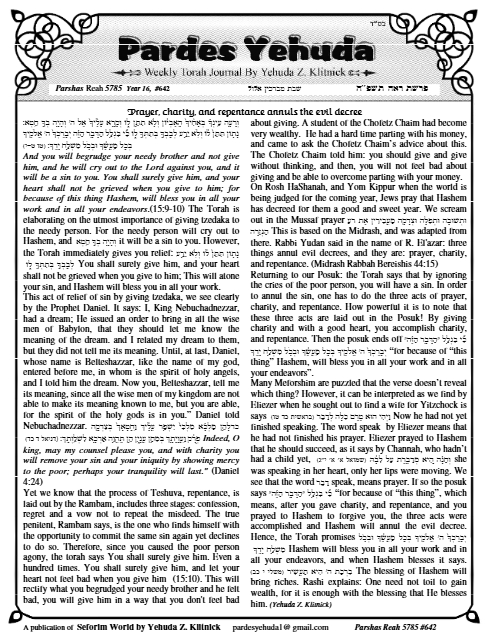
And you will begrudge your needy brother and not give him, and he will cry out to the Lord against you, and it will be a sin to you. You shall surely give him, and your heart shall not be grieved when you give to him; for because of this thing Hashem, will bless you in all your work and in all your endeavors.(15:9-10) The Torah is elaborating on the utmost importance of giving tzedaka to the needy person. For the needy person will cry out to Hashem, and it will be a sin to you. However, the Torah immediately gives you relief: You shall surely give him, and your heart shall not be grieved when you give to him; This will atone your sin, and Hashem will bless you in all your work.

This act of relief of sin by giving tzedaka, we see clearly by the Prophet Daniel. It says: I, King Nebuchadnezzar, had a dream; He issued an order to bring in all the wise men of Babylon, that they should let me know the meaning of the dream. and I related my dream to them, but they did not tell me its meaning. Until, at last, Daniel, whose name is Belteshazzar, like the name of my god, entered before me, in whom is the spirit of holy angels, and I told him the dream. Now you, Belteshazzar, tell me its meaning, since all the wise men of my kingdom are not able to make its meaning known to me, but you are able, for the spirit of the holy gods is in you.” Daniel told Nebuchadnezzar: Indeed, O king, may my counsel please you, and with charity you will remove your sin and your iniquity by showing mercy to the poor; perhaps your tranquility will last." (Daniel 4:24)

Yet we know that the process of Teshuva, repentance, is laid out by the Rambam, includes three stages: confession, regret and a vow not to repeat the misdeed. The true penitent, Rambam says, is the one who finds himself with the opportunity to commit the same sin again yet declines to do so. Therefore, since you caused the poor person agony, the torah says You shall surely give him. Even a hundred times. You shall surely give him, and let your heart not feel bad when you give him (15:10). This will rectify what you begrudged your needy brother and he felt bad, you will give him in a way that you don't feel bad about giving. A student of the Chofetz Chaim had become very wealthy. He had a hard time parting with his money, and came to ask the Chofetz Chaim’s advice about this. The Chofetz Chaim told him: you should give and give without thinking, and then, you will not feel bad about giving and be able to overcome parting with your money.

On Rosh HaShanah, and Yom Kippur when the world is being judged for the coming year, Jews pray that Hashem has decreed for them a good and sweet year. We scream out in the Mussaf prayer: This is based on the Midrash, and was adapted from there. Rabbi Yudan said in the name of R. El'azar: three things annul evil decrees, and they are: prayer, charity, and repentance. (Midrash Rabbah Bereishis 44:15)

Returning to our Posuk: the Torah says that by ignoring the cries of the poor person, you will have a sin. In order to annul the sin, one has to do the three acts of prayer, charity, and repentance. How powerful it is to note that these three acts are laid out in the Posuk! By giving charity and with a good heart, you accomplish charity, and repentance. Then the posuk ends off “for because of “this thing” Hashem, will bless you in all your work and in all your endeavors”.

Many Meforshim are puzzled that the verse doesn’t reveal which thing? However, it can be interpreted as we find by Eliezer when he sought out to find a wife for Yitzchock is says: Now he had not yet finished speaking. The word speak by Eliezer means that he had not finished his prayer. Eliezer prayed to Hashem that he should succeed, as it says by Channah, who hadn’t had a child yet, she was speaking in her heart, only her lips were moving. We see that the word speak, means prayer. If so the posuk says “for because of “this thing”, which means, after you gave charity, and repentance, and you prayed to Hashem to forgive you, the three acts were accomplished and Hashem will annul the evil decree. Hence, the Torah promises Hashem will bless you in all your work and in all your endeavors, and when Hashem blesses it says. The blessing of Hashem will bring riches. Rashi explains: One need not toil to gain wealth, for it is enough with the blessing that He blesses him.

(Yehuda Z. Klitnick)

PDF Preview