Redefining Self and Sacrifice
Torah Papers | August 11, 2023
Print This Article
View Original PDF

Redefining Self and Sacrifice

Torah Papers | December 31, 2025

This Shabbat marks the third of the שׁ ִ בְ עָה דְּ נֶחָ מָ תָ א – the seven Haftarot of consolation, where we read how Bnei Yisrael refused to be comforted after the Churban: ָה סֹעֲרָה לֹא נֻחָמָה – Unhappy, storm-tossed one, uncomforted! This Shabbat is also Shabbat Mevarchim, as Parshat Re’eh generally falls out either just prior to, or on, Rosh Chodesh Elul.

In the names of our months, Chazal found hints to their nature and to the holidays celebrated. For example, everyone is familiar with אֱלוּל as an acronym for י 'לִ ד ו ֹדִ י 'וְ ד ו ֹדִ י 'לְ נִי 'אֲ – I am my beloved’s, and my beloved is mine. Additional acronyms for the month of Elul include אֶ בְ יוֹנִים'לָ מַ תּ ָ נו ֹת 'וּ רֵ עֵהוּ 'לְ י שׁ 'אִ from Megillat Esther; and the Kohen Gadol’s sprinkling of blood on Yom Kippur: מַ טָּ ה 'לְ שׁ ֶ ב ַ ע 'וְ מַ עְ לָה 'לְ חַת 'אַ. I recall my yeshiva’s mashgiach saying תּ ַ מּ וּז stands for בָ אִ ים 'וּ מּ ַ שמְ שׁ ִ ים 'משׁ ו ּ ב ָ ה 'תְּ מַ נֵּ י 'זְ – the times of teshuva are approaching, and אָ ב for א'בָּ לוּל 'אֱ – Elul is approaching. I asked him who determines these acronyms and why they’re all connected similarly. Perhaps תּ ַ מּ וּז, a hot summer month, really stands for the instruction: ה'זֶ זֶהוּ 'וְ זְגָן 'מַ דְ לִ יק 'תּ ַ – turn on the air conditioning and that’s it.

He responded: “Before there were individual specialized stores on the streets, there was a collective market, and in that market, there were stands. There was a tailor's stand, a barber’s stand, a shoemaker's stand, and so forth. When someone entered the market, each merchant raised their head. The tailor looked to see what pants or shirt the passerby was wearing; the shoemaker looked at their shoes; and the barber looked at their hair. Each looked at the person but focused only on their area of interest. Talmidei chachamim and ba’alei mussar have only one area of interest – teshuva and closeness to Hakadosh Baruch Hu. If that is always on their mind, that is what they always look to connect to.”

The Imrei Chaim of Viznitz says the name רְ אֵ ה is an acronym for גִּיעַ 'הִ לוּל 'אֱ אוּ 'רְ – take note, Elul has arrived, and there is more profound significance than an innocent announcement of the time. Our parsha begins with the words: וֹם בְּרָכָה וּקְלָלָה׃ רְאֵה אָנֹכִי נֹתֵן לִפְנֵיכֶם הַי See, this day I set before you blessing and curse:

We learn in several places that the word וֹם הַי is in reference to Rosh Hashanah. One such learning is from Musaf of Rosh Hashanah, where we recite: וֹם יַעֲמִיד בַּמִּשְׁפָּט כָּל יְצוּרֵי עוֹלָמִי וֹם הֲרַת עוֹלָם. הַי On this day, the world came into being; On this day, He makes stand in judgment – all the creatures of the worlds.

Similarly, וֹם הַ י at the start of Parshat Nitzavim, where Chazal derive that the brachot and klalot were decreed on the day of Rosh Hashanah. Additionally, Chazal point out that the day referred to as וֹם הַי in Sefer Iyov (1:6) was also Rosh Hashanah: ָבֹאוּ בְּנֵי הָאֱ וֹם וַי וַיְהִי הַי-ֵב עַל־ לֹהִים לְהִתְיַצה' ָבוֹא גַם־הַשָּׂטָן בְּתוֹכָם׃ וַי Now there was a day when the sons of God came to present themselves before the Lord, and the adversary came also among them.

Rabbi Natan of Breslov, in Alim Litrufa, brings the words of the third Belzer rebbe, Rav Yissachar Dov Rokeach, who comments on the story in Parshat Vayeitzei. Lavan said to Yaakov, “It is within the power of my hand to harm you, but the G-d of your father spoke to me last night (אֶ מֶ שׁ) saying, Guard yourself not to speak to Yaakov either good or evil.” The Rebbe says Yaakov represents Knesset Yisrael and Lavan represents the Satan who can do us much harm – coming down to mislead us into sinning, ascending to Heaven to prosecute us and inflame Hashem’s anger, and then returning to take our soul as punishment. The Satan can harm us were it not for אֶ מֶ " שׁ, an acronym for לוּל'אֱ בָ רְ כִ ים 'מְ בָּת 'שׁ ַ. Hakadosh Baruch Hu informs the Satan that on Rosh Chodesh Elul, His children begin a journey of teshuva and forgiveness, and he should dare not try to harm them.

These are wonderful days of closeness to Hakadosh Baruch Hu: דִּ רְשׁ וּ ה' בְּהִמָּצְאוֹ, קְרָאֻהוּ בִּהְיוֹתוֹ קָרוֹב – Seek Hashem while He can be found, call to Him while He is near. We generally understand this pasuk to be referring to the Aseret Yemei Teshuva, yet the Me'iri points to a Midrash in Vayikra in saying the entire month of Elul is that time when He is near!

Besiyata Dishmaya, there is a wonderful yesod to be learned from our Parsha, connected to this concept and the month we’re entering. Chazal discuss the meaning of the Parsha’s opening words: וֹם רְ אֵ ה אָ נֹכִ י נֹתֵ ן לִפְ נֵיכֶם הַי. Who is talking to who? If Moshe is speaking to Bnei Yisrael, why do we find the singular conjugation of רְ אֵ ה and not רְ או ּ? And if an individual is being addressed, why immediately switch to the plural of לִפְ נֵיכֶם? Some maintain these pesukim refer to Hakadosh Baruch Hu speaking, as He is called אָ נֹכִ י, most notably at the start of the Aseret Hadibrot. The Chida follows this approach of it being Hakadosh Baruch Hu speaking and demonstrates how the numerical value of the closing letters in ן נֹתֵ ' י' אָ נֹכִ ה'רְ אֵ (65) matches that of שׁ ֵ ם א ָ ד נ ו ּ ת. I would like to go in a completely different direction, though. The Ohr HaChaim Hakadosh, and before him the Rosh and Da'at Zekainim MiBa'alei HaTosafot, explain the pasuk as Moshe Rabbeinu speaking to Bnei Yisrael and saying to them: “Look at me.”

ד"א רָאָה אָנֹכִי שׁ ֶבָּחַרְתִּי בְּטוֹבָה וּלְפִי' אֲנִי מְשֻׁנֶּה מִכָּל שׁ ֶנֶּאֱמַר וּמֹשׁ ֶה לֹא יָדַע כִּי קָרַן עוֹר פָּנָיו:

An alternate interpretation of our verse: “Behold it is I Who gave goodness, therefore I am different from anyone else,” Moshe not having been aware that when he descended from Mount Sinai that his forehead radiated light.

Moshe was pointing out his uniqueness to Bnei Yisrael. He chose goodness and therefore he appeared differently than them, with his skin radiating light. He reached great heights and achievements, all a result of his spiritual choices. He was telling Bnei Yisrael: “Look at me and follow in my footsteps.”

A story is told of a boy who was ill and needed to eat on Yom Kippur but refused to do so. Doctors and family members all tried convincing him, explaining that his eating on Yom Kippur was the equivalent mitzvah to another’s fasting; but he continued to refuse. They sought the help of Rav Shlomo Zalman Auerbach, who entered the hospital room and introduced himself as follows: “Do you know who I am? Do you know what my job is? I’m the head of Yeshivat Kol Torah. And I am also the rav of the Shaarei Chesed neighborhood of Yerushalayim, and I lead all the talmidim there. I came all the way here to tell you that if you eat, every bite you take is another mitzvah just like fasting. And I, as the rav, and rosh yeshiva of 500 talimidim, who has taught tens of thousands of additional talmidim over the years – I instruct you to eat!”

Upon stepping outside, the Rav’s attendant was shocked. He asked Rav Auerbach, “K’vod Harav, I never heard you speak about yourself like this. I’ve never heard you praise yourself or highlight your accomplishments even a drop! Where did this originate?” The Rav replied, “I’m a humble person, but when one needs to activate a certain trait required for their mission, they should have one-eighth of one-eighth of ga’ava (ego) for this reason!” As the Chazon Ish said, the עַנוְתַ ן – the humble person, knows they have what to be proud of, because if they didn’t, they’d have nothing to be modest about!

Moshe Rabbeinu was speaking to Bnei Yisrael, wanting to convey a message in terms they’d grasp and hold onto. “Look at me. Look at my decisions and look at the heights I reached.” Moshe, the humblest of all men, now had a vital message to deliver even at the expense of his most prominent midah. Before leaving this earth, Moshe wanted his people to learn to assign more meaning and value to the brachot they’ll receive in Olam Haba, and less to those in this world, one of hevel havalim – vanity of vanities.

The Ohr HaChaim tells us that Moshe Rabbeinu pointed to himself to teach Bnei Yisrael that this world is merely a corridor to Olam Haba, and their limited time and work here is mere preparation for that eternal life. The message carried credibility and effectiveness coming from him, a rich and accomplished leader in Olam Hazeh. It is one thing to receive such a message from one who is suffering in the world and lacks more than he has. It would be natural for such a person to reflect pessimistically on the world they struggle in. But one who has it all and is willing to give it up? The message must be true! The same thing can be said with regards to speaking about Olam Haba. Anyone can say what they will about Olam Haba but they were never there and have no real idea. Moshe ascended to Hakadosh Baruch Hu on three occasions, each for forty days and forty nights while fasting, and could thus point to himself as speaking authoritatively regarding Olam Haba, unlike one who never experienced it.

Shemen Rosh on Moshe’s Words

Shemen Rosh provides an amazing idea on the words spoken by Moshe. The Mishnah in Avot (3:1) teaches us:

עֲקַבְיָא בֶן מַהֲלַלְאֵל אוֹ מֵר, הִסְתַּכֵּל בִּשְׁלשׁ ָה דְבָרִים וְאִי אַתָּה בָא לִידֵי , וְלִפְנֵי מִי אַתָּה עָתִיד לִתֵּן דִּין , ו ְ ח ֶ שׁ ְ ב ּ ו ֹ ן .

Akavya ben Mahalalel says: Take to heart three things and you will not be brought to transgression: Know whence you came and whither you are going and before Whom you are destined to render judgment and accounting.

The Vilna Gaon asks, what exactly is ח ֶ שׁ ְ ב ּ ו ֹ ן in דִּ ין וְחֶשׁ ְ בּוֹן? When people go to court, they go to Beit Din and not to Beit Din v’Cheshbon. What does the additional term v’cheshbon denote? He answers, for all sins you commit there is further punishment in addition to that of the sin itself. The reason being, instead of sinning you could have been performing a mitzvah. Shemen Rosh then adds another answer to the significance of v’cheshbon. In our earthly courts, there is a concept of mitigating factors – namely, circumstances or conditions that may be considered by a judge during a ruling or sentencing, and which can include a person's upbringing, social environment, or other aspects of their background that might have influenced their behavior. These factors can potentially lead to a less severe punishment or a more lenient judgment, as they provide context and insight into the individual's actions. The same is true in בֵּית דִּ ין שׁ ֶל מַעְלָה – the Heavenly Court. When a person is judged, where they came from, how they were raised, and what events they experienced are all factored in. He provides proof from the words of the Shelah HaKadosh (Bechukotai). Towards the end of the curses, it says (Bamidbar 26:42):

וְזָכַרְ תִּ י אֶת־בְּרִיתִי יַעֲקוֹב וְאַף אֶת־בְּרִיתִי יִצְחָק וְאַף אֶת־בְּרִיתִי אַבְרָהָם אֶ זְכּ ֹר וְהָאָ רֶ ץ אֶ זְכּ ֹר׃

I will then remember My covenant with Yaakov and also My covenant with Yitzchak and also My covenant with Avraham, I will remember and I will remember the land.

Why are the Avot and Eretz Yisrael suddenly being brought into the equation when Bnei Yisrael are being judged and punished? The Shelah explains, Hakadosh Baruch Hu is turning to us and saying, “Do you know why you’re receiving these curses? It is because your grandparents were Avraham, Yitzchak, and Yaakov; and because you were in Eretz Yisrael and experienced its holiness. You came from the best of the best, and experienced the holiest of holies, yet you still sunk to the depths of your sins!” Shemen Rosh says, in pointing to himself, Moshe is professing to Bnei Yisrael that their journey and experiences, including which rebbe they were privileged to learn Torah from, will be factored into their fate.

The Maggid Mi'Dubno says similar and provides the example of two boys who stole the same item from the same store. One received a sentence of three months in jail, whereas the other received only thirty days. The former asked why he was being treated more harshly given it was the exact same crime. The judge answered, “The other boy comes from a house of thieves and if I leave him in jail any longer, he’ll just reunite with them there and learn more from them. You, however, come from an upright house that provided you with everything, including a proper education. How could you lower yourself so much to committing such a terrible act?” Moshe told Bnei Yisrael that as his descendants, they are set up today for brachot; but if they fail to live up to the standards shown to them, they are also set up for terrible kelalot.

Maor VaShemesh and the Duality of Anochiyut

There is one more explanation for us to look at, from Rav Kalonymus Kalman Epstein in Maor VaShemesh, who brings the words of the Admor of Zlotchov. Why in our Parsha is it written רְ אֵ ה אָ נֹכִ י as opposed to רְ אֵ ה אֲ נִ י, as we find in: ל ֹהִ ים-אֲנִי רִאשׁ וֹן וַאֲנִי אַחֲרוֹן וּמִבַּלְעָ דַ י אֵ ין אֱ? He provides an answer from the Kotzker Rebbe, based on the introductory pasuk to the Aseret Hadibrot in Va’etchanan:

אָנֹכִי עֹמֵד בֵּין ה’ וּבֵינֵיכֶם בָּעֵת הַהִוא לְהַגִּיד לָכֶם אֶת־דְּבַר ה’ כִּי יְרֵאתֶם מִפְּנֵי הָאֵשׁ וְלֹא־עֲלִיתֶם בָּהָר לֵאמֹר׃

I stood between the Lord and you at that time, to show you the word of the Lord: for you were afraid by reason of the fire, and went not up to the mountain; saying,

“Anochi” stands between you and Hakadosh Baruch Hu. The וּת אָ נוֹכִ י – egotism and self-centeredness of a person, determines their proximity to Hakadosh Baruch Hu! The more focus they put on themselves, and the greater they prioritize themselves, the further from Hakadosh Baruch Hu they stand. Conversely, the less they highlight themselves, the closer to Hakadosh Baruch Hu they are. The Admor of Zlotchov adds an astounding thought regarding the duality of anochiyut as both a blessing and curse. Moshe Rabbeinu said, “Look at me.” When a person takes their anochiyut and uses it to promote how great they are, how important they are, and how righteous they are, this type of anochiyut is negative and the ultimate curse. In such cases אָ נֹכִ י indeed stands between them and Hakadosh Baruch Hu. But there is another side to אָ נֹכִ י and anochiyut, demonstrated by Moshe Rabbeinu, which can be a blessing and part of our Avodat Hashem. What is this second type of anochiyut?

The Admor’s answer connects us to the yetzer hara, who has a mission of driving a person to despair. Before performing a mitzvah, such as reciting shmoneh esrei, the yetzer hara will provoke you: “Who are you? You’re a nobody. Do you think your tefilla is worth anything? How long does it take you to recite the whole thing, maybe two or three minutes? Maybe a remarkable five minutes? And with how many interruptions and lapses of concentration? How much of that time is focused on Hakadosh Baruch Hu and how much on the bank? How much time are your lips and thoughts not aligned or not even in the same universe?” It does not end there, as after you sin, the yetzer hara incites you yet again: “Do you think your tefilla was worth anything at all? Nobody else knows this, as they see you pretending to daven, but you and I both know the entire two or three minutes was a waste. Do you think Hakadosh Baruch Hu will listen to you at this point? You’re full of sin and embarrassment!” As we can see, the yetzer hara drives you away from mitzvot and denigrates you following aveirot: שָׂטָן מִלְּפָנֵינוּ וּמֵאַחֲרֵינוּ וְהָ סֵר – Remove the adversary from before and from behind, pushing you towards complete despair. The Admor says, this is where you need to completely remove the negative form of אָ נֹכִ י from the equation and replace it with another type of אָ נֹכִ י. But what does this mean, and how does one do that?

The Ba’al Shem Tov refers to a pasuk found in Mishlei: אַל תָּקֹץ בְּתוֹכַחְתּוֹ מוּסַר ה' בְּנִי אַל תִּמְאָס וְ – My son, do not despise the chastening of the Lord; nor be weary of his correction. The mussar of Hakadosh Baruch Hu is referring to His expression of: “לֹהֵיכֶם-בָּנִים אַתֶּם לַה' אֱ – You are children of the King! How can you behave this way? Don’t bring Me embarrassment!” When the Satan and yetzer hara tell you you’re a nobody and have no path forward, that is when you must play the other card of אָ נֹכִ י – I’m not a nobody, I am the child of Hakadosh Baruch Hu! רְ אֵ ה אָ נֹכִ י – look at who I am and look at where I come from! With that self-confidence, even after falling due to aveirot, the yetzer hara will struggle to conquer you and you will silence it. With this, we can now see how anochiyut can be both a blessing and a curse – בְּ רָ כָ ה וּקְ לָלָה.

The Admor concludes with a remarkable piece of advice. A person must always keep two small notes in their pockets. In one pocket, a note saying: וְאָ נֹכִ י עָפָר וָאֵ פֶר – I am but dust and ashes. And in the other pocket: עָשָׂ ה אֶ ת הָאָ דָ םכִּי בְּצֶלֶם אֱ - ל ֹהִ ים – In the image of G-d was man created. These are powerful reminders, but too often we mix up the notes and pull the wrong one out. When asked to contribute, serve in a key role, or volunteer for an important job, one must not pull out the note of וְאָנֹכִי עָפָר וָאֵ פֶר, resulting in a response of, “Who, me? I’m a nobody. It’s someone else you’re looking for.” Similarly, when insulted or embarrassed by another person, one must not pull out the note of ל ֹהִ ים עָשָׂ ה אֶ ת הָאָ דָ ם-כִּי בְּצֶלֶם אֱ, resulting in a response of, “Do you know who I am? I am the image of G-d! How dare you treat the child of Hakadosh Baruch Hu like that!” When asked to participate in a holy endeavor, we must emulate the divine image and act with holiness, and when trampled upon and kicked around, we must compare ourselves to the dust of the earth, which gets stepped on routinely without fanfare or objection.

We can now wrap up the second approach to our question of who is speaking to who at the start of the Parsha. Moshe Rabbeinu is showing Bnei Yisrael how to properly use אָ נֹכִ י – towards the emphasis on Olam Haba rather than Olam Hazeh, and in a way that brings them closer to Hakadosh Baruch Hu. This is the lesson we learn from our Parsha’s opening words of וֹם רְ אֵ ה אָ נֹכִ י נֹתֵ ן לִפְ נֵיכֶם הַי.

Tzni’ut and Redemption

There is also a third direction, one that will open the light before our very eyes and guide us in the days and weeks to come. Rav Chaim Friedlander, in Siftei Chaim, focuses on the midah of tzni’ut – modesty, of Rachel Imeinu. She transferred the simanim – the signs – to her older sister, so that Leah could marry Yaakov first. Her act could be considered an act of chesed rather than modesty, if it were not for the fact that she did so in a manner unbeknownst to her sister. She suppressed her own desires and needs and did so in a concealed way so that her sister would not know or feel bad. I believe the same approach can be applied here to Moshe Rabbeinu.

The Gemara says (Megillah 15a):

וְאָמַ ר רַ בִּי אֶלְעָזָר אָמַ ר רַ בִּי חֲנִינָא: כׇּל הָאוֹמֵ ר דָּ בָר בְּשׁ ֵם א וֹמְרוֹ מֵבִיא גְּאוּלָּה לָעוֹלָם, שׁ ֶנֶּאֱמַר: ״וַתֹּאמֶר אֶסְתֵּר לַמֶּלֶך בְּשׁ ֵם מׇרְדֳּכָי״.

And Rabbi Elazar said that Rabbi Chanina said: Whoever reports a saying in the name of he who said it, brings redemption to the world. As it is stated: “And Esther reported it to the king in the name of Mordechai,” [and this eventually brought redemption, as Mordechai was later rewarded, paving the way for salvation.]

The Maharal explains why this principle is in place. It is because one who acts this way clearly doesn’t regard themselves as anything. The Imrei Emet adds, if you come up with a chiddush – a new explanation or idea – and then find the same written in a book, you have two choices. You could either say you came up with the idea and then also found it in a sefer, or you could point to the sefer without any mention whatsoever of your individual finding. The latter is what we must choose. Credit the source as though we never thought of it previously. The Gemara brings the example of Esther relaying word of a planned assassination in the name of Mordechai, but how did Mordechai himself find out? We are told וּמָרְ דֳּכַי יָדַ ע אֶת־כָּל־אֲשׁ ֶר נַעֲשָׂה, but where did Mordechai get his information from? From an angel in a dream, or from Eliyahu HaNavi? The Imrei Emet says, as soon as Mordechai received the information, so did Esther, as she was a prophet just like him. Yet, despite also receiving the information directly, she still relayed it in name of Mordechai, which led to the salvation of Bnei Yisrael. The Gemara says (Bava Kama 92a):

דַאֲמוּר רַבָּנַן כׇּל הַמְבַקֵּשׁ רַחֲמִים עַל חֲבֵירוֹ וְהוּא צָרִיך לְאוֹתוֹ דָּבָר הוּא נַעֲנֶה תְּחִילָּה.

Whereby the Sages stated: Anyone who asks for compassion from Heaven on behalf of another, and he requires compassion from Heaven concerning that same matter, he is answered first.

Why should such a person be answered first? Why should they be ‘redeemed’ ahead of their friend, and why should each not simply daven for themselves? The answer is, if they do so, and focus solely on their own needs, they’d epitomize anochiyut – egotism and self-centeredness. But if they set aside their own needs and focus on their neighbor – even when they themselves need the exact same thing! – anochiyut is removed from the picture and they’ll be worthy of redemption.

The Alter of Kelm, in Ohr Rashaz, asks why Moshe Rabbeinu is not mentioned in the Pesach Haggadah? The story of Yetziat Mitzraim is attributed solely to Hakadosh Baruch Hu, and Moshe’s name does not come up even once.
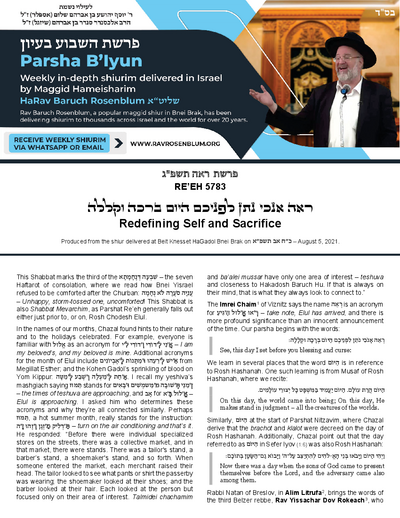
This Shabbat marks the third of the שׁ ִ בְ עָה דְּ נֶחָ מָ תָ א – the seven Haftarot of consolation, where we read how Bnei Yisrael refused to be comforted after the Churban: ָה סֹעֲרָה לֹא נֻחָמָה – Unhappy, storm-tossed one, uncomforted! This Shabbat is also Shabbat Mevarchim, as Parshat Re’eh generally falls out either just prior to, or on, Rosh Chodesh Elul.

In the names of our months, Chazal found hints to their nature and to the holidays celebrated. For example, everyone is familiar with אֱלוּל as an acronym for י 'לִ ד ו ֹדִ י 'וְ ד ו ֹדִ י 'לְ נִי 'אֲ – I am my beloved’s, and my beloved is mine. Additional acronyms for the month of Elul include אֶ בְ יוֹנִים'לָ מַ תּ ָ נו ֹת 'וּ רֵ עֵהוּ 'לְ י שׁ 'אִ from Megillat Esther; and the Kohen Gadol’s sprinkling of blood on Yom Kippur: מַ טָּ ה 'לְ שׁ ֶ ב ַ ע 'וְ מַ עְ לָה 'לְ חַת 'אַ. I recall my yeshiva’s mashgiach saying תּ ַ מּ וּז stands for בָ אִ ים 'וּ מּ ַ שמְ שׁ ִ ים 'משׁ ו ּ ב ָ ה 'תְּ מַ נֵּ י 'זְ – the times of teshuva are approaching, and אָ ב for א'בָּ לוּל 'אֱ – Elul is approaching. I asked him who determines these acronyms and why they’re all connected similarly. Perhaps תּ ַ מּ וּז, a hot summer month, really stands for the instruction: ה'זֶ זֶהוּ 'וְ זְגָן 'מַ דְ לִ יק 'תּ ַ – turn on the air conditioning and that’s it.

He responded: “Before there were individual specialized stores on the streets, there was a collective market, and in that market, there were stands. There was a tailor's stand, a barber’s stand, a shoemaker's stand, and so forth. When someone entered the market, each merchant raised their head. The tailor looked to see what pants or shirt the passerby was wearing; the shoemaker looked at their shoes; and the barber looked at their hair. Each looked at the person but focused only on their area of interest. Talmidei chachamim and ba’alei mussar have only one area of interest – teshuva and closeness to Hakadosh Baruch Hu. If that is always on their mind, that is what they always look to connect to.”

The Imrei Chaim of Viznitz says the name רְ אֵ ה is an acronym for גִּיעַ 'הִ לוּל 'אֱ אוּ 'רְ – take note, Elul has arrived, and there is more profound significance than an innocent announcement of the time. Our parsha begins with the words: וֹם בְּרָכָה וּקְלָלָה׃ רְאֵה אָנֹכִי נֹתֵן לִפְנֵיכֶם הַי See, this day I set before you blessing and curse:

We learn in several places that the word וֹם הַי is in reference to Rosh Hashanah. One such learning is from Musaf of Rosh Hashanah, where we recite: וֹם יַעֲמִיד בַּמִּשְׁפָּט כָּל יְצוּרֵי עוֹלָמִי וֹם הֲרַת עוֹלָם. הַי On this day, the world came into being; On this day, He makes stand in judgment – all the creatures of the worlds.

Similarly, וֹם הַ י at the start of Parshat Nitzavim, where Chazal derive that the brachot and klalot were decreed on the day of Rosh Hashanah. Additionally, Chazal point out that the day referred to as וֹם הַי in Sefer Iyov (1:6) was also Rosh Hashanah: ָבֹאוּ בְּנֵי הָאֱ וֹם וַי וַיְהִי הַי-ֵב עַל־ לֹהִים לְהִתְיַצה' ָבוֹא גַם־הַשָּׂטָן בְּתוֹכָם׃ וַי Now there was a day when the sons of God came to present themselves before the Lord, and the adversary came also among them.

Rabbi Natan of Breslov, in Alim Litrufa, brings the words of the third Belzer rebbe, Rav Yissachar Dov Rokeach, who comments on the story in Parshat Vayeitzei. Lavan said to Yaakov, “It is within the power of my hand to harm you, but the G-d of your father spoke to me last night (אֶ מֶ שׁ) saying, Guard yourself not to speak to Yaakov either good or evil.” The Rebbe says Yaakov represents Knesset Yisrael and Lavan represents the Satan who can do us much harm – coming down to mislead us into sinning, ascending to Heaven to prosecute us and inflame Hashem’s anger, and then returning to take our soul as punishment. The Satan can harm us were it not for אֶ מֶ " שׁ, an acronym for לוּל'אֱ בָ רְ כִ ים 'מְ בָּת 'שׁ ַ. Hakadosh Baruch Hu informs the Satan that on Rosh Chodesh Elul, His children begin a journey of teshuva and forgiveness, and he should dare not try to harm them.

These are wonderful days of closeness to Hakadosh Baruch Hu: דִּ רְשׁ וּ ה' בְּהִמָּצְאוֹ, קְרָאֻהוּ בִּהְיוֹתוֹ קָרוֹב – Seek Hashem while He can be found, call to Him while He is near. We generally understand this pasuk to be referring to the Aseret Yemei Teshuva, yet the Me'iri points to a Midrash in Vayikra in saying the entire month of Elul is that time when He is near!

Besiyata Dishmaya, there is a wonderful yesod to be learned from our Parsha, connected to this concept and the month we’re entering. Chazal discuss the meaning of the Parsha’s opening words: וֹם רְ אֵ ה אָ נֹכִ י נֹתֵ ן לִפְ נֵיכֶם הַי. Who is talking to who? If Moshe is speaking to Bnei Yisrael, why do we find the singular conjugation of רְ אֵ ה and not רְ או ּ? And if an individual is being addressed, why immediately switch to the plural of לִפְ נֵיכֶם? Some maintain these pesukim refer to Hakadosh Baruch Hu speaking, as He is called אָ נֹכִ י, most notably at the start of the Aseret Hadibrot. The Chida follows this approach of it being Hakadosh Baruch Hu speaking and demonstrates how the numerical value of the closing letters in ן נֹתֵ ' י' אָ נֹכִ ה'רְ אֵ (65) matches that of שׁ ֵ ם א ָ ד נ ו ּ ת. I would like to go in a completely different direction, though. The Ohr HaChaim Hakadosh, and before him the Rosh and Da'at Zekainim MiBa'alei HaTosafot, explain the pasuk as Moshe Rabbeinu speaking to Bnei Yisrael and saying to them: “Look at me.”

ד"א רָאָה אָנֹכִי שׁ ֶבָּחַרְתִּי בְּטוֹבָה וּלְפִי' אֲנִי מְשֻׁנֶּה מִכָּל שׁ ֶנֶּאֱמַר וּמֹשׁ ֶה לֹא יָדַע כִּי קָרַן עוֹר פָּנָיו:

An alternate interpretation of our verse: “Behold it is I Who gave goodness, therefore I am different from anyone else,” Moshe not having been aware that when he descended from Mount Sinai that his forehead radiated light.

Moshe was pointing out his uniqueness to Bnei Yisrael. He chose goodness and therefore he appeared differently than them, with his skin radiating light. He reached great heights and achievements, all a result of his spiritual choices. He was telling Bnei Yisrael: “Look at me and follow in my footsteps.”

A story is told of a boy who was ill and needed to eat on Yom Kippur but refused to do so. Doctors and family members all tried convincing him, explaining that his eating on Yom Kippur was the equivalent mitzvah to another’s fasting; but he continued to refuse. They sought the help of Rav Shlomo Zalman Auerbach, who entered the hospital room and introduced himself as follows: “Do you know who I am? Do you know what my job is? I’m the head of Yeshivat Kol Torah. And I am also the rav of the Shaarei Chesed neighborhood of Yerushalayim, and I lead all the talmidim there. I came all the way here to tell you that if you eat, every bite you take is another mitzvah just like fasting. And I, as the rav, and rosh yeshiva of 500 talimidim, who has taught tens of thousands of additional talmidim over the years – I instruct you to eat!”

Upon stepping outside, the Rav’s attendant was shocked. He asked Rav Auerbach, “K’vod Harav, I never heard you speak about yourself like this. I’ve never heard you praise yourself or highlight your accomplishments even a drop! Where did this originate?” The Rav replied, “I’m a humble person, but when one needs to activate a certain trait required for their mission, they should have one-eighth of one-eighth of ga’ava (ego) for this reason!” As the Chazon Ish said, the עַנוְתַ ן – the humble person, knows they have what to be proud of, because if they didn’t, they’d have nothing to be modest about!

Moshe Rabbeinu was speaking to Bnei Yisrael, wanting to convey a message in terms they’d grasp and hold onto. “Look at me. Look at my decisions and look at the heights I reached.” Moshe, the humblest of all men, now had a vital message to deliver even at the expense of his most prominent midah. Before leaving this earth, Moshe wanted his people to learn to assign more meaning and value to the brachot they’ll receive in Olam Haba, and less to those in this world, one of hevel havalim – vanity of vanities.

The Ohr HaChaim tells us that Moshe Rabbeinu pointed to himself to teach Bnei Yisrael that this world is merely a corridor to Olam Haba, and their limited time and work here is mere preparation for that eternal life. The message carried credibility and effectiveness coming from him, a rich and accomplished leader in Olam Hazeh. It is one thing to receive such a message from one who is suffering in the world and lacks more than he has. It would be natural for such a person to reflect pessimistically on the world they struggle in. But one who has it all and is willing to give it up? The message must be true! The same thing can be said with regards to speaking about Olam Haba. Anyone can say what they will about Olam Haba but they were never there and have no real idea. Moshe ascended to Hakadosh Baruch Hu on three occasions, each for forty days and forty nights while fasting, and could thus point to himself as speaking authoritatively regarding Olam Haba, unlike one who never experienced it.

Shemen Rosh on Moshe’s Words

Shemen Rosh provides an amazing idea on the words spoken by Moshe. The Mishnah in Avot (3:1) teaches us:

עֲקַבְיָא בֶן מַהֲלַלְאֵל אוֹ מֵר, הִסְתַּכֵּל בִּשְׁלשׁ ָה דְבָרִים וְאִי אַתָּה בָא לִידֵי , וְלִפְנֵי מִי אַתָּה עָתִיד לִתֵּן דִּין , ו ְ ח ֶ שׁ ְ ב ּ ו ֹ ן .

Akavya ben Mahalalel says: Take to heart three things and you will not be brought to transgression: Know whence you came and whither you are going and before Whom you are destined to render judgment and accounting.

The Vilna Gaon asks, what exactly is ח ֶ שׁ ְ ב ּ ו ֹ ן in דִּ ין וְחֶשׁ ְ בּוֹן? When people go to court, they go to Beit Din and not to Beit Din v’Cheshbon. What does the additional term v’cheshbon denote? He answers, for all sins you commit there is further punishment in addition to that of the sin itself. The reason being, instead of sinning you could have been performing a mitzvah. Shemen Rosh then adds another answer to the significance of v’cheshbon. In our earthly courts, there is a concept of mitigating factors – namely, circumstances or conditions that may be considered by a judge during a ruling or sentencing, and which can include a person's upbringing, social environment, or other aspects of their background that might have influenced their behavior. These factors can potentially lead to a less severe punishment or a more lenient judgment, as they provide context and insight into the individual's actions. The same is true in בֵּית דִּ ין שׁ ֶל מַעְלָה – the Heavenly Court. When a person is judged, where they came from, how they were raised, and what events they experienced are all factored in. He provides proof from the words of the Shelah HaKadosh (Bechukotai). Towards the end of the curses, it says (Bamidbar 26:42):

וְזָכַרְ תִּ י אֶת־בְּרִיתִי יַעֲקוֹב וְאַף אֶת־בְּרִיתִי יִצְחָק וְאַף אֶת־בְּרִיתִי אַבְרָהָם אֶ זְכּ ֹר וְהָאָ רֶ ץ אֶ זְכּ ֹר׃

I will then remember My covenant with Yaakov and also My covenant with Yitzchak and also My covenant with Avraham, I will remember and I will remember the land.

Why are the Avot and Eretz Yisrael suddenly being brought into the equation when Bnei Yisrael are being judged and punished? The Shelah explains, Hakadosh Baruch Hu is turning to us and saying, “Do you know why you’re receiving these curses? It is because your grandparents were Avraham, Yitzchak, and Yaakov; and because you were in Eretz Yisrael and experienced its holiness. You came from the best of the best, and experienced the holiest of holies, yet you still sunk to the depths of your sins!” Shemen Rosh says, in pointing to himself, Moshe is professing to Bnei Yisrael that their journey and experiences, including which rebbe they were privileged to learn Torah from, will be factored into their fate.

The Maggid Mi'Dubno says similar and provides the example of two boys who stole the same item from the same store. One received a sentence of three months in jail, whereas the other received only thirty days. The former asked why he was being treated more harshly given it was the exact same crime. The judge answered, “The other boy comes from a house of thieves and if I leave him in jail any longer, he’ll just reunite with them there and learn more from them. You, however, come from an upright house that provided you with everything, including a proper education. How could you lower yourself so much to committing such a terrible act?” Moshe told Bnei Yisrael that as his descendants, they are set up today for brachot; but if they fail to live up to the standards shown to them, they are also set up for terrible kelalot.

Maor VaShemesh and the Duality of Anochiyut

There is one more explanation for us to look at, from Rav Kalonymus Kalman Epstein in Maor VaShemesh, who brings the words of the Admor of Zlotchov. Why in our Parsha is it written רְ אֵ ה אָ נֹכִ י as opposed to רְ אֵ ה אֲ נִ י, as we find in: ל ֹהִ ים-אֲנִי רִאשׁ וֹן וַאֲנִי אַחֲרוֹן וּמִבַּלְעָ דַ י אֵ ין אֱ? He provides an answer from the Kotzker Rebbe, based on the introductory pasuk to the Aseret Hadibrot in Va’etchanan:

אָנֹכִי עֹמֵד בֵּין ה’ וּבֵינֵיכֶם בָּעֵת הַהִוא לְהַגִּיד לָכֶם אֶת־דְּבַר ה’ כִּי יְרֵאתֶם מִפְּנֵי הָאֵשׁ וְלֹא־עֲלִיתֶם בָּהָר לֵאמֹר׃

I stood between the Lord and you at that time, to show you the word of the Lord: for you were afraid by reason of the fire, and went not up to the mountain; saying,

“Anochi” stands between you and Hakadosh Baruch Hu. The וּת אָ נוֹכִ י – egotism and self-centeredness of a person, determines their proximity to Hakadosh Baruch Hu! The more focus they put on themselves, and the greater they prioritize themselves, the further from Hakadosh Baruch Hu they stand. Conversely, the less they highlight themselves, the closer to Hakadosh Baruch Hu they are. The Admor of Zlotchov adds an astounding thought regarding the duality of anochiyut as both a blessing and curse. Moshe Rabbeinu said, “Look at me.” When a person takes their anochiyut and uses it to promote how great they are, how important they are, and how righteous they are, this type of anochiyut is negative and the ultimate curse. In such cases אָ נֹכִ י indeed stands between them and Hakadosh Baruch Hu. But there is another side to אָ נֹכִ י and anochiyut, demonstrated by Moshe Rabbeinu, which can be a blessing and part of our Avodat Hashem. What is this second type of anochiyut?

The Admor’s answer connects us to the yetzer hara, who has a mission of driving a person to despair. Before performing a mitzvah, such as reciting shmoneh esrei, the yetzer hara will provoke you: “Who are you? You’re a nobody. Do you think your tefilla is worth anything? How long does it take you to recite the whole thing, maybe two or three minutes? Maybe a remarkable five minutes? And with how many interruptions and lapses of concentration? How much of that time is focused on Hakadosh Baruch Hu and how much on the bank? How much time are your lips and thoughts not aligned or not even in the same universe?” It does not end there, as after you sin, the yetzer hara incites you yet again: “Do you think your tefilla was worth anything at all? Nobody else knows this, as they see you pretending to daven, but you and I both know the entire two or three minutes was a waste. Do you think Hakadosh Baruch Hu will listen to you at this point? You’re full of sin and embarrassment!” As we can see, the yetzer hara drives you away from mitzvot and denigrates you following aveirot: שָׂטָן מִלְּפָנֵינוּ וּמֵאַחֲרֵינוּ וְהָ סֵר – Remove the adversary from before and from behind, pushing you towards complete despair. The Admor says, this is where you need to completely remove the negative form of אָ נֹכִ י from the equation and replace it with another type of אָ נֹכִ י. But what does this mean, and how does one do that?

The Ba’al Shem Tov refers to a pasuk found in Mishlei: אַל תָּקֹץ בְּתוֹכַחְתּוֹ מוּסַר ה' בְּנִי אַל תִּמְאָס וְ – My son, do not despise the chastening of the Lord; nor be weary of his correction. The mussar of Hakadosh Baruch Hu is referring to His expression of: “לֹהֵיכֶם-בָּנִים אַתֶּם לַה' אֱ – You are children of the King! How can you behave this way? Don’t bring Me embarrassment!” When the Satan and yetzer hara tell you you’re a nobody and have no path forward, that is when you must play the other card of אָ נֹכִ י – I’m not a nobody, I am the child of Hakadosh Baruch Hu! רְ אֵ ה אָ נֹכִ י – look at who I am and look at where I come from! With that self-confidence, even after falling due to aveirot, the yetzer hara will struggle to conquer you and you will silence it. With this, we can now see how anochiyut can be both a blessing and a curse – בְּ רָ כָ ה וּקְ לָלָה.

The Admor concludes with a remarkable piece of advice. A person must always keep two small notes in their pockets. In one pocket, a note saying: וְאָ נֹכִ י עָפָר וָאֵ פֶר – I am but dust and ashes. And in the other pocket: עָשָׂ ה אֶ ת הָאָ דָ םכִּי בְּצֶלֶם אֱ - ל ֹהִ ים – In the image of G-d was man created. These are powerful reminders, but too often we mix up the notes and pull the wrong one out. When asked to contribute, serve in a key role, or volunteer for an important job, one must not pull out the note of וְאָנֹכִי עָפָר וָאֵ פֶר, resulting in a response of, “Who, me? I’m a nobody. It’s someone else you’re looking for.” Similarly, when insulted or embarrassed by another person, one must not pull out the note of ל ֹהִ ים עָשָׂ ה אֶ ת הָאָ דָ ם-כִּי בְּצֶלֶם אֱ, resulting in a response of, “Do you know who I am? I am the image of G-d! How dare you treat the child of Hakadosh Baruch Hu like that!” When asked to participate in a holy endeavor, we must emulate the divine image and act with holiness, and when trampled upon and kicked around, we must compare ourselves to the dust of the earth, which gets stepped on routinely without fanfare or objection.

We can now wrap up the second approach to our question of who is speaking to who at the start of the Parsha. Moshe Rabbeinu is showing Bnei Yisrael how to properly use אָ נֹכִ י – towards the emphasis on Olam Haba rather than Olam Hazeh, and in a way that brings them closer to Hakadosh Baruch Hu. This is the lesson we learn from our Parsha’s opening words of וֹם רְ אֵ ה אָ נֹכִ י נֹתֵ ן לִפְ נֵיכֶם הַי.

Tzni’ut and Redemption

There is also a third direction, one that will open the light before our very eyes and guide us in the days and weeks to come. Rav Chaim Friedlander, in Siftei Chaim, focuses on the midah of tzni’ut – modesty, of Rachel Imeinu. She transferred the simanim – the signs – to her older sister, so that Leah could marry Yaakov first. Her act could be considered an act of chesed rather than modesty, if it were not for the fact that she did so in a manner unbeknownst to her sister. She suppressed her own desires and needs and did so in a concealed way so that her sister would not know or feel bad. I believe the same approach can be applied here to Moshe Rabbeinu.

The Gemara says (Megillah 15a):

וְאָמַ ר רַ בִּי אֶלְעָזָר אָמַ ר רַ בִּי חֲנִינָא: כׇּל הָאוֹמֵ ר דָּ בָר בְּשׁ ֵם א וֹמְרוֹ מֵבִיא גְּאוּלָּה לָעוֹלָם, שׁ ֶנֶּאֱמַר: ״וַתֹּאמֶר אֶסְתֵּר לַמֶּלֶך בְּשׁ ֵם מׇרְדֳּכָי״.

And Rabbi Elazar said that Rabbi Chanina said: Whoever reports a saying in the name of he who said it, brings redemption to the world. As it is stated: “And Esther reported it to the king in the name of Mordechai,” [and this eventually brought redemption, as Mordechai was later rewarded, paving the way for salvation.]

The Maharal explains why this principle is in place. It is because one who acts this way clearly doesn’t regard themselves as anything. The Imrei Emet adds, if you come up with a chiddush – a new explanation or idea – and then find the same written in a book, you have two choices. You could either say you came up with the idea and then also found it in a sefer, or you could point to the sefer without any mention whatsoever of your individual finding. The latter is what we must choose. Credit the source as though we never thought of it previously. The Gemara brings the example of Esther relaying word of a planned assassination in the name of Mordechai, but how did Mordechai himself find out? We are told וּמָרְ דֳּכַי יָדַ ע אֶת־כָּל־אֲשׁ ֶר נַעֲשָׂה, but where did Mordechai get his information from? From an angel in a dream, or from Eliyahu HaNavi? The Imrei Emet says, as soon as Mordechai received the information, so did Esther, as she was a prophet just like him. Yet, despite also receiving the information directly, she still relayed it in name of Mordechai, which led to the salvation of Bnei Yisrael. The Gemara says (Bava Kama 92a):

דַאֲמוּר רַבָּנַן כׇּל הַמְבַקֵּשׁ רַחֲמִים עַל חֲבֵירוֹ וְהוּא צָרִיך לְאוֹתוֹ דָּבָר הוּא נַעֲנֶה תְּחִילָּה.

Whereby the Sages stated: Anyone who asks for compassion from Heaven on behalf of another, and he requires compassion from Heaven concerning that same matter, he is answered first.

Why should such a person be answered first? Why should they be ‘redeemed’ ahead of their friend, and why should each not simply daven for themselves? The answer is, if they do so, and focus solely on their own needs, they’d epitomize anochiyut – egotism and self-centeredness. But if they set aside their own needs and focus on their neighbor – even when they themselves need the exact same thing! – anochiyut is removed from the picture and they’ll be worthy of redemption.

The Alter of Kelm, in Ohr Rashaz, asks why Moshe Rabbeinu is not mentioned in the Pesach Haggadah? The story of Yetziat Mitzraim is attributed solely to Hakadosh Baruch Hu, and Moshe’s name does not come up even once.

PDF Preview