Statutes, Judgements, and the Influence of Foreign Ideas
מגדל אור | August 11, 2023
Print This Article
View Original PDF

Statutes, Judgements, and the Influence of Foreign Ideas

מגדל אור | December 31, 2025

“These are the statutes and judgements you shall guard to do...” (Devarim 12:1)

Normally, statutes are understood as laws for which we don’t have a reason, and judgments are those which are more logical to the human mind. Here, however, the Sifri, as quoted in the Gemara in Kiddushin (37a) says the words of this posuk refer to the various ways Torah is expounded and learned, leading us to learn proper practice. Statutes, for example, says the Haamek Davar, refers to the thirteen hermeneutical principles (Familiar to those who recite R’ Yishmael Omer at the beginning of Shacharis.)

One other important point is that this verse discusses living in the Land of Israel, and living, “on the earth.” From here, Chazal learn that mitzvos incumbent on the person’s body are to be kept both in Israel and elsewhere, while mitzvos incumbent on a person’s land only apply in Eretz Yisrael. This is significant and we will come back to it in a moment.

Then, the Torah seems to make a detour, as it discusses ridding the land of Israel of idolatry. All the places of idol worship and foreign gods are to eradicated. This is a preparation for the following verse, which discusses the various korbanos we will offer in the land we were promised. The rationale is that the presence of foreign worship drives away Hashem’s presence from resting among us, and then the sacrifices will not achieve their intended purpose or fostering closeness between Hashem and the Jewish People.

What is the message of the juxtaposition of the tools for understanding Torah alongside the commandment to remove idolatry as a preparatory step for korbanos?

Perhaps the Torah is teaching us that just as the presence of foreign deity worship will pervert the korbanos and lessen their efficacy, the presence of foreign concepts and ideas will do the same to our understanding of Torah. The influence of the nations and their philosophies, values, and understandings, will undermine our ability to find the truth in Hashem’s Torah.

Therefore, just after the Torah tells us the principles and methods we will use to understand what Hashem is saying in the Torah, it directs us to get rid of the things that will stand in the way of our connection to Hashem. We must ensure that our actions are not tainted by the external ideas and forces of those who do not worship Hashem and do not wish to be guided by His will.

Wherever we go, so long as we are living on this earth, we must keep this in mind so we don’t falter and succumb to the mistaken beliefs that will hinder our connection to Hashem and preventing us from becoming all that we can.

Parable of the Peasant and the Louvre

A peasant who had heard much about the famed art in the Louvre took a trip to Paris to see the works for himself. He hired a wagon to take him from his small hamlet through the countryside until he reached a city where he could hop on a train to Paris. Upon his advent there, he mentioned to a museum guard that he had traveled all this way to see the beautiful masterpieces. Hearing this, the guard offered to give him a personal tour. The first work he showed the traveler was a Rembrandt.

“This is a masterpiece?” snickered the peasant. “It looks like smudges of mud!” The guard was taken aback but showed him to a work by Van Gogh. “Harumph!” snorted the visitor, “this also looks like smudges of mud.”

When he heard that, the guard wheeled around to face the peasant. Instantly, he noticed that the man’s face and glasses were streaked with mud from his trip! What he saw as a deficiency in the paintings was really just a problem with his own vision.

©2023 – J. Gewirtz
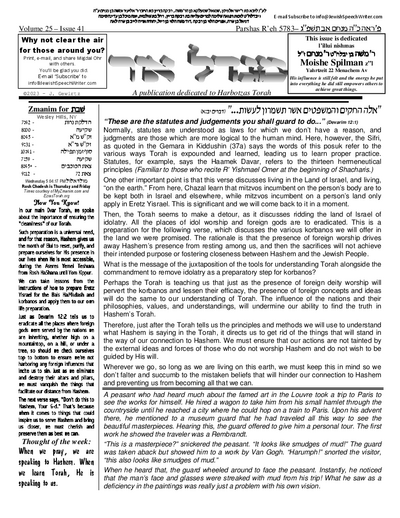
“These are the statutes and judgements you shall guard to do...” (Devarim 12:1)

Normally, statutes are understood as laws for which we don’t have a reason, and judgments are those which are more logical to the human mind. Here, however, the Sifri, as quoted in the Gemara in Kiddushin (37a) says the words of this posuk refer to the various ways Torah is expounded and learned, leading us to learn proper practice. Statutes, for example, says the Haamek Davar, refers to the thirteen hermeneutical principles (Familiar to those who recite R’ Yishmael Omer at the beginning of Shacharis.)

One other important point is that this verse discusses living in the Land of Israel, and living, “on the earth.” From here, Chazal learn that mitzvos incumbent on the person’s body are to be kept both in Israel and elsewhere, while mitzvos incumbent on a person’s land only apply in Eretz Yisrael. This is significant and we will come back to it in a moment.

Then, the Torah seems to make a detour, as it discusses ridding the land of Israel of idolatry. All the places of idol worship and foreign gods are to eradicated. This is a preparation for the following verse, which discusses the various korbanos we will offer in the land we were promised. The rationale is that the presence of foreign worship drives away Hashem’s presence from resting among us, and then the sacrifices will not achieve their intended purpose or fostering closeness between Hashem and the Jewish People.

What is the message of the juxtaposition of the tools for understanding Torah alongside the commandment to remove idolatry as a preparatory step for korbanos?

Perhaps the Torah is teaching us that just as the presence of foreign deity worship will pervert the korbanos and lessen their efficacy, the presence of foreign concepts and ideas will do the same to our understanding of Torah. The influence of the nations and their philosophies, values, and understandings, will undermine our ability to find the truth in Hashem’s Torah.

Therefore, just after the Torah tells us the principles and methods we will use to understand what Hashem is saying in the Torah, it directs us to get rid of the things that will stand in the way of our connection to Hashem. We must ensure that our actions are not tainted by the external ideas and forces of those who do not worship Hashem and do not wish to be guided by His will.

Wherever we go, so long as we are living on this earth, we must keep this in mind so we don’t falter and succumb to the mistaken beliefs that will hinder our connection to Hashem and preventing us from becoming all that we can.

Parable of the Peasant and the Louvre

A peasant who had heard much about the famed art in the Louvre took a trip to Paris to see the works for himself. He hired a wagon to take him from his small hamlet through the countryside until he reached a city where he could hop on a train to Paris. Upon his advent there, he mentioned to a museum guard that he had traveled all this way to see the beautiful masterpieces. Hearing this, the guard offered to give him a personal tour. The first work he showed the traveler was a Rembrandt.

“This is a masterpiece?” snickered the peasant. “It looks like smudges of mud!” The guard was taken aback but showed him to a work by Van Gogh. “Harumph!” snorted the visitor, “this also looks like smudges of mud.”

When he heard that, the guard wheeled around to face the peasant. Instantly, he noticed that the man’s face and glasses were streaked with mud from his trip! What he saw as a deficiency in the paintings was really just a problem with his own vision.

©2023 – J. Gewirtz

PDF Preview