Stop the Litter
L’Chaim | August 11, 2023
Print This Article
View Original PDF

Stop the Litter

L’Chaim | December 31, 2025

This week’s Torah portion, Re’eh, begins with the continuation of Moses’ words to the Jewish people before his passing: “Behold, I set before you today a blessing and a curse.” Thus G-d spoke to the Jewish people through Moses.

Jewish philosophical teachings explain that G-d is all good. How then can we understand this verse? What does it mean that G-d gives a curse?

The question is further compounded because in this instance; G-d refers to Himself as “Anochi.” Anochi means “I.” It is not a name of G-d. When G-d refers to himself as “Anochi” He is referring to His essence, greater than any of His names. How is it possible that the essence of G-d be connected to a curse?

Targum Yonaton translates the word “curse” (klolo) as “it’s exchange,” (chilufa). In other words there is a blessing and then something other. Similar but different.

There are different kinds of blessings. There are superficial blessings, the ones we all see; basic pleasures we recognize as good. Then there is a deeper good that comes into the world through difficulty and suffering. We don’t see them as blessings at the onset, however with time we recognize how they are truly blessings.

Many times, it’s the suffering that brings the greatest amount of change in the world.

So the verse could be understood like this: “Behold I give before you a revealed blessing and a concealed blessing.”

Anochi, G-d’s essence, then, is only connected to blessing—different kinds of blessing.

Unfortunately, no one is free from suffering. Recognizing that all of life’s challenges are from G-d will keep you positive, as you will be filled with a sense of deep purpose knowing that your struggle is making a difference.

May G-d send clear, open revealed blessing. There is no need for suffering anymore. We are all ready for Moshiach to come. May it happen now!

Adapted by Rabbi Yitzi Hurwitz from the teachings of the Rebbe, yitzihurwitz.blogspot.com. Rabbi Hurwitz, who is battling ALS, and his wife Dina, are emissaries of the Rebbe in Temecula, Ca.

Talmudic Story

The Talmud tells the following story about litter:

A man was clearing the stones from his field, as they were disturbing the growth of his produce. But, rather than disposing of the stones in a suitable area, he just did what was easiest for him: he threw them out onto the path in front of his property.

Passing by one day, as the landowner was throwing out stones, there was an old man who called out: “Oy, you fool! What are you doing? Why are you throwing stones from a place that isn’t yours onto a place that is yours?!”

The landowner stopped his work for a moment and looked at who was speaking to him. Then he laughed and said, “You are the fool! What are you saying? The opposite is true. I am throwing stones from my land onto public property!”

The old man shook his head and passed by. Throughout the rest of the day, the landowner would remember the conversation of earlier in the day and break out in laughter. As he continued clearing his field, he thought of the stupidity of that passerby.

Not too long afterward, the landowner found himself burdened with a huge debt. In order to pay it, he had to sell his field and he had to hire himself out as a laborer.

One day, as he was walking home from work, he began reminiscing about the good old days. Since he was not concentrating on the path in front of him, he tripped over a rock in the path in front of his former field. He just about managed to lift his bruised and aching body from the ground when he looked up and noticed where he was.

“Why, I’m right in front of my old field,” the landowner said aloud. And the stone that I just tripped over is undoubtedly one of the stones I threw out years ago! How right that old man was. My field is truly not mine any longer! And the path onto which I threw the stones belongs to me as it belongs to every person who passes over it. I myself caused this accident!”

Of course, no one would trip over a candy wrapper, a cigarette butt or food packaging littering the sidewalk. But like many stories from the Talmud, it can give us pause to consider how to live a more considerate and communally responsible life.
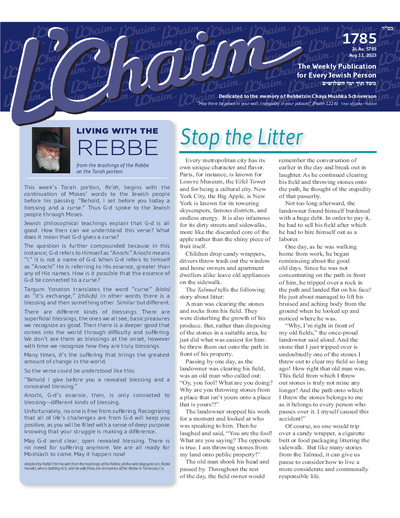
This week’s Torah portion, Re’eh, begins with the continuation of Moses’ words to the Jewish people before his passing: “Behold, I set before you today a blessing and a curse.” Thus G-d spoke to the Jewish people through Moses.

Jewish philosophical teachings explain that G-d is all good. How then can we understand this verse? What does it mean that G-d gives a curse?

The question is further compounded because in this instance; G-d refers to Himself as “Anochi.” Anochi means “I.” It is not a name of G-d. When G-d refers to himself as “Anochi” He is referring to His essence, greater than any of His names. How is it possible that the essence of G-d be connected to a curse?

Targum Yonaton translates the word “curse” (klolo) as “it’s exchange,” (chilufa). In other words there is a blessing and then something other. Similar but different.

There are different kinds of blessings. There are superficial blessings, the ones we all see; basic pleasures we recognize as good. Then there is a deeper good that comes into the world through difficulty and suffering. We don’t see them as blessings at the onset, however with time we recognize how they are truly blessings.

Many times, it’s the suffering that brings the greatest amount of change in the world.

So the verse could be understood like this: “Behold I give before you a revealed blessing and a concealed blessing.”

Anochi, G-d’s essence, then, is only connected to blessing—different kinds of blessing.

Unfortunately, no one is free from suffering. Recognizing that all of life’s challenges are from G-d will keep you positive, as you will be filled with a sense of deep purpose knowing that your struggle is making a difference.

May G-d send clear, open revealed blessing. There is no need for suffering anymore. We are all ready for Moshiach to come. May it happen now!

Adapted by Rabbi Yitzi Hurwitz from the teachings of the Rebbe, yitzihurwitz.blogspot.com. Rabbi Hurwitz, who is battling ALS, and his wife Dina, are emissaries of the Rebbe in Temecula, Ca.

Talmudic Story

The Talmud tells the following story about litter:

A man was clearing the stones from his field, as they were disturbing the growth of his produce. But, rather than disposing of the stones in a suitable area, he just did what was easiest for him: he threw them out onto the path in front of his property.

Passing by one day, as the landowner was throwing out stones, there was an old man who called out: “Oy, you fool! What are you doing? Why are you throwing stones from a place that isn’t yours onto a place that is yours?!”

The landowner stopped his work for a moment and looked at who was speaking to him. Then he laughed and said, “You are the fool! What are you saying? The opposite is true. I am throwing stones from my land onto public property!”

The old man shook his head and passed by. Throughout the rest of the day, the landowner would remember the conversation of earlier in the day and break out in laughter. As he continued clearing his field, he thought of the stupidity of that passerby.

Not too long afterward, the landowner found himself burdened with a huge debt. In order to pay it, he had to sell his field and he had to hire himself out as a laborer.

One day, as he was walking home from work, he began reminiscing about the good old days. Since he was not concentrating on the path in front of him, he tripped over a rock in the path in front of his former field. He just about managed to lift his bruised and aching body from the ground when he looked up and noticed where he was.

“Why, I’m right in front of my old field,” the landowner said aloud. And the stone that I just tripped over is undoubtedly one of the stones I threw out years ago! How right that old man was. My field is truly not mine any longer! And the path onto which I threw the stones belongs to me as it belongs to every person who passes over it. I myself caused this accident!”

Of course, no one would trip over a candy wrapper, a cigarette butt or food packaging littering the sidewalk. But like many stories from the Talmud, it can give us pause to consider how to live a more considerate and communally responsible life.

PDF Preview