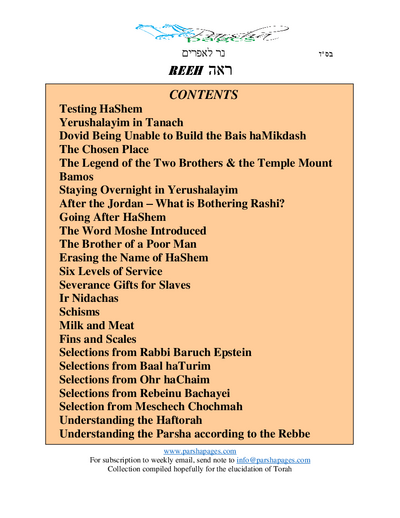
The Chosen Place
Parsha Pages | August 06, 2023
Based on P.G. Waxman
In Sefer Devarim, we are commanded 21 times to travel to, or do something in, “the place that HaShem will choose – 'ה יבחר אשר המקום אל.” The Rambam addresses the question: Why did HaShem not specify in the Torah that the Chosen Place is Yerushalayim?
He offers “three practical reasons” as to why the location was not disclosed:
- So that other nations not preempt Klal Yisroel and fight to occupy it.
- In order that other nations not destroy it.
- To prevent discord between the shevatim, as each shevet would want Yerushalayim to be included in its portion.
Hence, the Chosen Place was first disclosed after the land was divided and Klal Yisroel was united in peace under one king.
The following is a synopsis of additional answers from other commentators:
- The Chizkuni explains that the Chosen Place incorporates Shiloh, Nov, Givoan and Yerushalayim, with the Torah following the dictum that “one should always teach in an abbreviated manner.”
- The Kli Yakar answers that if Yerushalayim had been divulged as the Chosen Place, it would undermine Shiloh, Nov and Givoan, places of established Mishkan and Mikdosh that preceded the building of the Beis Hamikdosh in Yerushalayim.
- The Radak writes that HaShem did not want the Chosen Place to be revealed until Dovid was melech, because the choosing Dovid as king was a prerequisite for Yerushalayim being chosen as the designated place.
- Chazal give various reasons why Yerushalayim was not captured when Klal Yisroel entered Eretz Yisroel, but was conquered by Dovid Hamelech over 400 years later. The Sifri explains that the capture of Yerushalayim was deferred due to the oath that Avrahom Aveinu made to Avimelech. Pirkei D’Rebi Eliezer elaborates that Yerushalayim was not captured at the onset because of the oath that Avrahom made to the bnei Ches when he purchased a burial place for Sarah. The Radak suggests that HaShem caused the postponement because He wanted Dovid Hamelech, the leading king, to complete the capture of Yerushalayim in order that it be named for him. As the capture of Yerushalayim had to be postponed for these reasons, HaShem did not disclose that it was the Chosen Place until later so that it not appear that Klal Yisroel was tardy in taking possession of it.
- The Abarbanel writes that the Chosen Place was described in a cryptic manner to highlight that only one place was designated as a makom Hamikdosh, as compared to multiple places of worship that were prevalent by other nations.
- He also explains that the phrase, “the place that HaShem will choose,” comes to emphasize that the Chosen Place was chosen solely by HaShem and not designated by man as other areas of worship were.
- The Sfas Emes and the Malbim suggest that it was integral to the process that the Chosen Place be searched for. The pasuk speaks in future tense, “to the place that HaShem will choose,” because the designation occurred subsequent to Klal Yisroel searching for it and coming closer to it. Shmuel Hanavi and Dovid HaMelech had to look for the makom Hamikdosh; only then did HaShem complete the process and reveal its location through nevuah. Kedushah and Shechinah must be sought after, and are found by those who properly prepare for it and truly pursue it.
- Chazal state that in the future, kedushas Yerushalayim will extend to the entire Eretz Yisroel. This may be the reason why the Torah – whose message is eternal – omits specifying the current, limited geographic area of Yerushalayim.
- Rav Yisroel Rubin suggested that since at the outset any place in Eretz Yisroel had the potential to be designated as the chosen place of Shechinah, when Yerushalayim was chosen, the roshem of the initial broad kedushah remained in the areas that were not selected.
- The brother of the Maharal of Prague answers that the Chosen Place was not specified because it is a subjective frame of mind and encompasses one who “faces” and thinks eastward.
- The Gra, Nefesh Hachaim and Alshich elaborate that the primary mikdosh is in the inner hearts of those who make themselves into a dwelling place for the Shechinah. This may be a reason why the geographic location of Yerushalayim was not delineated.
- The Arizal and the Shelah ask: Why was there a commandment to bring korbanos outside of Eretz Yisroel when Klal Yisroel traveled in the desert for forty years? They explain that the parameters of Eretz Yisroel and the makom Hamikdosh extend and encompass places where Yidden gather for avodas HaShem and holiness. This may explain why the Torah does not specify that Yerushalayim is the location of the Chosen Place.
- Possibly, the question is negated because the terminology, “the place that HaShem will choose,” comes, not as a cryptic description of Yerushalayim, but as a primary name for the Beis Hamikdosh which expresses the underlying reason for its kedushah – it is holy because HaShem chose it. This is reflected in the Gemara’s wording, that the third mitzva to be implemented when Klal Yisroel settled in Eretz Yisroel was “livnos Beis Habechirah – to build the Chosen House.” This phraseology appears as well in Tefillas Musaf of Yom Tov, where we acknowledge our inability to ascend to, and bring the obligatory korbonos in, the “House of Your choice.” Likewise, the Rambam titles the laws pertaining to the Beis Hamikdosh as “Hilchos Beis Habechirah,” and in the Haggadah shel Pesach, the final line of Dayainu references the building of the Beis Habechirah.
- The word יבחר/בחר is universally translated as chose/will choose (pick/select). We say every morning “ashar bachar banu,” that HaShem chose us, in past tense. Likewise, before Krias Shema we say, “uvanu bacharta,” that HaShem chose us at Mattan Torah. Yet, the bracha concludes with “habocher b’amo Yisrael b’ahavah,” that HaShem chooses us with love – in current tense. If we were already chosen, how can it be a continuing process? Similarly, at the end of Yishtabach, we say “habocher b’shirei zimra,” that HaShem chooses (present tense) songs of praise. Weren’t they (Klal Yisrael who sing them or the words of Tehillim) already chosen? Likewise, what does the navi Zechariah mean, “ubachar od b’Yerushalayim,” that HaShem will again choose Yerushalayim? Wasn’t Yerushalayim already chosen, especially according to those who maintain that the initial kedushah was designated for all-time? Possibly that in this context, the word bachar means designated to be special, and can be translated as preferred or distinguished. We find this use by Paroh’s “rechev bachor,” his 600 preferred and special chariots, and by Yaakov Aveinu who is titled ”b’chir shebi’avos,” the distinguished and outstanding of the Avos. A single boy is called a bachor, not because he is chosen, but because he is special and pure due to his celibacy. At the end of the Haggadah, we praise the Ribbono Shel Olam, “Bachur kihalacha“ and “Bachur Hu,” respectively defined as “perfectly distinguished” and “He is distinguished” – not as chosen. If so, we can explain: Ahavah Rabbah culminates how HaShem lovingly and uniquely relates to Klal Yisrael on an ongoing basis.45 In Yishtabach we praise HaShem for preferring shirei zimra.46 The navi declares that HaShem will strengthen His unique bond with Yerushalayim, and the Torah repeatedly calls Yerushalayim, 'ה יבחר אשר המקום – “The place that HaShem will designate as special.” It is a description and not a physical delineation of a choice, negating the initial question.
- If 'ה יבחר אשר המקום is an isolated phrase, then the question arises: Why isn’t the geographic location specified? However, many times47 the phrase 'ה יבחר אשר המקום אל is quantified with the added words שם שמו לשכן/ לשום – to the place that HaShem will choose to place/dwell His name there. This is also expressed in Mussaf of Yom Tov and in Birchas Hamazon, “Your great and holy house, upon which Your name is assigned.” These supplementary words may diminish the question, as the pasuk comes to highlight the purpose of the Chosen Place.
- The Kli Yakor posits that the place of the Akeidah was not initially revealed to Avrahom Aveinu because the appreciation of kedushah is greater from a distance. Similarly, Rabbi Yisrael Reisman suggests, the Chosen Place remained mysterious and unspecified in order that Klal Yisrael not take it for granted and appreciate it more.
- Moreover, our fundamental belief in Moshiach contains an integral component, that we hope for and anticipate the Geulah. Possibly, the location of the Chosen Place was not revealed so that Klal Yisrael eagerly hope for and actively anticipate its fruition.
- The Chosen Place is defined as Yerushalayim. However, at times, the term seemingly refers to the makom Hamikdosh, such as when the pasuk describes where korbanos are sacrificed. Perhaps, the Torah uses a general term to describe both Yerushalayim and the Beis Hamikdosh as they are intertwined, and each was chosen because of the parallel choosing of the other. This overlap is reflected in the Mishnah in Avos which lists ten miracles that occurred in the Beis Hamikdosh, yet the last two took place in the city of Yerushalayim.
- We find that HaShem did not initially reveal to Avraham Aveinu where the Akeidah should take place in order to make the nisayon even greater. Yaakov Aveinu was also not initially told that he was in the makom Hamikdosh, as HaShem wanted him to sleep and receive nevuah there. Had the Torah specified the Chosen Place, Avraham would have identified the location where the Akeidah should take place, and it would be unbecoming for Yaakov to sleep there.
- In addition, Chazal teach that “ma’aseh avos siman l’banim” – what transpires to fathers foretells what will occur to their children. As HaShem did not reveal the Chosen Place to the Avos at the onset, He would not reveal it to their children by identifying it in the Torah.
- The word מקום – defined as a place that is a physical location, also translates as a spiritual “place” which is another name for the Shechinah. When Avrahom saw “the place” as he traveled to the Akeidah, and when Yaakov slept in “the place,” it refers to the presence of Shechinah that was there.55 Likewise, HaShem – Who encompasses and transcends every place – is called המקום, a name used when a mourner is comforted, in the tefillah Acheinu kul Bais Yisroel, and in the Haggadah, Baruch HaMakom. Maybe, the terminology 'ה יבחר אשר המקום relates to the Shechinah and spirituality that permeates the Chosen Place.56
- The pasuk says that when Yaakov Aveinu awoke, he became frightened as he realized that “this is the abode of HaShem and the gate of the heavens.” Rashi explains that our tefillos ascend heavenward, as the Mikdosh of above is synchronized with, and mirrors, the Mikdosh of below, and vice-versa. Perhaps, the Chosen Place is not specified because it transcends physical location and geographical boundaries, as its deeper meaning reflects the Mikdosh of above as well as the corresponding Mikdosh below – fused in unison and not limited by space or time.
View The Full Article (PDF)