The Good Society
BET Journal | August 21, 2025
Print This Article
View Original PDF

The Good Society

BET Journal | December 10, 2025

Having set out the prologue and preamble to the covenant and its general guiding principles, Moshe turns to the details, which will form most of the book of Devarim, from chapter 12 to chapter 26. But before he begins with the specifics, he states a proposal that is the most fundamental one in the book and one that will be repeated over and over by Israel’s Prophets:

“See, this day I set before you blessing and curse: blessing, if you obey the commandments of the Lord your G-d that I command you this day; and curse, if you do not obey the commandments of the Lord your G-d, but turn away from the path that I command you this day and follow other gods, whom you have not experienced.” (Devarim 11:26-28)

Simply put, if you behave well, things will go well. If you act badly, things will turn out badly. Behaving well means honoring our covenant with G-d, being faithful to Him, listening to His words, and following His commands. That was the foundation of the nation. Uniquely, it had G-d as its liberator and lawgiver, its sovereign, judge, and defender. Other nations had their gods, but none had a covenant with any of them, let alone with the Creator of Heaven and Earth.

There are things Israel must do in order to survive. Therefore, warns Moshe, beware of any temptation to act like the nations around you, copying their gods, their worship, or their practices. Their way is not yours. If you behave like them, you will perish like them. To survive and thrive, stay true to your faith, history, and destiny, your mission, calling, and task as a “Kingdom of Priests and a holy nation.”

As you act, so shall you fare. A free society is a moral achievement. A society is strong when it cares for the weak, rich when it cares for the poor, and invulnerable when it takes care of the vulnerable. Historically, the only ultimate guarantor of this is a belief in Someone greater than this time and place, greater than all time and place, who guides us in the path of righteousness, seeing all we do, urging us to see the world as His work, and humans as His image, and therefore, to care for both. Bein adam le-Makom and bein adam le-chavero – the duties we have to G-d and those we owe our fellow humans – are inseparable. Without a belief in G-d, we would pursue our own interests, and eventually, those at the social margins, with little power and less wealth, would lose. That is not the kind of society Jews are supposed to build.

The good society does not just happen. Nor is it created by the market (how we spend our money) or the state (the government). It is made from the moral choices of each of us. That is the basic message of Devarim: will we choose the blessing or the curse? As Moshe says at the end of the book: “This day I call the Heavens and the Earth as witnesses that I have set before you life and death, blessings and curses. Now choose life, so that you and your children may live.” (30:15, 19)

RABBI JONATHAN SACKS, Z”L
Having set out the prologue and preamble to the covenant and its general guiding principles, Moshe turns to the details, which will form most of the book of Devarim, from chapter 12 to chapter 26. But before he begins with the specifics, he states a proposal that is the most fundamental one in the book and one that will be repeated over and over by Israel’s Prophets:

“See, this day I set before you blessing and curse: blessing, if you obey the commandments of the Lord your G-d that I command you this day; and curse, if you do not obey the commandments of the Lord your G-d, but turn away from the path that I command you this day and follow other gods, whom you have not experienced.” (Devarim 11:26-28)

Simply put, if you behave well, things will go well. If you act badly, things will turn out badly. Behaving well means honoring our covenant with G-d, being faithful to Him, listening to His words, and following His commands. That was the foundation of the nation. Uniquely, it had G-d as its liberator and lawgiver, its sovereign, judge, and defender. Other nations had their gods, but none had a covenant with any of them, let alone with the Creator of Heaven and Earth.

There are things Israel must do in order to survive. Therefore, warns Moshe, beware of any temptation to act like the nations around you, copying their gods, their worship, or their practices. Their way is not yours. If you behave like them, you will perish like them. To survive and thrive, stay true to your faith, history, and destiny, your mission, calling, and task as a “Kingdom of Priests and a holy nation.”

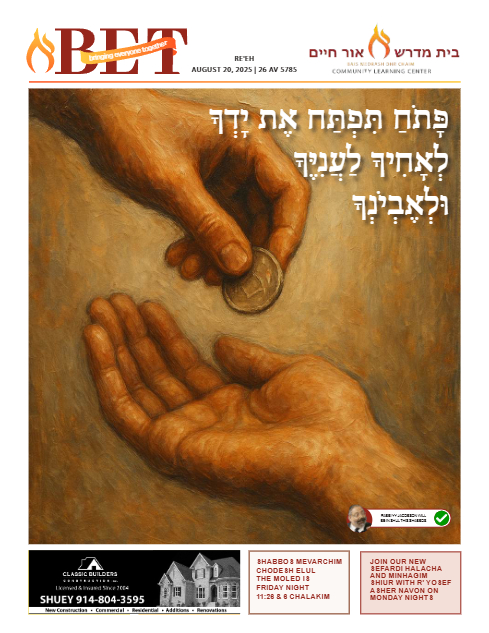
As you act, so shall you fare. A free society is a moral achievement. A society is strong when it cares for the weak, rich when it cares for the poor, and invulnerable when it takes care of the vulnerable. Historically, the only ultimate guarantor of this is a belief in Someone greater than this time and place, greater than all time and place, who guides us in the path of righteousness, seeing all we do, urging us to see the world as His work, and humans as His image, and therefore, to care for both. Bein adam le-Makom and bein adam le-chavero – the duties we have to G-d and those we owe our fellow humans – are inseparable. Without a belief in G-d, we would pursue our own interests, and eventually, those at the social margins, with little power and less wealth, would lose. That is not the kind of society Jews are supposed to build.

The good society does not just happen. Nor is it created by the market (how we spend our money) or the state (the government). It is made from the moral choices of each of us. That is the basic message of Devarim: will we choose the blessing or the curse? As Moshe says at the end of the book: “This day I call the Heavens and the Earth as witnesses that I have set before you life and death, blessings and curses. Now choose life, so that you and your children may live.” (30:15, 19)

RABBI JONATHAN SACKS, Z”L

PDF Preview