The Power of Vision in Parshas Re'eh
Print This Article
View Original PDF

The Power of Vision in Parshas Re'eh

הפצת המיינות חוצה | December 31, 2025

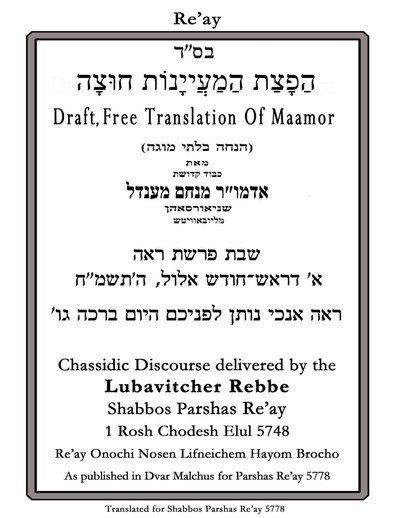
The Parsha starts off with the words of the Possuk: רְאֵה אָנֹכִי נֹתֵן לִפְנֵיכֶם הַיּוֹם בְרָכָה גּוֹ׳ “Behold, I set before you today a blessing ...”. The Alter Rebbe explains in this week’s Chassidishe Parsha of Likkutei Torah, highlighting the words of this Possuk רְאֵה אָנֹכִי נֹתֵן and says this refers to אָנֹכִי מִי שֶׁאָנֹכִי “I am who I am” ... נֹתֵן לִפְנֵיכֶם give you blessings to your פְנִים right into your inner core. Blessings are a state of ‘vision’ as they are visible and recognisable. (This differs from ‘admission’ which is based on belief as opposed to blessing which is akin to vision).

This explains אָנֹכִי נֹתֵן לִפְנֵיכֶם הַיּוֹם בְרָכָה that as a result of ‘HaShem setting inside us blessing’ from a supernal level of ‘Onochi’ we are able to reach a level of ‘רְאֵה’ vision, which is symbolic of ‘Bittul’ – self nullification at the lofty level of ‘Supernal Chochma’.

Clarifying Moshe's Request

Here we need clarification! This is because the Alter Rebbe explains in Likkutei Torah in (the Chassidishe Parsha of) Parshas Vo’eschanan, that when Moshe requested of HaShem אֶעְבְרָה־נָא וְאֶרְאֶה אֶת־הָאָרֶץ הַטּוֹבָה גּוֹ׳ “Let me cross over and see the good land”, what Moshe was really requesting, was to draw down into ‘Kenesses Yisroel’ a state of ‘Re’iyah’, – a state of ‘vision’ an ability for all Yisroel to see.

However, Moshe nevertheless was not able to achieve (practically) this mammoth task of drawing down the ability for all of Yisroel to have a ‘visual’ connection with HaShem, and [so] instead he drew down an ability for ‘Kenesses Yisroel’ to connect to HaShem through ‘listening’.

From Vision to Listening

This can be seen when Moshe says thereafter: וְעַתָה יִשְרָאֵל שְׁמַע גּוֹ׳ “And now Yisroel listen” ‘Listen’ being the operative word.

It can be said that this is also what the Possuk writes in Parshas Eikev (The Parsha after Vo’eschanan): וְהָיָה עֵקֶב תִשְׁמְעוּן גּוֹ׳ “And it will be, because you will listen” ‘Listen’ again being the operative word. [This is also] because Moshe Rabeinu was unable to draw down into the B’nei Yisroel the ability to connect to HaShem through [the level of] ‘vision’, but only the ability to connect through [the level of] ‘listening’.

Accordingly, the Possuk in our Parsha רְאֵה אָנֹכִי נֹתֵן לִפְנֵיכֶם הַיּוֹם גּוֹ׳ seems difficult to understand. Especially when the Alter Rebbe explains in Likkutei Torah our Possuk to mean “Drawing down the ability to connect to HaShem through the faculty of ‘vision’”.

The Faculty of Vision for Every Jew

This would imply that every single Jew not only has the ability to connect to and serve HaShem through his ‘auditory’ faculty but also through the faculty of ‘vision’-‘’רְאֵה.

An explanation however can be given [which] accords with that which Is stated in Likkutei Torah; [namely] that this Hamshocha that connects on a state of ‘vision’ comes from the [lofty Divine] level of אָנֹכִי מִי שֶׁאָנֹכִי. This means that this ‘Hamshocha’ from a state of ‘vision’ is only possible from the lofty level of נֹכִי מִי שֶׁאָנֹכִי where no letter or even sign can even hint at this Divine level.

Accordingly, it can be said, that where in Likkutei Torah in Parshas Vo’eschanan it explains that Moshe was unable to effectuate this connection (of ‘vision’), it refers to a ‘Hamshocha’ through the regular system of ‘Seder Hishtalshelus’ which are all lower levels than that of ‘Onochi’ because they have limitations.

Therefore, at best, Moshe was only able to affect a connection through an Avodah of ‘listening’ between the B’nei Yisroel and Hakodosh Boruch Hu, but not a deeper connection through the Avodah of ‘seeing’.

The Direct Gift from On High

Whereas, in this week’s Parsha in Likkutei Torah, when the Alter Rebbe says that everybody has access to a connection through the Avodah of ‘seeing’ [this is so] because this Hamshocha of ‘seeing’ is given to us directly from the lofty supernal level of ‘Onochi’ (אָנֹכִי נֹתֵן – I give). This is so because when the Hamshocha comes from the Divine level of אָנֹכִי מִי שֶׁאָנֹכִי there are no limitations so that every single Jew has the [unlimited] potential to attain this lofty level of ‘vision’ in G-dliness.

[This becomes] particularly so, according to the [interpretation of the] specific phraseology used by the Possuk; the word נֹתֵן which implies that there is a novel ‘gifting’ of this unique Hamshocha. The manner in which it is given is in accordance with the dictum “One who gives a gift gives it generously” so most certainly with regards to this lofty level there are no boundaries; and [thus] the potential to connect to HaShem through ‘vision’ is extended into Yisroel.

The Blessing and the Curse

With this explanation, we can now understand that which the Possuk writes: אָנֹכִי נֹתֵן לִפְנֵיכֶם הַיּוֹם בְרָכָה וּקְלָלָה “I set before you today a blessing and a curse”. For seemingly, according to that which has been explained above, what relevance does a curse have here amongst such a lofty and positive topic of discussion?

The answer is that the concept behind this curse is the ability to transform the curse into a blessing, just as one can transform transgressions into merits. That the ‘Koach’ for this Avodah originates also from the lofty Divine level of אָנֹכִי מִי שֶׁאָנֹכִי that it is Hakodosh Boruch Hu Himself that ‘gives generously’ ‘the ability to transform transgressions into merits’.
The Parsha starts off with the words of the Possuk: רְאֵה אָנֹכִי נֹתֵן לִפְנֵיכֶם הַיּוֹם בְרָכָה גּוֹ׳ “Behold, I set before you today a blessing ...”. The Alter Rebbe explains in this week’s Chassidishe Parsha of Likkutei Torah, highlighting the words of this Possuk רְאֵה אָנֹכִי נֹתֵן and says this refers to אָנֹכִי מִי שֶׁאָנֹכִי “I am who I am” ... נֹתֵן לִפְנֵיכֶם give you blessings to your פְנִים right into your inner core. Blessings are a state of ‘vision’ as they are visible and recognisable. (This differs from ‘admission’ which is based on belief as opposed to blessing which is akin to vision).

This explains אָנֹכִי נֹתֵן לִפְנֵיכֶם הַיּוֹם בְרָכָה that as a result of ‘HaShem setting inside us blessing’ from a supernal level of ‘Onochi’ we are able to reach a level of ‘רְאֵה’ vision, which is symbolic of ‘Bittul’ – self nullification at the lofty level of ‘Supernal Chochma’.

Clarifying Moshe's Request

Here we need clarification! This is because the Alter Rebbe explains in Likkutei Torah in (the Chassidishe Parsha of) Parshas Vo’eschanan, that when Moshe requested of HaShem אֶעְבְרָה־נָא וְאֶרְאֶה אֶת־הָאָרֶץ הַטּוֹבָה גּוֹ׳ “Let me cross over and see the good land”, what Moshe was really requesting, was to draw down into ‘Kenesses Yisroel’ a state of ‘Re’iyah’, – a state of ‘vision’ an ability for all Yisroel to see.

However, Moshe nevertheless was not able to achieve (practically) this mammoth task of drawing down the ability for all of Yisroel to have a ‘visual’ connection with HaShem, and [so] instead he drew down an ability for ‘Kenesses Yisroel’ to connect to HaShem through ‘listening’.

From Vision to Listening

This can be seen when Moshe says thereafter: וְעַתָה יִשְרָאֵל שְׁמַע גּוֹ׳ “And now Yisroel listen” ‘Listen’ being the operative word.

It can be said that this is also what the Possuk writes in Parshas Eikev (The Parsha after Vo’eschanan): וְהָיָה עֵקֶב תִשְׁמְעוּן גּוֹ׳ “And it will be, because you will listen” ‘Listen’ again being the operative word. [This is also] because Moshe Rabeinu was unable to draw down into the B’nei Yisroel the ability to connect to HaShem through [the level of] ‘vision’, but only the ability to connect through [the level of] ‘listening’.

Accordingly, the Possuk in our Parsha רְאֵה אָנֹכִי נֹתֵן לִפְנֵיכֶם הַיּוֹם גּוֹ׳ seems difficult to understand. Especially when the Alter Rebbe explains in Likkutei Torah our Possuk to mean “Drawing down the ability to connect to HaShem through the faculty of ‘vision’”.

The Faculty of Vision for Every Jew

This would imply that every single Jew not only has the ability to connect to and serve HaShem through his ‘auditory’ faculty but also through the faculty of ‘vision’-‘’רְאֵה.

An explanation however can be given [which] accords with that which Is stated in Likkutei Torah; [namely] that this Hamshocha that connects on a state of ‘vision’ comes from the [lofty Divine] level of אָנֹכִי מִי שֶׁאָנֹכִי. This means that this ‘Hamshocha’ from a state of ‘vision’ is only possible from the lofty level of נֹכִי מִי שֶׁאָנֹכִי where no letter or even sign can even hint at this Divine level.

Accordingly, it can be said, that where in Likkutei Torah in Parshas Vo’eschanan it explains that Moshe was unable to effectuate this connection (of ‘vision’), it refers to a ‘Hamshocha’ through the regular system of ‘Seder Hishtalshelus’ which are all lower levels than that of ‘Onochi’ because they have limitations.

Therefore, at best, Moshe was only able to affect a connection through an Avodah of ‘listening’ between the B’nei Yisroel and Hakodosh Boruch Hu, but not a deeper connection through the Avodah of ‘seeing’.

The Direct Gift from On High

Whereas, in this week’s Parsha in Likkutei Torah, when the Alter Rebbe says that everybody has access to a connection through the Avodah of ‘seeing’ [this is so] because this Hamshocha of ‘seeing’ is given to us directly from the lofty supernal level of ‘Onochi’ (אָנֹכִי נֹתֵן – I give). This is so because when the Hamshocha comes from the Divine level of אָנֹכִי מִי שֶׁאָנֹכִי there are no limitations so that every single Jew has the [unlimited] potential to attain this lofty level of ‘vision’ in G-dliness.

[This becomes] particularly so, according to the [interpretation of the] specific phraseology used by the Possuk; the word נֹתֵן which implies that there is a novel ‘gifting’ of this unique Hamshocha. The manner in which it is given is in accordance with the dictum “One who gives a gift gives it generously” so most certainly with regards to this lofty level there are no boundaries; and [thus] the potential to connect to HaShem through ‘vision’ is extended into Yisroel.

The Blessing and the Curse

With this explanation, we can now understand that which the Possuk writes: אָנֹכִי נֹתֵן לִפְנֵיכֶם הַיּוֹם בְרָכָה וּקְלָלָה “I set before you today a blessing and a curse”. For seemingly, according to that which has been explained above, what relevance does a curse have here amongst such a lofty and positive topic of discussion?

The answer is that the concept behind this curse is the ability to transform the curse into a blessing, just as one can transform transgressions into merits. That the ‘Koach’ for this Avodah originates also from the lofty Divine level of אָנֹכִי מִי שֶׁאָנֹכִי that it is Hakodosh Boruch Hu Himself that ‘gives generously’ ‘the ability to transform transgressions into merits’.

PDF Preview