How to Ruin a Relationship by Trying
זכרון יעקב | April 04, 2024
Print This Article
View Original PDF

How to Ruin a Relationship by Trying

זכרון יעקב | June 27, 2025

Edmund Burke famously said, "All that is necessary for the triumph of evil is that good men do nothing."

In stark contradistinction, this weeks' parsha points out that what good people need do, is not say anything.

A little background is required here. Aharon's two sons had just tragically died, cut off in the true prime of life. Moshe tries to comfort his brother and tells Aharon, don't think they died because they were bad, rather they died because they were good! (10:3)

If you have blood flowing through your veins then it's virtually impossible to not find that answer distinctly disturbing, and you would not be alone - for Aharon himself found it challenging.

It's important to understand that Moshe is not wrong here (of course, who am I to point that out), but sometimes truth is not what is needed. Like when your teenage daughter wants your opinion on her new fashion statement.

I should mention here that in Jewish tradition it isn't our place to foist upon mourners what we think are the reasons for their tragedy. Our responsibility is to mourn with them in silence unless they request something deeper. It's of the utmost importance to not impose your philosophy at a time like that. Mourning is often a time of confusion and the mourner needs their space to find peace, and we must respect that.

However, Moshe and Aharon knew each other very well, Moshe obviously knew what his brother wanted or needed to hear.

Nevertheless, Aharon felt compelled to respond, and I am sure many of us would too. So what did Aharon say?

The Torah actually tells us that he did not reply (ibid).

Just imagine if the Torah told us every time someone didn't say anything!

It surely only needed to not say anything and we would have figured it out. But the Torah is making a very important point here.

Aharon wanted to say something, but didn't.

So what could he have said? The Torah fails to tell us.

And that is precisely the point. If there were something Aharon could have said, it would have told us. But there was nothing to say.

And this is the truth, not having anything rarely stopped anyone from saying it.

Aharons' greatness was he realized there was nothing to say, and so he respected that truth.

Don't think this is a small lesson.

Relationships are rarely ruined because you didn't say what needed to be said, rather, it's because you couldn't keep from saying what did not need to be said.

As my wife curtly puts it, if you HAVE TO say it, you are going to say it wrong. When the words are burning in your mouth to spit them out, you will invariably make the situation worse by saying it.

This is not limited to the intimacies of family life, to paraphrase Warren Buffett, "You can always shoot them tomorrow." Meaning, if you need to say something bad, it can always wait.

So important is this idea that the Talmud declares, "The world exists only for those who curb their mouth in an argument." (Chullin 89a).

This is the story told to me of a couple who could not have children. They went to the greatest Rabbi alive, who told them to get a blessing from a person who controls their mouth after being insulted.

Not exactly something you can post on your facebook page.

Nevertheless, one day the husband was in Shul and a man walked in and rudely and loudly accused the person sitting next to him of the most abominable transgressions. It was vitriolic and vile. And just as the victim was about to let loose and give his accuser a real dressing down, our friend grabbed his hand and asked him to just let it go. When the accuser left he asked for a blessing, to which, I am pleased to say, they benefited a beautiful daughter.

The ability to say the right thing at the right time, is as Mishley points out, is like a golden apple in a silver tray (Proverbs 25:11). Disraeli was once accosted by an anti-Semite who asked him, "What is the difference between a Jew and a Pig?" He answered astutely, "About three feet."

You have to be Disraeli to answer like that. Most of us don't possess that kind of genius. To say the right thing at the right time, is a rare talent. But it's not a talent
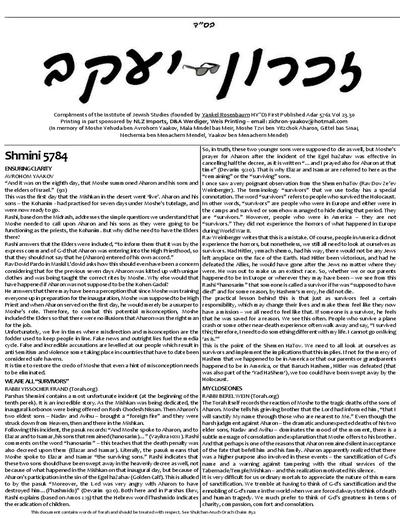

Edmund Burke famously said, "All that is necessary for the triumph of evil is that good men do nothing."

In stark contradistinction, this weeks' parsha points out that what good people need do, is not say anything.

A little background is required here. Aharon's two sons had just tragically died, cut off in the true prime of life. Moshe tries to comfort his brother and tells Aharon, don't think they died because they were bad, rather they died because they were good! (10:3)

If you have blood flowing through your veins then it's virtually impossible to not find that answer distinctly disturbing, and you would not be alone - for Aharon himself found it challenging.

It's important to understand that Moshe is not wrong here (of course, who am I to point that out), but sometimes truth is not what is needed. Like when your teenage daughter wants your opinion on her new fashion statement.

I should mention here that in Jewish tradition it isn't our place to foist upon mourners what we think are the reasons for their tragedy. Our responsibility is to mourn with them in silence unless they request something deeper. It's of the utmost importance to not impose your philosophy at a time like that. Mourning is often a time of confusion and the mourner needs their space to find peace, and we must respect that.

However, Moshe and Aharon knew each other very well, Moshe obviously knew what his brother wanted or needed to hear.

Nevertheless, Aharon felt compelled to respond, and I am sure many of us would too. So what did Aharon say?

The Torah actually tells us that he did not reply (ibid).

Just imagine if the Torah told us every time someone didn't say anything!

It surely only needed to not say anything and we would have figured it out. But the Torah is making a very important point here.

Aharon wanted to say something, but didn't.

So what could he have said? The Torah fails to tell us.

And that is precisely the point. If there were something Aharon could have said, it would have told us. But there was nothing to say.

And this is the truth, not having anything rarely stopped anyone from saying it.

Aharons' greatness was he realized there was nothing to say, and so he respected that truth.

Don't think this is a small lesson.

Relationships are rarely ruined because you didn't say what needed to be said, rather, it's because you couldn't keep from saying what did not need to be said.

As my wife curtly puts it, if you HAVE TO say it, you are going to say it wrong. When the words are burning in your mouth to spit them out, you will invariably make the situation worse by saying it.

This is not limited to the intimacies of family life, to paraphrase Warren Buffett, "You can always shoot them tomorrow." Meaning, if you need to say something bad, it can always wait.

So important is this idea that the Talmud declares, "The world exists only for those who curb their mouth in an argument." (Chullin 89a).

This is the story told to me of a couple who could not have children. They went to the greatest Rabbi alive, who told them to get a blessing from a person who controls their mouth after being insulted.

Not exactly something you can post on your facebook page.

Nevertheless, one day the husband was in Shul and a man walked in and rudely and loudly accused the person sitting next to him of the most abominable transgressions. It was vitriolic and vile. And just as the victim was about to let loose and give his accuser a real dressing down, our friend grabbed his hand and asked him to just let it go. When the accuser left he asked for a blessing, to which, I am pleased to say, they benefited a beautiful daughter.

The ability to say the right thing at the right time, is as Mishley points out, is like a golden apple in a silver tray (Proverbs 25:11). Disraeli was once accosted by an anti-Semite who asked him, "What is the difference between a Jew and a Pig?" He answered astutely, "About three feet."

You have to be Disraeli to answer like that. Most of us don't possess that kind of genius. To say the right thing at the right time, is a rare talent. But it's not a talent

PDF Preview


