Mosheh Heard and it Was Good in His Eyes
Sichos In English | April 25, 2025
Print This Article
View Original PDF

Mosheh Heard and it Was Good in His Eyes

Sichos In English | June 27, 2025

We can now turn to our questions. Moshe forgot a ruling that pertained only to offerings concerning the completion of the Mishkan, and not a ruling pertaining to offerings in general. As soon as Aharon spoke to him, he realized that Aharon was right, and immediately admitted without shame that he had erred when he was upset with what Aharon did. But he did not stop with a private admission. Rather, he made it heard (an alternative vowelization of the word וישמע, which normally means he heard) throughout the camp that he had erred. On a deeper level this, too, stems from his good eye. The Gemara says that a person doesn’t truly understand a Torah law until he stumbles concerning it.

Mosheh, who had never before “stumbled” over a Torah matter, was overjoyed when he understood from Aharon that he had erred – now he could truly understand the matter. Out of the greatness of his spiritual generosity (goodness of eye), he wanted to share this lesson with all of Yisrael, even if it would decrease in the reverence they had for him – after all, how often is it that other great people admit to being wrong? He thus sent a herald throughout the camp saying that he had erred and that Aharon had corrected him. In this manner, he hoped to teach them that one should be happy when he errs and is corrected in Torah matters, for that is the true way for them to learn.

The Eyes of Hashem – They Scan the Whole World

We can now understand why the passage begins with Aharon speaking of the eyes of Hashem, and then changing to the eyes of Mosheh. It was specifically because he was so happy to have erred and been corrected, to the degree that he sent a herald to that effect throughout the camp that, as it were, his eyes are compared to those of Hashem. His interest in the benefit of each and every Jew is comparable to The eyes of Hashem – they scan the whole world.
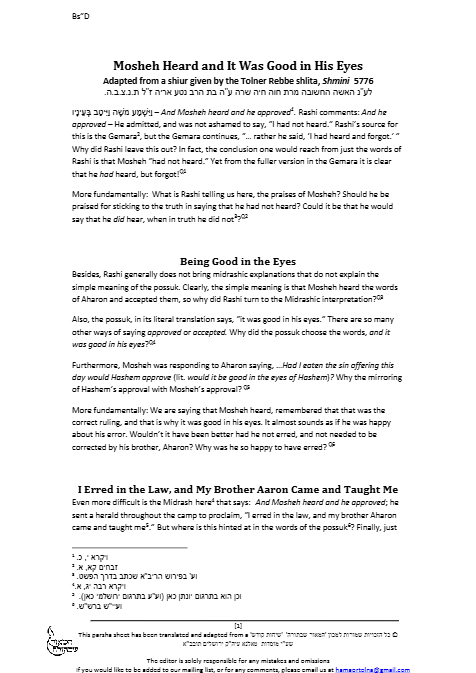

We can now turn to our questions. Moshe forgot a ruling that pertained only to offerings concerning the completion of the Mishkan, and not a ruling pertaining to offerings in general. As soon as Aharon spoke to him, he realized that Aharon was right, and immediately admitted without shame that he had erred when he was upset with what Aharon did. But he did not stop with a private admission. Rather, he made it heard (an alternative vowelization of the word וישמע, which normally means he heard) throughout the camp that he had erred. On a deeper level this, too, stems from his good eye. The Gemara says that a person doesn’t truly understand a Torah law until he stumbles concerning it.

Mosheh, who had never before “stumbled” over a Torah matter, was overjoyed when he understood from Aharon that he had erred – now he could truly understand the matter. Out of the greatness of his spiritual generosity (goodness of eye), he wanted to share this lesson with all of Yisrael, even if it would decrease in the reverence they had for him – after all, how often is it that other great people admit to being wrong? He thus sent a herald throughout the camp saying that he had erred and that Aharon had corrected him. In this manner, he hoped to teach them that one should be happy when he errs and is corrected in Torah matters, for that is the true way for them to learn.

The Eyes of Hashem – They Scan the Whole World

We can now understand why the passage begins with Aharon speaking of the eyes of Hashem, and then changing to the eyes of Mosheh. It was specifically because he was so happy to have erred and been corrected, to the degree that he sent a herald to that effect throughout the camp that, as it were, his eyes are compared to those of Hashem. His interest in the benefit of each and every Jew is comparable to The eyes of Hashem – they scan the whole world.

PDF Preview