Rewriting History
By Rabbi Moshe Hirschberg
Among Rabbi Dovid Braverman’s sacred work is visiting prisons to be mechazek fellow Yidden. To some, he offers words of chizuk; to others, he becomes a guide on their path toward becoming baalei teshuvah.
One day, he was taken on a tour of a prison wing he had never entered before — a section reserved for hardened criminals. What he saw there startled him. Seated among the rough, intimidating inmates was a young bachur — unmistakably a Bnei Brak child — his appearance and bearing entirely out of place in that environment. Rabbi Braverman restrained his curiosity, but something deep inside him was stirred.
As he exited the prison, he noticed the same young man waiting at the bus stop. He approached him and inquired as to where he was headed. When the bachur replied that he was traveling to Bnei Brak, Rabbi Braverman warmly invited him to join his ride.
Before Rabbi Braverman could even begin a conversation, the young man began telling his story.
“I grew up secular,” he said quietly. “I knew very little about my heritage. My life wasn’t really a life. My father was a sought-after thief, constantly on the run. I grew up with fear, instability, and tension. When I was still a child, I was adopted — by a Bnei Brak family.”
He paused.
“They showed me what life could be. For the first time, I experienced a family sitting around a table. No cellphones. No alcohol. Just warmth. Just Shabbos. Just meaning. I gravitated toward that life. It was a no-brainer. I integrated fully into their family and embraced their lifestyle. I wanted nothing to do with my past.
“Years went by. I was learning in Mesivta and studying Maseches Kiddushin, where it discusses the mitzvah of kibbud av v’eim. And I felt stuck. On the one hand, I desperately wanted to fulfill this sacred mitzvah. On the other hand, my father is a criminal behind bars. How am I meant to be mekayem such a mitzvah?”
He brought the question to Rabbi Mendel Shefrin, one of the respected rabbanim of Bnei Brak. “In a warm tone,” the bachur continued, “Rabbi Shefrin said, ‘I would not have instructed you to pursue the matter. But now that you are asking — yes, you should respect him and visit.’”
“How can I?” I asked. “What is there to respect?”
“Just go and visit,” Rabbi Shefrin told me. “Nothing more.”
“My first visit was about a month ago. As I entered, my father stood up to kiss me — but I wasn’t ready for that. I couldn’t receive it. Today,” he concluded, “when I visited, he extended his hand for a handshake, but I turned him down.”
Rabbi Braverman was silent.
Instead of dropping the young man off at his yeshivah, he made a sudden turn. They drove to Rechov Chazon Ish and stopped in front of a modest building marked simply: 5.
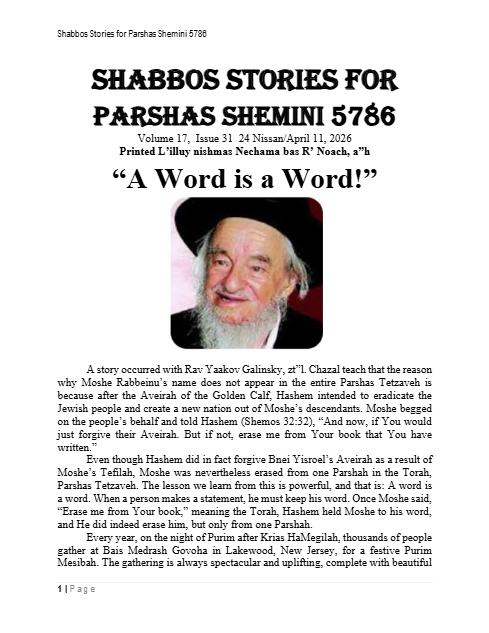
Rabbi Braverman led the bewildered bachur inside — to the home of the Rosh Yeshivah, Rabbi Aharon Leib Shteinman (1914-2017)
After briefly explaining the situation, the bachur was ushered into the room. The Rosh Yeshivah rose and extended both hands warmly. “Shalom Aleichem.” Then he said words that stunned the young man. “Ich bin dir mekaneh — I envy you.”
“Envy me?” the bachur replied incredulously. “There is nothing to envy.”
Rabbi Shteinman responded softly: “The reason I envy you is because you have parents — and I no longer do. I can no longer fulfill the obligation of respecting my parents.”
“Respect my parents?!” the young man burst out. “There is nothing worthy of respect! And if you want it, you can have it.”
Rabbi Aharon Leib Shteinman
Rabbi Shteinman’s eyes grew serious. “You are looking at your father’s face — and therefore all you see is his faults. You must learn to look at his neshamah. True kavod lies in the neshamah — the very same neshamah that stood at Har Sinai. That neshamah is now trapped in the darkness of galus. You cannot imagine the pain it endures.
“So, the next time you visit your father,” he concluded, “search for the part that is worthy of respect.”
The words lingered.
The next time the bachur visited the prison, his father did not attempt a hug or a kiss. He remembered the previous rejection. But this time, the son stepped forward — and embraced him.
It was no small embrace. It lasted until his clothing was damp from tears — tears he did not fully understand. As they slowly separated, his father looked at him and said: “This...this is what the Torah does to you? Then I want to learn some.”
And that was the real turning point.
Not when the son extended his hand. Not even when he accepted his hug. But when he chose to see a neshamah instead of a criminal.
Rabbi Braverman began visiting the father regularly during his prison rounds. Slowly, patiently, he drew him closer to his own buried neshamah, which had been lying in silent pain for decades.
When we learn to see the neshamah, we do not only rewrite someone else’s future. We can rewrite history.
Reprinted from Zichru Toras Moshe – Issue #245