Screaming My Name
The Jewish Weekly | April 01, 2024
Print This Article
View Original PDF

Screaming My Name

The Jewish Weekly | June 27, 2025

Years ago, I was in Florida for a few days and it happened to be raining. Given the inclement weather, my wife and I decided we’d go to the Sawgrass Mills mall for a few hours. We left Miami at 2:00 knowing that Mincha was at 5:20.

But, not native to Florida, I got so lost on my way driving to the mall that we only got there at 4:55. Knowing that Mincha was in a short while, I phoned the shul near Fort Lauderdale and asked how long it would take me to get from the mall to the shul. “40 minutes,” I was told. But that wasn’t good. “Can I make it in 25 minutes?”

Despite my question, I had the feeling that the answer was no. “It’s 4:55 and it’s rush hour. It’ll be at least 40 minutes.” Now, I knew that I don’t miss davening at a minyan and especially to miss it because I decided to go shopping. How could this happen? I had left for the mall with enough time to make it to Mincha, except I had gotten very lost and here I now was.

“Why don’t you ask if there’s a shul that’s closer to Sawgrass?” prompted my wife. Asking the shul secretary, I was told that there is a Lubavitch shul in Plantation. “I don’t know if they have a minyan every day though,” she said, “but it’s closer to you - 15 minutes away.”

That sounded like a great idea. I’d get there in time. Still unsure if they’d be having a minyan, I called the shul just in case. No answer, but I did find out the address. At this point, I figured that I should go on the off chance that they did have a minyan, and even if they didn’t, at least I’d be able to daven in a shul which is preferred to davening at home. So off I went, dropping my wife off at the mall.

The shul was located in a strip mall near a Walgreens in Plantation, which I had never heard of. I had gotten lost going to Fort Lauderdale, and had the feeling that I’d have no chance finding this small shul in 25 minutes. So, I went slowly, driving from one block to the next and asking at each corner how to get closer to the strip mall near Walgreens.

Time wasn’t stopping, and soon it was 5:15, then 5:20, and finally 5:25. I still didn’t know if there would be a minyan, and even if there would be, I missed it already. Eventually though, to my surprise and relief, I arrived at Walgreens and noticed the sign that read Chabad. I figured that even if I missed the minyan accidently, at least I’d be able to daven in a shul.

I came driving up, and standing outside the shul door was a man. “We need a minyan,” he said, “and you’re the man.” I walked in and I was the tenth guy.

As I took a seat, I understood why I needed to get lost. Had I not, I would have gone to Fort Lauderdale and the Chabad here would not have had a minyan. My whole getting lost and being worried that I was going to miss the minyan was all so that I could make a minyan to help these people. (Truthfully, maybe this is so, but maybe not. Had I not been the tenth man, they would have called another guy and they would have gotten a minyan anyway. It just so happened that Hashem arranged for me to be the tenth man both because they needed a minyan and I did too).

As I settled into the davening, I noticed an older man who I recognized. I couldn’t believe that I’d know anyone in Plantation, Florida, but something about him looked familiar. Keeping my thoughts to myself, as I finished Mincha, the man came over to me.

“You’re Rabbi Wallerstein, right?”

“I’m not speaking tonight,” I said, trying to play down any requests.

“No, you’re Rabbi Wallerstein. You know, my grandchildren were in your class.” I then put it together and figured out who he was. “I’d like you to be the Chazan for Arvit,” he said.

That wasn’t the only encounter I’d have that evening at the shul.

After I finished Maariv and started making my way out the door, a man accompanied me. Quickly, he turned to chatting with me. “So, you’re a rabbi and a rebbe?”

“Yeah, I am,” I said.

“I wanted to tell you who I am,” he then added. I didn’t think I knew him. After telling me his name, nothing registered, and I could tell he was surprised.

“You don’t recognize my name?” I shook my head.

“I was on the Israeli Olympic Soccer team five times. Doesn’t ring a bell?”

Half-jokingly I told him that if someone is not on the Yankees or Giants, I don’t know their name. With that, he began telling me about himself.

“I was on a team when I was pretty young, and as it happened, I sustained an injury. From that point on, I was never as good as I used to be. But then my father passed away, and I started saying Kaddish.”

As he said those words, I began to sense where he was going with the story. We tend to think that the Kaddish said by a child when their parent passes away is for the parent. And while that is true, the impact it has on the child is tremendous. Hundreds of thousands of Jewish people have become baalei teshuva later in their life when they had no choice but to go to shul.

Even those who are irreligious feel that for that year, they owe their parents to say Kaddish. Coming to shul, meeting people, giving tzedakah and keeping Shabbos becomes one of the last chances a person has, to do teshuva. So many times, through saying Kaddish, the child returns to Yiddishkeit. They’re not only helping their parent, but they are helping themselves.

“As I started saying Kaddish for my father,” continued the former Olympian, “I realized something profound. I used to walk into the sports arena and hear 50,000 people scream my name. You know what I do now? I’m a Chazan. I don’t have 50,000 people screaming my name, but I have hundreds of people screaming Amen.”

As I heard this, all I could think to myself was “Wow.” To this former world-class soccer player, hearing Amen when he davens in front of the shul gives him more appreciation and happiness than when he used to walk into an arena where there were thousands of people enamored with him. Now they scream Hashem’s Name.

After the man told me this, I fully realized why I ended up in Plantation, Florida. It wasn’t as much because they needed me for a minyan; Hashem could have arranged that someone else be the tenth man. It was because I needed to hear this from this former Olympian.

If you make it your business not to miss davening with a minyan, Hashem will give you the Siyata Dishmaya not only to make the minyan, but to learn something from every minyan you go to. And that day I learned a lesson I will never forget.

“I don’t have 50,000 people screaming my name, but I have hundreds of people screaming Amen.”

Reprinted from an email Newsletter of Torahanytime.com.
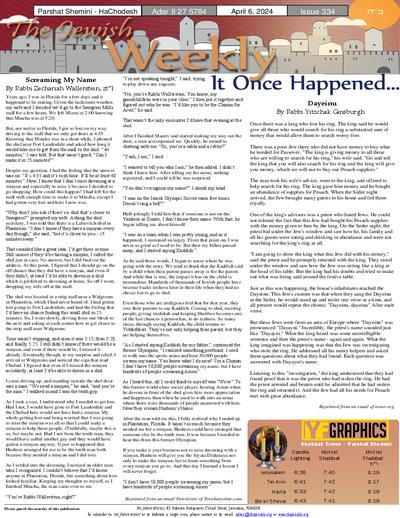
Years ago, I was in Florida for a few days and it happened to be raining. Given the inclement weather, my wife and I decided we’d go to the Sawgrass Mills mall for a few hours. We left Miami at 2:00 knowing that Mincha was at 5:20.

But, not native to Florida, I got so lost on my way driving to the mall that we only got there at 4:55. Knowing that Mincha was in a short while, I phoned the shul near Fort Lauderdale and asked how long it would take me to get from the mall to the shul. “40 minutes,” I was told. But that wasn’t good. “Can I make it in 25 minutes?”

Despite my question, I had the feeling that the answer was no. “It’s 4:55 and it’s rush hour. It’ll be at least 40 minutes.” Now, I knew that I don’t miss davening at a minyan and especially to miss it because I decided to go shopping. How could this happen? I had left for the mall with enough time to make it to Mincha, except I had gotten very lost and here I now was.

“Why don’t you ask if there’s a shul that’s closer to Sawgrass?” prompted my wife. Asking the shul secretary, I was told that there is a Lubavitch shul in Plantation. “I don’t know if they have a minyan every day though,” she said, “but it’s closer to you - 15 minutes away.”

That sounded like a great idea. I’d get there in time. Still unsure if they’d be having a minyan, I called the shul just in case. No answer, but I did find out the address. At this point, I figured that I should go on the off chance that they did have a minyan, and even if they didn’t, at least I’d be able to daven in a shul which is preferred to davening at home. So off I went, dropping my wife off at the mall.

The shul was located in a strip mall near a Walgreens in Plantation, which I had never heard of. I had gotten lost going to Fort Lauderdale, and had the feeling that I’d have no chance finding this small shul in 25 minutes. So, I went slowly, driving from one block to the next and asking at each corner how to get closer to the strip mall near Walgreens.

Time wasn’t stopping, and soon it was 5:15, then 5:20, and finally 5:25. I still didn’t know if there would be a minyan, and even if there would be, I missed it already. Eventually though, to my surprise and relief, I arrived at Walgreens and noticed the sign that read Chabad. I figured that even if I missed the minyan accidently, at least I’d be able to daven in a shul.

I came driving up, and standing outside the shul door was a man. “We need a minyan,” he said, “and you’re the man.” I walked in and I was the tenth guy.

As I took a seat, I understood why I needed to get lost. Had I not, I would have gone to Fort Lauderdale and the Chabad here would not have had a minyan. My whole getting lost and being worried that I was going to miss the minyan was all so that I could make a minyan to help these people. (Truthfully, maybe this is so, but maybe not. Had I not been the tenth man, they would have called another guy and they would have gotten a minyan anyway. It just so happened that Hashem arranged for me to be the tenth man both because they needed a minyan and I did too).

As I settled into the davening, I noticed an older man who I recognized. I couldn’t believe that I’d know anyone in Plantation, Florida, but something about him looked familiar. Keeping my thoughts to myself, as I finished Mincha, the man came over to me.

“You’re Rabbi Wallerstein, right?”

“I’m not speaking tonight,” I said, trying to play down any requests.

“No, you’re Rabbi Wallerstein. You know, my grandchildren were in your class.” I then put it together and figured out who he was. “I’d like you to be the Chazan for Arvit,” he said.

That wasn’t the only encounter I’d have that evening at the shul.

After I finished Maariv and started making my way out the door, a man accompanied me. Quickly, he turned to chatting with me. “So, you’re a rabbi and a rebbe?”

“Yeah, I am,” I said.

“I wanted to tell you who I am,” he then added. I didn’t think I knew him. After telling me his name, nothing registered, and I could tell he was surprised.

“You don’t recognize my name?” I shook my head.

“I was on the Israeli Olympic Soccer team five times. Doesn’t ring a bell?”

Half-jokingly I told him that if someone is not on the Yankees or Giants, I don’t know their name. With that, he began telling me about himself.

“I was on a team when I was pretty young, and as it happened, I sustained an injury. From that point on, I was never as good as I used to be. But then my father passed away, and I started saying Kaddish.”

As he said those words, I began to sense where he was going with the story. We tend to think that the Kaddish said by a child when their parent passes away is for the parent. And while that is true, the impact it has on the child is tremendous. Hundreds of thousands of Jewish people have become baalei teshuva later in their life when they had no choice but to go to shul.

Even those who are irreligious feel that for that year, they owe their parents to say Kaddish. Coming to shul, meeting people, giving tzedakah and keeping Shabbos becomes one of the last chances a person has, to do teshuva. So many times, through saying Kaddish, the child returns to Yiddishkeit. They’re not only helping their parent, but they are helping themselves.

“As I started saying Kaddish for my father,” continued the former Olympian, “I realized something profound. I used to walk into the sports arena and hear 50,000 people scream my name. You know what I do now? I’m a Chazan. I don’t have 50,000 people screaming my name, but I have hundreds of people screaming Amen.”

As I heard this, all I could think to myself was “Wow.” To this former world-class soccer player, hearing Amen when he davens in front of the shul gives him more appreciation and happiness than when he used to walk into an arena where there were thousands of people enamored with him. Now they scream Hashem’s Name.

After the man told me this, I fully realized why I ended up in Plantation, Florida. It wasn’t as much because they needed me for a minyan; Hashem could have arranged that someone else be the tenth man. It was because I needed to hear this from this former Olympian.

If you make it your business not to miss davening with a minyan, Hashem will give you the Siyata Dishmaya not only to make the minyan, but to learn something from every minyan you go to. And that day I learned a lesson I will never forget.

“I don’t have 50,000 people screaming my name, but I have hundreds of people screaming Amen.”

Reprinted from an email Newsletter of Torahanytime.com.

PDF Preview