The Halfway Points
BET Journal | April 25, 2025
Print This Article
View Original PDF

The Halfway Points

BET Journal | June 27, 2025

Moshe inquired in detail (10:16)
And (the Metzora) shall shave himself (13:33)
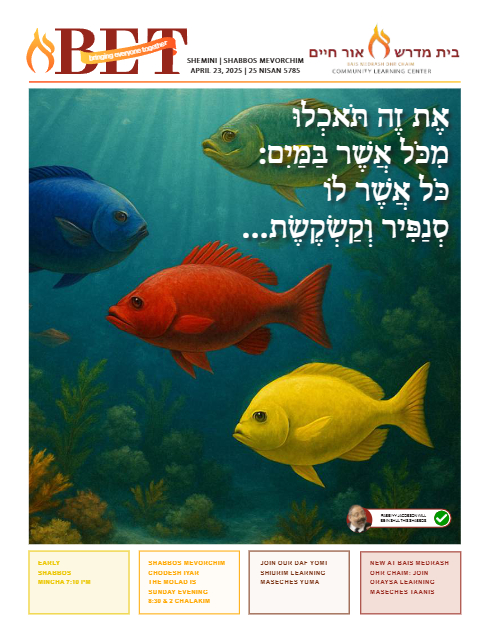
All that goes on its stomach (11:42)

The Gemara says (Kiddushin 30a) that the words דרש דרש are the halfway point of words in the Torah. The passuk that begins with והתגלח is the halfway point of the Torah in pessukim, and the letter ו in the word גחון is the halfway point of letters in the Torah.

The well-known and well-addressed question is that these words, letters, and pessukim are not the halfway point of their respective positions.

The Zera Shimshon (Avos 3:1) answers this question based on the Maharsha, who explains the abovementioned Gemara.

Throughout the generations, we find that numerous times, the Chachamim added on stringencies and restrictions that earlier generations did not have to keep. This usually occurs when the influence of the side of impurity gets stronger in the world. To counter this, the Jewish People, led by the Chachamim, have to take a stronger stand to protect the Torah. This can only be accomplished by adding protective measures and fences around the mitzvos of the Torah.

Although these new stringencies are not written in the Torah, and one may even say that based on the letter of the law and the simple understanding of the Torah, something should be permitted, this is a fundamental misunderstanding, and the reason for this serves as the answer to the question we began with.

Chazal teach (Sofrim 16:6) that Moshe Rabbeinu received the Torah with 49 ways of permitting (something in question) and 49 ways of forbidding (the very same thing). This is all dependent on the rav studying and ruling on the question. Therefore, although in earlier times, something may have been permitted, and it may even seem simple from the Torah that it is in fact permitted, in a later generation, it can be forbidden due to the Chachamim's understanding of the issues at hand and knowing how to understand the Torah from both angles - the 49 ways that permit and the 49 ways that forbid.

This is hinted to in the words דרש דרש and the fact that the Gemara says that these words are the halfway point of the Torah. Although when counting the words of the Torah, this is not the halfway point, the meaning of the Gemara is that the entire Torah revolves around the ability of the Chachamim to be דרש - sometimes, strictly, and other times, leniently. Hence, דרש דרש.

In fact, the very words דרש דרש show this. These words speak about how Moshe Rabbeinu asked why one of the korbanos was eaten (permitted), and the other one was burned (forbidden). The same idea explains why the passuk beginning with the word והתגלח is called the middle passuk of the Torah. Sometimes, the shaving process of the Metzora is to establish his impurity (forbidden; this is seen in that very passuk). And other times, the shaving of the Metzora is part of the process that purifies him (permitted; see Vayikra 14:8).

See Maharsha Kiddushin 30a for a further explanation of why the ו of גחון is the halfway point of the letters of the Torah.

ZERA SHIMSHON
ZERA SHIMSHON SHIUR BY RABBI SIMCHA BUNIM BURGER
THURSDAY 8:15 PM - 9:15 PM (20 Upstairs) Zera Shimshon Whatsapp Group
Moshe inquired in detail (10:16)
And (the Metzora) shall shave himself (13:33)
All that goes on its stomach (11:42)

The Gemara says (Kiddushin 30a) that the words דרש דרש are the halfway point of words in the Torah. The passuk that begins with והתגלח is the halfway point of the Torah in pessukim, and the letter ו in the word גחון is the halfway point of letters in the Torah.

The well-known and well-addressed question is that these words, letters, and pessukim are not the halfway point of their respective positions.

The Zera Shimshon (Avos 3:1) answers this question based on the Maharsha, who explains the abovementioned Gemara.

Throughout the generations, we find that numerous times, the Chachamim added on stringencies and restrictions that earlier generations did not have to keep. This usually occurs when the influence of the side of impurity gets stronger in the world. To counter this, the Jewish People, led by the Chachamim, have to take a stronger stand to protect the Torah. This can only be accomplished by adding protective measures and fences around the mitzvos of the Torah.

Although these new stringencies are not written in the Torah, and one may even say that based on the letter of the law and the simple understanding of the Torah, something should be permitted, this is a fundamental misunderstanding, and the reason for this serves as the answer to the question we began with.

Chazal teach (Sofrim 16:6) that Moshe Rabbeinu received the Torah with 49 ways of permitting (something in question) and 49 ways of forbidding (the very same thing). This is all dependent on the rav studying and ruling on the question. Therefore, although in earlier times, something may have been permitted, and it may even seem simple from the Torah that it is in fact permitted, in a later generation, it can be forbidden due to the Chachamim's understanding of the issues at hand and knowing how to understand the Torah from both angles - the 49 ways that permit and the 49 ways that forbid.

This is hinted to in the words דרש דרש and the fact that the Gemara says that these words are the halfway point of the Torah. Although when counting the words of the Torah, this is not the halfway point, the meaning of the Gemara is that the entire Torah revolves around the ability of the Chachamim to be דרש - sometimes, strictly, and other times, leniently. Hence, דרש דרש.

In fact, the very words דרש דרש show this. These words speak about how Moshe Rabbeinu asked why one of the korbanos was eaten (permitted), and the other one was burned (forbidden). The same idea explains why the passuk beginning with the word והתגלח is called the middle passuk of the Torah. Sometimes, the shaving process of the Metzora is to establish his impurity (forbidden; this is seen in that very passuk). And other times, the shaving of the Metzora is part of the process that purifies him (permitted; see Vayikra 14:8).

See Maharsha Kiddushin 30a for a further explanation of why the ו of גחון is the halfway point of the letters of the Torah.

ZERA SHIMSHON
ZERA SHIMSHON SHIUR BY RABBI SIMCHA BUNIM BURGER
THURSDAY 8:15 PM - 9:15 PM (20 Upstairs) Zera Shimshon Whatsapp Group

PDF Preview