The Rebbe Within Us
Shabbos Stories | March 31, 2026
Print This Article
View Original PDF

The Rebbe Within Us

Shabbos Stories | March 31, 2026

By Rabbi Paysach Krohn

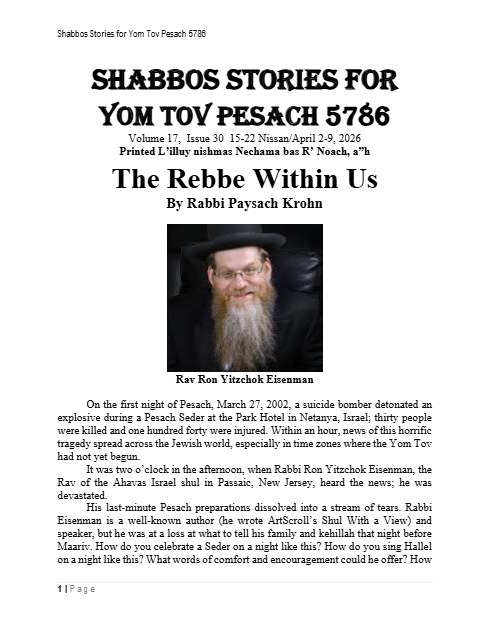
Rav Ron Yitzchok Eisenman

On the first night of Pesach, March 27, 2002, a suicide bomber detonated an explosive during a Pesach Seder at the Park Hotel in Netanya, Israel; thirty people were killed and one hundred forty were injured. Within an hour, news of this horrific tragedy spread across the Jewish world, especially in time zones where the Yom Tov had not yet begun.

It was two o’clock in the afternoon, when Rabbi Ron Yitzchok Eisenman, the Rav of the Ahavas Israel shul in Passaic, New Jersey, heard the news; he was devastated.

His last-minute Pesach preparations dissolved into a stream of tears. Rabbi Eisenman is a well-known author (he wrote ArtScroll’s Shul With a View) and speaker, but he was at a loss at what to tell his family and kehillah that night before Maariv. How do you celebrate a Seder on a night like this? How do you sing Hallel on a night like this? What words of comfort and encouragement could he offer? How could he give consolation when he was inconsolable? He davened quietly that Hashem give him the appropriate thoughts and words.

The Skverer Rebbe, Rabbi Dovid Twersky

And then he remembered an incident he had experienced years earlier. He was in New Square to attend the funeral of a Skverer chassid who was close to the Rebbe, Rabbi Dovid Twersky. Rabbi Eisenman describes the scene. “I arrived at the Beis Medrash in New Square and as I reached the steps leading to the Beis Medrash I noticed the Rebbe as he stood next to the aron. He was obviously very saddened by the demise of a beloved chassid. The levayah began and then the Rebbe spoke warmly but briefly. The niftar was then carried to a nearby cemetery for burial.”

Rabbi Eisenman followed the procession from the Beis Medrash to the cemetery and then returned to the Beis Medrash for Minchah and Maariv. Shortly after Maariv, he noticed that a chuppah had been erected exactly where the aron had rested just a few hours earlier.

A crowd gathered and soon a chassan and kallah were standing under the chuppah. The Rebbe stood next to the chuppah. As soon as the wedding ceremony concluded, the Rebbe moved toward the chassan and kallah and wished them a heartfelt Mazal Tov.

Rabbi Eisenman was astounded. Here the Rebbe stood wishing a new couple Mazal Tov with total sincerity and warmth while just an hour or two before he had been feeling the pain and the loss of a beloved chassid. How could he do this? Rabbi Eisenman realized then that the Rebbe was teaching him a lesson for life and that precise lesson was exactly what he conveyed to his kehillah on that first night of Pesach in 2002.

Rabbi Eisenman told his kehillah, “I am sure that at the chuppah, the Rebbe was still grieving over the loss of his beloved chassid; however, that grief did not preclude him from showing gladness and joy over the wedding of the young couple.

“My dear friends, I know we are in pain. I know our hearts are broken.

“However, we must not let our pain and our suffering destroy the Seder for our wives and our children. Our children have been waiting and preparing for months to ‘show off’ tonight. Our wives have been cooking and cleaning to make this night so special. Tonight, we must all be the Skverer Rebbe; although inside our hearts are pained and broken, outwardly we must be joyous and cheerful. This is the avodah of tonight.”

Rabbi Eisenman wondered what effect his words would have. He did not have to wait long. The next morning, Avigdor,* known in shul as Viggy, who usually did not have anything serious to say, came up to him and said, “Last night when I came home I was broken and crushed. I know you think I am the shul clown, but I have an elderly aunt and uncle who live in Netanya and they go to one of the local hotels for Pesach.

“When I came home, I was in no mood to lead a Seder. I was in no mood to smile at my little daughter’s recital of Mah Nishtanah in Yiddish. However, as she climbed on the chair and began to say the Mah Nishtanah, I thought of the Skverer Rebbe standing next to the aron and then just a few hours later next to the chuppah. Your words, ‘Tonight, we all must be the Skverer Rebbe,” echoed in my head. “I bit my lip, smiled and said to my daughter, ‘Please sing, Rivkeleh; please sing for us the Mah Nishtanah — it is the most beautiful song in the world.’

“My daughter sang the Mah Nishtanah, and my wife, my mother-in-law, and even I had tears in our eyes. What difference did it make that my tears were tinged with sadness? What difference did it make that inside I was broken? My daughter just saw the smile and that is all that matters. Thank you, Rabbi, for making this the most meaningful Seder in my life.”

Rabbi Eisenman now says with great heart and great perception, “Never forget that whatever your personal peckel of problems may be — on Seder night you are the Skverer Rebbe.”

By Rabbi Paysach Krohn

Rav Ron Yitzchok Eisenman

On the first night of Pesach, March 27, 2002, a suicide bomber detonated an explosive during a Pesach Seder at the Park Hotel in Netanya, Israel; thirty people were killed and one hundred forty were injured. Within an hour, news of this horrific tragedy spread across the Jewish world, especially in time zones where the Yom Tov had not yet begun.

It was two o’clock in the afternoon, when Rabbi Ron Yitzchok Eisenman, the Rav of the Ahavas Israel shul in Passaic, New Jersey, heard the news; he was devastated.

His last-minute Pesach preparations dissolved into a stream of tears. Rabbi Eisenman is a well-known author (he wrote ArtScroll’s Shul With a View) and speaker, but he was at a loss at what to tell his family and kehillah that night before Maariv. How do you celebrate a Seder on a night like this? How do you sing Hallel on a night like this? What words of comfort and encouragement could he offer? How could he give consolation when he was inconsolable? He davened quietly that Hashem give him the appropriate thoughts and words.

The Skverer Rebbe, Rabbi Dovid Twersky

And then he remembered an incident he had experienced years earlier. He was in New Square to attend the funeral of a Skverer chassid who was close to the Rebbe, Rabbi Dovid Twersky. Rabbi Eisenman describes the scene. “I arrived at the Beis Medrash in New Square and as I reached the steps leading to the Beis Medrash I noticed the Rebbe as he stood next to the aron. He was obviously very saddened by the demise of a beloved chassid. The levayah began and then the Rebbe spoke warmly but briefly. The niftar was then carried to a nearby cemetery for burial.”

Rabbi Eisenman followed the procession from the Beis Medrash to the cemetery and then returned to the Beis Medrash for Minchah and Maariv. Shortly after Maariv, he noticed that a chuppah had been erected exactly where the aron had rested just a few hours earlier.

A crowd gathered and soon a chassan and kallah were standing under the chuppah. The Rebbe stood next to the chuppah. As soon as the wedding ceremony concluded, the Rebbe moved toward the chassan and kallah and wished them a heartfelt Mazal Tov.

Rabbi Eisenman was astounded. Here the Rebbe stood wishing a new couple Mazal Tov with total sincerity and warmth while just an hour or two before he had been feeling the pain and the loss of a beloved chassid. How could he do this? Rabbi Eisenman realized then that the Rebbe was teaching him a lesson for life and that precise lesson was exactly what he conveyed to his kehillah on that first night of Pesach in 2002.

Rabbi Eisenman told his kehillah, “I am sure that at the chuppah, the Rebbe was still grieving over the loss of his beloved chassid; however, that grief did not preclude him from showing gladness and joy over the wedding of the young couple.

“My dear friends, I know we are in pain. I know our hearts are broken.

“However, we must not let our pain and our suffering destroy the Seder for our wives and our children. Our children have been waiting and preparing for months to ‘show off’ tonight. Our wives have been cooking and cleaning to make this night so special. Tonight, we must all be the Skverer Rebbe; although inside our hearts are pained and broken, outwardly we must be joyous and cheerful. This is the avodah of tonight.”

Rabbi Eisenman wondered what effect his words would have. He did not have to wait long. The next morning, Avigdor,* known in shul as Viggy, who usually did not have anything serious to say, came up to him and said, “Last night when I came home I was broken and crushed. I know you think I am the shul clown, but I have an elderly aunt and uncle who live in Netanya and they go to one of the local hotels for Pesach.

“When I came home, I was in no mood to lead a Seder. I was in no mood to smile at my little daughter’s recital of Mah Nishtanah in Yiddish. However, as she climbed on the chair and began to say the Mah Nishtanah, I thought of the Skverer Rebbe standing next to the aron and then just a few hours later next to the chuppah. Your words, ‘Tonight, we all must be the Skverer Rebbe,” echoed in my head. “I bit my lip, smiled and said to my daughter, ‘Please sing, Rivkeleh; please sing for us the Mah Nishtanah — it is the most beautiful song in the world.’

“My daughter sang the Mah Nishtanah, and my wife, my mother-in-law, and even I had tears in our eyes. What difference did it make that my tears were tinged with sadness? What difference did it make that inside I was broken? My daughter just saw the smile and that is all that matters. Thank you, Rabbi, for making this the most meaningful Seder in my life.”

Rabbi Eisenman now says with great heart and great perception, “Never forget that whatever your personal peckel of problems may be — on Seder night you are the Skverer Rebbe.”

PDF Preview