We Are All Survivors
זכרון יעקב | April 04, 2024
Print This Article
View Original PDF

We Are All Survivors

זכרון יעקב | June 27, 2025

Parshas Shemini contains a most unfortunate incident (at the beginning of the tenth perek). It is an incredible story. As the Mishkan was being dedicated, the inaugural korbonos were being offered on Rosh Chodesh Nissan. Then Aharon’s two eldest sons – Nadav and Avihu – brought a “foreign fire” and they were struck down from Heaven, then and there in the Mishkan.

Following this incident, the pasuk records: “And Moshe spoke to Aharon, and to Elazar and to Isamar, his sons that remained (hanosarim)...” (Vayikra 10:12). Rashi comments on the word “hanosarim” – this teaches that the death penalty was also decreed upon them (Elazar and Isamar). Literally, the pasuk means that Moshe spoke to Elazar and Isamar “the surviving sons.” Rashi indicates that these two sons should have been swept away in the heavenly decree as well, not because of what happened in the Mishkan on that inaugural day, but because of Aharon’s participation in the sin of the Egel haZahav (Golden Calf). This is alluded to by the pasuk “Moreover, the L-rd was very angry with Aharon to have destroyed him...(l’hashmido)” (Devarim 9:20). Both here and in Parshas Ekev, Rashi explains (based on Amos 2:9) that the Hebrew word l’hashmido indicates the eradication of children.

So, in truth, these two younger sons were supposed to die as well, but Moshe’s prayer for Aharon after the incident of the Egel haZahav was effective in cancelling half the decree, as it is written “...and I prayed also for Aharon at that time” (Devarim 9:20). That is why Elazar and Isamar are referred to here as the “remaining” or the “surviving” sons.

I once saw a very poignant observation from the Shemen haTov (Rav Dov Ze’ev Weinberger). The terminology “survivors” that we use today has a special connotation. The word “survivors” refers to people who survived the Holocaust. In other words, “survivors” are people who were in Europe and either were in the camps and survived or somehow managed to hide during that period. They are “survivors.” However, people who were in America – they are not “survivors.” They did not experience the horrors of what happened in Europe during World War II.

Rav Weinberger writes that this is a mistake. Of course, people in America did not experience the horrors, but nonetheless, we still all need to look at ourselves as survivors. Had Hitler, yemach shemo, had his way, there would not be any Jews left anyplace on the face of the Earth. Had Hitler been victorious, and had he defeated the Allies, he would have gone after the Jews no matter where they were. He was out to make us an extinct race. So, whether we or our parents happened to be in Europe or wherever they may have been – we see from this Rashi “hanosarim” that someone is called a survivor if he was “supposed to have died” and for some reason, by Hashem‘s mercy, he did not die.

The practical lesson behind this is that just as survivors feel a certain responsibility, which may change their lives and make them feel like they now have a mission – we all need to feel like that. If someone is a survivor, he feels that he was saved for a reason. We see this often. People who survive a plane crash or some other near-death experience often walk away and say, “I survived this; therefore, I need to do something different with my life. I cannot go on living ‘as is.'”

This is the point of the Shemen HaTov. We need to all look at ourselves as survivors and implement the implications that this implies. If not for the mercy of Hashem that we happened to be in America or that our parents or grandparents happened to be in America, or that Baruch Hashem, Hitler was defeated (that was also part of the ‘Yad HaShem‘), we too could have been swept away by the Holocaust.
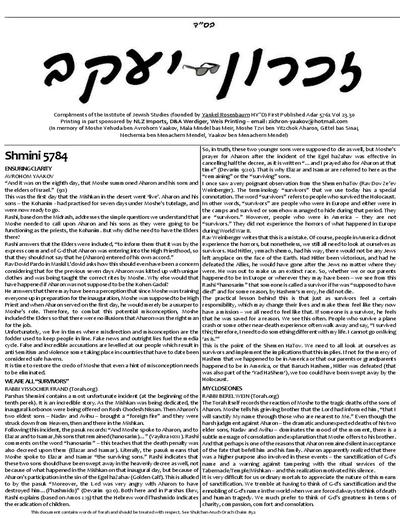

Parshas Shemini contains a most unfortunate incident (at the beginning of the tenth perek). It is an incredible story. As the Mishkan was being dedicated, the inaugural korbonos were being offered on Rosh Chodesh Nissan. Then Aharon’s two eldest sons – Nadav and Avihu – brought a “foreign fire” and they were struck down from Heaven, then and there in the Mishkan.

Following this incident, the pasuk records: “And Moshe spoke to Aharon, and to Elazar and to Isamar, his sons that remained (hanosarim)...” (Vayikra 10:12). Rashi comments on the word “hanosarim” – this teaches that the death penalty was also decreed upon them (Elazar and Isamar). Literally, the pasuk means that Moshe spoke to Elazar and Isamar “the surviving sons.” Rashi indicates that these two sons should have been swept away in the heavenly decree as well, not because of what happened in the Mishkan on that inaugural day, but because of Aharon’s participation in the sin of the Egel haZahav (Golden Calf). This is alluded to by the pasuk “Moreover, the L-rd was very angry with Aharon to have destroyed him...(l’hashmido)” (Devarim 9:20). Both here and in Parshas Ekev, Rashi explains (based on Amos 2:9) that the Hebrew word l’hashmido indicates the eradication of children.

So, in truth, these two younger sons were supposed to die as well, but Moshe’s prayer for Aharon after the incident of the Egel haZahav was effective in cancelling half the decree, as it is written “...and I prayed also for Aharon at that time” (Devarim 9:20). That is why Elazar and Isamar are referred to here as the “remaining” or the “surviving” sons.

I once saw a very poignant observation from the Shemen haTov (Rav Dov Ze’ev Weinberger). The terminology “survivors” that we use today has a special connotation. The word “survivors” refers to people who survived the Holocaust. In other words, “survivors” are people who were in Europe and either were in the camps and survived or somehow managed to hide during that period. They are “survivors.” However, people who were in America – they are not “survivors.” They did not experience the horrors of what happened in Europe during World War II.

Rav Weinberger writes that this is a mistake. Of course, people in America did not experience the horrors, but nonetheless, we still all need to look at ourselves as survivors. Had Hitler, yemach shemo, had his way, there would not be any Jews left anyplace on the face of the Earth. Had Hitler been victorious, and had he defeated the Allies, he would have gone after the Jews no matter where they were. He was out to make us an extinct race. So, whether we or our parents happened to be in Europe or wherever they may have been – we see from this Rashi “hanosarim” that someone is called a survivor if he was “supposed to have died” and for some reason, by Hashem‘s mercy, he did not die.

The practical lesson behind this is that just as survivors feel a certain responsibility, which may change their lives and make them feel like they now have a mission – we all need to feel like that. If someone is a survivor, he feels that he was saved for a reason. We see this often. People who survive a plane crash or some other near-death experience often walk away and say, “I survived this; therefore, I need to do something different with my life. I cannot go on living ‘as is.'”

This is the point of the Shemen HaTov. We need to all look at ourselves as survivors and implement the implications that this implies. If not for the mercy of Hashem that we happened to be in America or that our parents or grandparents happened to be in America, or that Baruch Hashem, Hitler was defeated (that was also part of the ‘Yad HaShem‘), we too could have been swept away by the Holocaust.

PDF Preview