Defining Ourselves Through Chassidus and the Rebbe
Cyber Farbrengens | January 09, 2026
Print This Article
View Original PDF

Defining Ourselves Through Chassidus and the Rebbe

Cyber Farbrengens | January 09, 2026

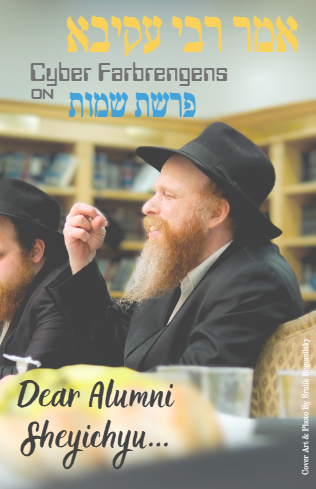
Dear Alumni Sheyichyu!
Sholom U’Brocho!
Mazeltov to Rabbi and Mrs. Dovid Perl on the birth of their daughter. Mazeltov to Rabbi and Mrs. Mendy Pellin on the birth of their son. Mazeltov to Rabbi and Mrs. Peretz Mishulovin on the birth of their son. May they bring them up lTOveCHuMAA”T mitoch harchovo, and to be true chayolim/os! (If anyone is aware of any mazeltov’s that I omitted please let me know). Thank you as always for the feedback, it is much appreciated.

Sometimes, Lubavitchers are accused of being chauvinistic; - everything is always about Lubavitch and about the Rebbe (which is not really true, but is it our fault that all of the best stories are about the Rebbe..). So just to maintain a balance, I will share with you now a Litvishe maaseh. I was recently at a community melaveh malka in Toronto, and I heard the following story from one of the respected Litvishe Rabbonim in town (who prefaced it by saying that motzoei Shabbos it is customary to relate a story, but he will say a Litvishe maaseh):

The Ponovezhe Rov, Rav Yosef Shlomo Kahaneman, was once in America to raise funds for his institutions. While there, he met with Rav Meir Schapiro, the Lubliner Rov and founder of Yeshivas Chachmei Lublin, the foremost chassidishe Yeshiva in Poland. The two conversed a bit, and then the Lubliner Rov said to the Ponevezhe Rov: “I would like to request a favour of you. I would like you to accompany me to a certain gvir who I am going to visit.

Rabbi Kahaneman was pleased to acquiesce, and they went together to visit this Yid who lived on the lower East Side of NY. The Jew welcomed them to his home warmly, and they conversed for a few minutes. After a bit, R’ Meir Schapiro asked the Ponovezhe Rov to excuse him, and he told the gvir that he would like to speak to him privately. They both left the room, while Rabbi Kahaneman waited. After a few moments they returned (undoubtedly R’ Meir Schapiro was holding a generous check), and, after saying their goodbyes, they left the house.

But Rabbi Kahaneman was puzzled. His presence there seemed to be, to him, superfluous (after all, R’ Meir Schapiro was well known to be a prodigious fundraiser). Why was he needed? Unable to come up with any explanation, he questioned the Lubliner Rov. The latter clarified: “Do you know what I said to him when we spoke privately? I said, ‘If you don’t support my Yeshiva (which is a chassidishe Yeshiva), then in the next generation, all of the Roshei Yeshivos are going to look like that yungerman!”

[To begin with, this may help us understand a story in Torah: When Yitzchok had his bar mitzvah (or his bris), Avrohom Avinu made a huge farbrengen. Chazal tell us that this was attended by the gedolei hador: Shem and Ever, Og and Avimelech. Which raises the question, Shem and Ever we can understand, they were the Roshei Yeshiva, they were respected and illustrious Rabbis. They were for sure worthy guests who added stature to the feast. But Og? He was a cynic, a heretic, who didn’t refrain from his blasphemous words even during that very banquet (as the midrash describes)?! Avimelech? The first person on record guilty of voyeurism, a person of questionable moral standards. Are these the important guests who dignify Avrohom’s celebration? But, perhaps, based on the above story, we can understand it better, they indeed served an important purpose. Perhaps they were there to give the message to Yitzchok: “You’d better learn and daven, and dedicate yourself to avodas Hashem; otherwise, a few years down the line you’ll be looking like some of those gedolim!”]

This is a question that we all need to ask ourselves. After all we are the products of the chassidisher Yeshiva, of Tomchei Tmimim. How would we have looked (and who would we have looked like) if not for Tomchei Tmimim? More specifically (or, perhaps, more importantly), in what way or ways do we look different (and behave differently, and think differently) as a result of Tomchei Tmimim; as a result of being chassidim and having learned chassidus?

We are chassidim, and, presumably, we are proud to be chassidim. But, Chassidim onu, be’mah? With what, in fact, are we chassidim? We need to be able to define–for ourselves–what impact chassidus had on us, each of us in an internal and personal manner.

There were once a few of the great chassidim of the Alter Rebbe, who were sitting together and farbrenging. The topic of discussion was about how one must sacrifice for chassidus,-in order to be a chosid. The various chassidim present were discussing their respective sacrifices for the sake of chassidus: One said: ‘If not for the fact that I am a chosid and devoted myself to chassidus, I would have been a Torah scholar on par with the shach and taz’. Another said: ‘If not for my dedication to chassidus I would have been recognized universally as a RaSHKeBeHaG’. The famous chosid, R’ Shmuel Munkes, was present at that farbrengen as well, and he remarked: ‘I, too, sacrificed for chassidus. Had I not been a chosid, I would have been a swindler. I would have cheated all of the misnagdim out of all of their money, and used it to buy mashkeh!’ [Although it is not so clear to me, had he not been a chosid, what would he need so much mashkeh for?]

We, too, have to be able to show, not just what we gave up for the sake of chassidus, but how we are definably different because of it. Everything that we learn in Chassidus needs to make a visible and pnimius’dige mark on every part of our being.

We are now preparing for Yud–Yud Aleph Shvat. It is the day that marks the beginning of dor hashvi’i,-the beginning of the nesius of the Rebbe. This is a time that, primarily, we all seek to strengthen our hiskashrus with the Rebbe. It is a time that it is most important for each of us to focus on this question: What exactly did I, and do I, learn from the Rebbe, and how, exactly, am I a different person because of it. We all read, surely, articles and write-ups, and perhaps even books, that elaborate on how the Rebbe revolutionized Jewish life and the entire world in our generation. But what is, arguably, equally important is the “olam katan zeh ho’odom”: A revolution is a change, even a drastic change. Every sicha and every maamar of the Rebbe that I learn, every farbrengen that I follow and even every story that I hear is meant to create a revolution in me;-to influence and impact my mindset. My way of thinking, of acting and of living need to be drastically changed. To achieve this, our original approach has to be geared towards this. Obviously, the first thing is that we have to take the time, more time, to learn these sichos and maamorim, and to learn them properly. But (perhaps more importantly) we have to learn them knowing and expecting that they are meant–designed–to change us, and with the willingness and desire to actually change.

There is a certain Litvishe Rosh Yeshiva, by the name of Rabbi Friedman, who gives a shiur in the Mir Yeshiva in Brooklyn (see, here’s another Litvishe story..), who occasionally reads the sichos of the Rebbe when they are given to him. Once, a bochur who was distributing the “Likras Shabbos” booklets (which is a short weekly collection of excerpts from the Torah of the Rebbe on the Parsha and current moadim), brought one to this Rosh Yeshiva. That particular Likras Shabbos included a sicha discussing a maamar Chazal about the comparison between Zocher es yom hashabbos and zocher es asher oso lecho Amolek. Rabbi Friedman read the...
Dear Alumni Sheyichyu!
Sholom U’Brocho!
Mazeltov to Rabbi and Mrs. Dovid Perl on the birth of their daughter. Mazeltov to Rabbi and Mrs. Mendy Pellin on the birth of their son. Mazeltov to Rabbi and Mrs. Peretz Mishulovin on the birth of their son. May they bring them up lTOveCHuMAA”T mitoch harchovo, and to be true chayolim/os! (If anyone is aware of any mazeltov’s that I omitted please let me know). Thank you as always for the feedback, it is much appreciated.

Sometimes, Lubavitchers are accused of being chauvinistic; - everything is always about Lubavitch and about the Rebbe (which is not really true, but is it our fault that all of the best stories are about the Rebbe..). So just to maintain a balance, I will share with you now a Litvishe maaseh. I was recently at a community melaveh malka in Toronto, and I heard the following story from one of the respected Litvishe Rabbonim in town (who prefaced it by saying that motzoei Shabbos it is customary to relate a story, but he will say a Litvishe maaseh):

The Ponovezhe Rov, Rav Yosef Shlomo Kahaneman, was once in America to raise funds for his institutions. While there, he met with Rav Meir Schapiro, the Lubliner Rov and founder of Yeshivas Chachmei Lublin, the foremost chassidishe Yeshiva in Poland. The two conversed a bit, and then the Lubliner Rov said to the Ponevezhe Rov: “I would like to request a favour of you. I would like you to accompany me to a certain gvir who I am going to visit.

Rabbi Kahaneman was pleased to acquiesce, and they went together to visit this Yid who lived on the lower East Side of NY. The Jew welcomed them to his home warmly, and they conversed for a few minutes. After a bit, R’ Meir Schapiro asked the Ponovezhe Rov to excuse him, and he told the gvir that he would like to speak to him privately. They both left the room, while Rabbi Kahaneman waited. After a few moments they returned (undoubtedly R’ Meir Schapiro was holding a generous check), and, after saying their goodbyes, they left the house.

But Rabbi Kahaneman was puzzled. His presence there seemed to be, to him, superfluous (after all, R’ Meir Schapiro was well known to be a prodigious fundraiser). Why was he needed? Unable to come up with any explanation, he questioned the Lubliner Rov. The latter clarified: “Do you know what I said to him when we spoke privately? I said, ‘If you don’t support my Yeshiva (which is a chassidishe Yeshiva), then in the next generation, all of the Roshei Yeshivos are going to look like that yungerman!”

[To begin with, this may help us understand a story in Torah: When Yitzchok had his bar mitzvah (or his bris), Avrohom Avinu made a huge farbrengen. Chazal tell us that this was attended by the gedolei hador: Shem and Ever, Og and Avimelech. Which raises the question, Shem and Ever we can understand, they were the Roshei Yeshiva, they were respected and illustrious Rabbis. They were for sure worthy guests who added stature to the feast. But Og? He was a cynic, a heretic, who didn’t refrain from his blasphemous words even during that very banquet (as the midrash describes)?! Avimelech? The first person on record guilty of voyeurism, a person of questionable moral standards. Are these the important guests who dignify Avrohom’s celebration? But, perhaps, based on the above story, we can understand it better, they indeed served an important purpose. Perhaps they were there to give the message to Yitzchok: “You’d better learn and daven, and dedicate yourself to avodas Hashem; otherwise, a few years down the line you’ll be looking like some of those gedolim!”]

This is a question that we all need to ask ourselves. After all we are the products of the chassidisher Yeshiva, of Tomchei Tmimim. How would we have looked (and who would we have looked like) if not for Tomchei Tmimim? More specifically (or, perhaps, more importantly), in what way or ways do we look different (and behave differently, and think differently) as a result of Tomchei Tmimim; as a result of being chassidim and having learned chassidus?

We are chassidim, and, presumably, we are proud to be chassidim. But, Chassidim onu, be’mah? With what, in fact, are we chassidim? We need to be able to define–for ourselves–what impact chassidus had on us, each of us in an internal and personal manner.

There were once a few of the great chassidim of the Alter Rebbe, who were sitting together and farbrenging. The topic of discussion was about how one must sacrifice for chassidus,-in order to be a chosid. The various chassidim present were discussing their respective sacrifices for the sake of chassidus: One said: ‘If not for the fact that I am a chosid and devoted myself to chassidus, I would have been a Torah scholar on par with the shach and taz’. Another said: ‘If not for my dedication to chassidus I would have been recognized universally as a RaSHKeBeHaG’. The famous chosid, R’ Shmuel Munkes, was present at that farbrengen as well, and he remarked: ‘I, too, sacrificed for chassidus. Had I not been a chosid, I would have been a swindler. I would have cheated all of the misnagdim out of all of their money, and used it to buy mashkeh!’ [Although it is not so clear to me, had he not been a chosid, what would he need so much mashkeh for?]

We, too, have to be able to show, not just what we gave up for the sake of chassidus, but how we are definably different because of it. Everything that we learn in Chassidus needs to make a visible and pnimius’dige mark on every part of our being.

We are now preparing for Yud–Yud Aleph Shvat. It is the day that marks the beginning of dor hashvi’i,-the beginning of the nesius of the Rebbe. This is a time that, primarily, we all seek to strengthen our hiskashrus with the Rebbe. It is a time that it is most important for each of us to focus on this question: What exactly did I, and do I, learn from the Rebbe, and how, exactly, am I a different person because of it. We all read, surely, articles and write-ups, and perhaps even books, that elaborate on how the Rebbe revolutionized Jewish life and the entire world in our generation. But what is, arguably, equally important is the “olam katan zeh ho’odom”: A revolution is a change, even a drastic change. Every sicha and every maamar of the Rebbe that I learn, every farbrengen that I follow and even every story that I hear is meant to create a revolution in me;-to influence and impact my mindset. My way of thinking, of acting and of living need to be drastically changed. To achieve this, our original approach has to be geared towards this. Obviously, the first thing is that we have to take the time, more time, to learn these sichos and maamorim, and to learn them properly. But (perhaps more importantly) we have to learn them knowing and expecting that they are meant–designed–to change us, and with the willingness and desire to actually change.

There is a certain Litvishe Rosh Yeshiva, by the name of Rabbi Friedman, who gives a shiur in the Mir Yeshiva in Brooklyn (see, here’s another Litvishe story..), who occasionally reads the sichos of the Rebbe when they are given to him. Once, a bochur who was distributing the “Likras Shabbos” booklets (which is a short weekly collection of excerpts from the Torah of the Rebbe on the Parsha and current moadim), brought one to this Rosh Yeshiva. That particular Likras Shabbos included a sicha discussing a maamar Chazal about the comparison between Zocher es yom hashabbos and zocher es asher oso lecho Amolek. Rabbi Friedman read the...

PDF Preview