Final Abstracts from Likkutei Sichos
Ben Chamesh L'Mikra | January 17, 2025
Print This Article
View Original PDF

Final Abstracts from Likkutei Sichos

Ben Chamesh L'Mikra | June 27, 2025

Serving G-d with all our abilities; with one’s essence (Kabolas Ol) and with one’s unique abilities (intellectual understanding)

Love for the oldest child vs. the youngest. Love to a young child is from one’s essence; whereas, for love to an older child one adds reason and appreciation.

Moshe’s Soul and the Nasi of Each Generation

Moshe’s soul enclothes itself in the Nasi of each generation. Since at the birth of Moshe, his house (his physical body) was filled with light (level of Emes); contrary to the nature of the body concealing the light of the soul. Birth of Moshe removed any negative effects of his death (same date ז' אדר).

Names of G-d in Galus

All the holy names of G-d are for us in Galus but are just names; this reference is connected. This reference to G-d, reflects His involvement and sharing of the Jews’ suffering in Galus (hidden mercy).

G-d’s Mercy in Exile

G-d’s Mercy is present and active in Exile, but its effects are concealed. Paradoxical behavior of mercy in Exile; it is concealed (Name not pronounced) and yet active (direct substitution).

Raising One’s Hand Against a Fellow Jew

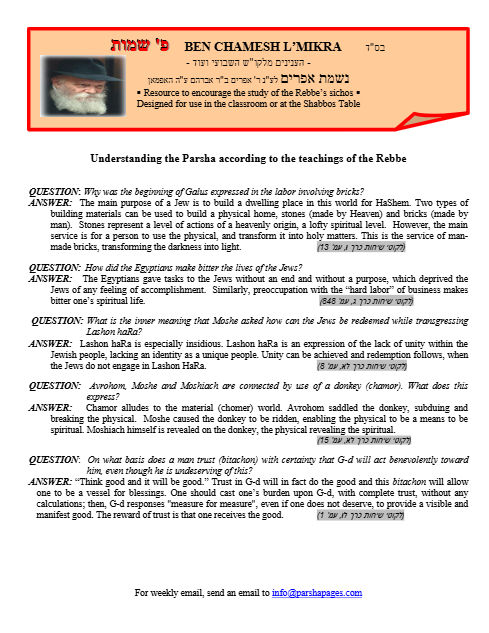
Raising one’s hand to help another beyond one’s limitations can affect the entire person. Three explanations of the prohibition to raise one’s hand against a fellow Jew. Just raising one’s hand is counter to the purpose of Creation (act for good).

The Ultimate Unity and Redemption

The ultimate unity, which brings the ultimate redemption, is one which comes from himself. Moshe saw Lashon HaRa as an indicator of the lack of unity among the Jews, thus, were unworthy of Redemption.

Chamor – Materiality and Redemption

Chamor - חומריות. Avodah of saddling, causing to ride, and use of the essence of physicality, leads to geulah. Avrohom’s relationship to the material (chumrius/chamor/donkey) was to subdue and break the physical. Moshe’s relationship was to make the physical a means for spiritual revelation. Moshiach’s relationship is that the physical itself should reveal the spiritual.

Bitachon and Trust in G-d

One should cast one’s burden upon G-d, with complete trust, without any calculations; then, G-d relates "measure for measure", even if the tally shows that one does not deserve, to provide good that is visibly and manifestly good. On what basis does a man trust (bitachon) with certainty that G-d will act benevolently toward him, even though he is undeserving of this? Think good and it will be good. Trust in G-d will in fact do the good and this bitachon will allow one to be a vessel for blessings.

Bitul and Receiving the Torah

Bitul to receive the Torah leads us to a higher level, the true freedom of release from one’s limitations. The Jews’ anticipation of receiving the Torah aroused a great love which caused a great merit, allowing for their redemption from Egypt.

Serving G-d with all our abilities; with one’s essence (Kabolas Ol) and with one’s unique abilities (intellectual understanding)

Love for the oldest child vs. the youngest. Love to a young child is from one’s essence; whereas, for love to an older child one adds reason and appreciation.

Moshe’s Soul and the Nasi of Each Generation

Moshe’s soul enclothes itself in the Nasi of each generation. Since at the birth of Moshe, his house (his physical body) was filled with light (level of Emes); contrary to the nature of the body concealing the light of the soul. Birth of Moshe removed any negative effects of his death (same date ז' אדר).

Names of G-d in Galus

All the holy names of G-d are for us in Galus but are just names; this reference is connected. This reference to G-d, reflects His involvement and sharing of the Jews’ suffering in Galus (hidden mercy).

G-d’s Mercy in Exile

G-d’s Mercy is present and active in Exile, but its effects are concealed. Paradoxical behavior of mercy in Exile; it is concealed (Name not pronounced) and yet active (direct substitution).

Raising One’s Hand Against a Fellow Jew

Raising one’s hand to help another beyond one’s limitations can affect the entire person. Three explanations of the prohibition to raise one’s hand against a fellow Jew. Just raising one’s hand is counter to the purpose of Creation (act for good).

The Ultimate Unity and Redemption

The ultimate unity, which brings the ultimate redemption, is one which comes from himself. Moshe saw Lashon HaRa as an indicator of the lack of unity among the Jews, thus, were unworthy of Redemption.

Chamor – Materiality and Redemption

Chamor - חומריות. Avodah of saddling, causing to ride, and use of the essence of physicality, leads to geulah. Avrohom’s relationship to the material (chumrius/chamor/donkey) was to subdue and break the physical. Moshe’s relationship was to make the physical a means for spiritual revelation. Moshiach’s relationship is that the physical itself should reveal the spiritual.

Bitachon and Trust in G-d

One should cast one’s burden upon G-d, with complete trust, without any calculations; then, G-d relates "measure for measure", even if the tally shows that one does not deserve, to provide good that is visibly and manifestly good. On what basis does a man trust (bitachon) with certainty that G-d will act benevolently toward him, even though he is undeserving of this? Think good and it will be good. Trust in G-d will in fact do the good and this bitachon will allow one to be a vessel for blessings.

Bitul and Receiving the Torah

Bitul to receive the Torah leads us to a higher level, the true freedom of release from one’s limitations. The Jews’ anticipation of receiving the Torah aroused a great love which caused a great merit, allowing for their redemption from Egypt.

PDF Preview