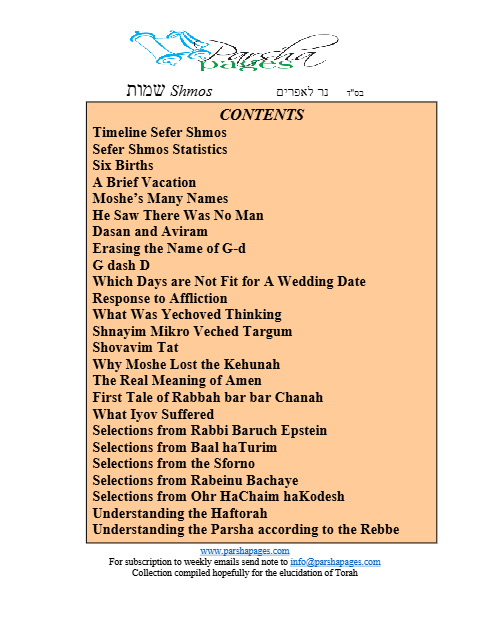
He Saw There Was No Man
Parsha Pages | January 17, 2025
Print This Article
View Original PDF

He Saw There Was No Man

Parsha Pages | June 27, 2025

Shmos 2,12 And he looked this way and that way, and when he saw that there was no man, he smote the Egyptian, and hid him in the sand.

The simplest reading of this verse is that prior to killing the Egyptian who was beating the Jew, Moshe looked around to make sure no one was looking.

“And he turned to and fro and he saw that there is no man” - Moshe engaged him by wrestling with him and easily tossed him to and fro. This brought him to realize that he was dealing with an "ein ish," a person with no great physical power. At this point Moshe smote him. (Rabbeinu Chaim Paltiel)

Moshe turned over two options in his mind, to either keep out of a fray that was not his, or to stand up and help someone, as per the mishnoh in Pirkei Avos, "B'mokome she'ein ish hishta'deil li'h'yos ISH." He saw that if he were to just look away, he would be an "ein ish," so he smote the Egyptian. (Abarbanel)

The Medrash as explained by Rashi means that Moshe took notice what the Egyptian had done to the Jew in his house (with his wife) and what he did to Jew in the field (beating him) and, Moshe “looked” to make sure that none of his descendants would convert, and then killed him.

Some philosophic questions: How could Moshe “see” that there were no converts, since he killed the Egyptian there would be no future converts since he had no future? Would such knowledge by a person take away the free will of the potential convert? How could Moshe’s knowledge of a potential “future” been absolute (if one potential future existed then many “futures” could also exist?

Halachically the commentators are bothered by why the potential of descendants’ future action should impact Moshe’s decision to put the Egyptian to death. Does halacha take descendants into account whenever a death sentence is issued?

The Gemara (Erchim 7a) states that if a pregnant woman is sentenced to death the penalty is not delayed until after she gives birth (also the story of Tamar). Also, Moshe was told to kill only the Midyan for what they had done (BeMidbar 25,17) Bava Kama (38b) says that Moshe thought to include Maov but G-d told him not to since Rus and Na’ama would come from that nation. However, the initial thought of Moshe was not to consider future descendants.

  1. Since a non-Jew is “only” obligated death by the hand of Heaven (Sanhedrin 58b), Moshe would not have killed the Egyptian unless he was not a “man” (one who would have descendants that converted). Mizrachi, Maharam Yafeh, Parshas haDerachim (Derush 10), Maharsha
  2. Since Moshe killed him with the Name of G-d (the 4-letter name, or, according to Rabeinu Bachaye, with the 42-letter Name) this was as is the Egyptian was killed by Heaven. Thus, death by Bais Din in this world does not concern itself with future descendants, but death by Heaven does take this into account. The Taz in his sefer Divrei David on Torah
  3. Since Moshe saw the wrong doing of the Egyptian (with the wife of the Jew) by mean of Ruach haKodesh, thus he was able to judge the Egyptian by means of Ruach haKodesh. Gur Aryeh
  4. It is permitted to kill a non-Jew in this world when they commit a wrong doing punishable by death by Heaven, only if one can determine that no convert would be from his descendants. Lechem haMishnah
  5. Since Moshe was only 12 years old at this time (per the Ramban) when he looked around and did not see an ISH (a person about the Bar-Mitzvah age), then Moshe was able to exact the punishment.
  6. Moshe used the method of killing by “cursing” with name of HaShem similar to the story of Elisha cursing and killing the youths that were make fun of him (Melachim II 2:23-34). The Gemara (Sotah 46b) says that Elisha killed them after seeing that there were Mitzvos in them or by their descendants. Perhaps Elisha worded his curse to include a stipulation that it only applies if the youth were so bereft of Mitzvos that there was no possibility of any good ever coming from them. The stipulation was fulfilled, and the curse became active. So was the case with Moshe, that is used a “curse” with a stipulation which was fulfilled. Nachalas Yaacov
  7. The death penalty for killing a non-Jew is not for the murder itself, but since the murdered person or their descendant might be righteous or a convert. Rabbi Chaim Vital states that only circumstances of witnesses being present to testify leading to the conviction would only occur, if no convert would emerge. Thus, when Moshe looked around and saw no witnesses, he knew no convert would occur in the future. Medrash Shmuel
Shmos 2,12 And he looked this way and that way, and when he saw that there was no man, he smote the Egyptian, and hid him in the sand.

The simplest reading of this verse is that prior to killing the Egyptian who was beating the Jew, Moshe looked around to make sure no one was looking.

“And he turned to and fro and he saw that there is no man” - Moshe engaged him by wrestling with him and easily tossed him to and fro. This brought him to realize that he was dealing with an "ein ish," a person with no great physical power. At this point Moshe smote him. (Rabbeinu Chaim Paltiel)

Moshe turned over two options in his mind, to either keep out of a fray that was not his, or to stand up and help someone, as per the mishnoh in Pirkei Avos, "B'mokome she'ein ish hishta'deil li'h'yos ISH." He saw that if he were to just look away, he would be an "ein ish," so he smote the Egyptian. (Abarbanel)

The Medrash as explained by Rashi means that Moshe took notice what the Egyptian had done to the Jew in his house (with his wife) and what he did to Jew in the field (beating him) and, Moshe “looked” to make sure that none of his descendants would convert, and then killed him.

Some philosophic questions: How could Moshe “see” that there were no converts, since he killed the Egyptian there would be no future converts since he had no future? Would such knowledge by a person take away the free will of the potential convert? How could Moshe’s knowledge of a potential “future” been absolute (if one potential future existed then many “futures” could also exist?

Halachically the commentators are bothered by why the potential of descendants’ future action should impact Moshe’s decision to put the Egyptian to death. Does halacha take descendants into account whenever a death sentence is issued?

The Gemara (Erchim 7a) states that if a pregnant woman is sentenced to death the penalty is not delayed until after she gives birth (also the story of Tamar). Also, Moshe was told to kill only the Midyan for what they had done (BeMidbar 25,17) Bava Kama (38b) says that Moshe thought to include Maov but G-d told him not to since Rus and Na’ama would come from that nation. However, the initial thought of Moshe was not to consider future descendants.

  1. Since a non-Jew is “only” obligated death by the hand of Heaven (Sanhedrin 58b), Moshe would not have killed the Egyptian unless he was not a “man” (one who would have descendants that converted). Mizrachi, Maharam Yafeh, Parshas haDerachim (Derush 10), Maharsha
  2. Since Moshe killed him with the Name of G-d (the 4-letter name, or, according to Rabeinu Bachaye, with the 42-letter Name) this was as is the Egyptian was killed by Heaven. Thus, death by Bais Din in this world does not concern itself with future descendants, but death by Heaven does take this into account. The Taz in his sefer Divrei David on Torah
  3. Since Moshe saw the wrong doing of the Egyptian (with the wife of the Jew) by mean of Ruach haKodesh, thus he was able to judge the Egyptian by means of Ruach haKodesh. Gur Aryeh
  4. It is permitted to kill a non-Jew in this world when they commit a wrong doing punishable by death by Heaven, only if one can determine that no convert would be from his descendants. Lechem haMishnah
  5. Since Moshe was only 12 years old at this time (per the Ramban) when he looked around and did not see an ISH (a person about the Bar-Mitzvah age), then Moshe was able to exact the punishment.
  6. Moshe used the method of killing by “cursing” with name of HaShem similar to the story of Elisha cursing and killing the youths that were make fun of him (Melachim II 2:23-34). The Gemara (Sotah 46b) says that Elisha killed them after seeing that there were Mitzvos in them or by their descendants. Perhaps Elisha worded his curse to include a stipulation that it only applies if the youth were so bereft of Mitzvos that there was no possibility of any good ever coming from them. The stipulation was fulfilled, and the curse became active. So was the case with Moshe, that is used a “curse” with a stipulation which was fulfilled. Nachalas Yaacov
  7. The death penalty for killing a non-Jew is not for the murder itself, but since the murdered person or their descendant might be righteous or a convert. Rabbi Chaim Vital states that only circumstances of witnesses being present to testify leading to the conviction would only occur, if no convert would emerge. Thus, when Moshe looked around and saw no witnesses, he knew no convert would occur in the future. Medrash Shmuel
PDF Preview