Insights from the Parsha
L’Chaim | January 02, 2024
Print This Article
View Original PDF

Insights from the Parsha

L’Chaim | December 31, 2025

These are the names of the Children of Israel coming into Egypt (Ex. 1:1)

The verse says “coming,” in the present tense, rather than “who came,” in the past tense. For the duration of the 210-year exile in Egypt, the Jews felt as if they had just arrived in that land. They never adopted Egyptian ways and always considered their sojourn temporary. (Ohel Yehoshua)

And she saw the child, and behold it was a weeping boy (Ex. 2:6)

We can learn (and emulate) three things from a child: He is always happy, he is always occupied and never sits idle, and when he wants something, he cries. (Reb Zussia of Annipoli)

And Moses was shepherding the flock of Jethro (Ex. 3:1)

A young goat once ran away from the rest of the flock Moses was tending in the desert. Moses followed the animal into a thicket that hid a pool of fresh water. Seeing the goat drinking he exclaimed, “I didn’t realize that you were thirsty. You must be so tired now.” After the animal had quenched its thirst, Moses tenderly picked it up and carried it back to the rest of the flock. When G-d saw Moses’s act of kindness toward his father-in-law’s goat, He decreed that Moses was equally worthy of tending G-d’s own flock--the Jewish People. (Midrash Rabba)

For I am heavy of speech, and heavy of tongue (Ex. 4:10)

The fact that Moses had difficulty speaking shows that his leadership was accepted solely because he carried G-d’s message, and not because he was a skillful orator and master of rhetoric. (Drashot Rabbenu Nissim)
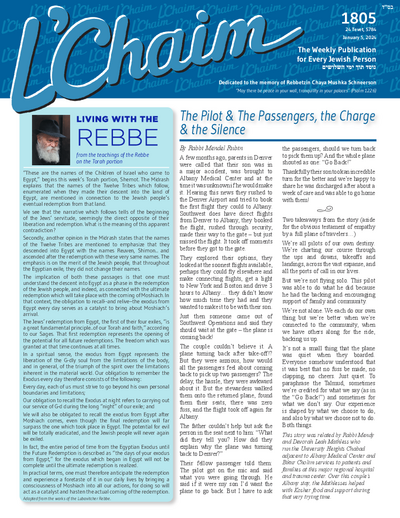

These are the names of the Children of Israel coming into Egypt (Ex. 1:1)

The verse says “coming,” in the present tense, rather than “who came,” in the past tense. For the duration of the 210-year exile in Egypt, the Jews felt as if they had just arrived in that land. They never adopted Egyptian ways and always considered their sojourn temporary. (Ohel Yehoshua)

And she saw the child, and behold it was a weeping boy (Ex. 2:6)

We can learn (and emulate) three things from a child: He is always happy, he is always occupied and never sits idle, and when he wants something, he cries. (Reb Zussia of Annipoli)

And Moses was shepherding the flock of Jethro (Ex. 3:1)

A young goat once ran away from the rest of the flock Moses was tending in the desert. Moses followed the animal into a thicket that hid a pool of fresh water. Seeing the goat drinking he exclaimed, “I didn’t realize that you were thirsty. You must be so tired now.” After the animal had quenched its thirst, Moses tenderly picked it up and carried it back to the rest of the flock. When G-d saw Moses’s act of kindness toward his father-in-law’s goat, He decreed that Moses was equally worthy of tending G-d’s own flock--the Jewish People. (Midrash Rabba)

For I am heavy of speech, and heavy of tongue (Ex. 4:10)

The fact that Moses had difficulty speaking shows that his leadership was accepted solely because he carried G-d’s message, and not because he was a skillful orator and master of rhetoric. (Drashot Rabbenu Nissim)

PDF Preview


