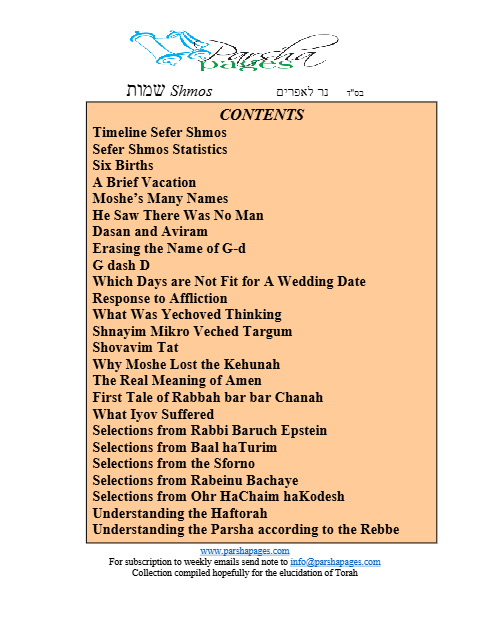
Shnayim Mikra Vechod Targum
"Shmos" – שמות This word is spelled Shin-Mem-Vov-Taf
We derive from these letters a mnemonic for Shnayim Mikra V’echod Targum, to say the weekly portion of the Torah twice in its original text and once in the text of Targum Onkeles (Shulchan Aruch O.Ch. 285:1).
An additional source is derived from the command at the crossing of the Yarden River that the Jews set up three sets of stones in three places. Two had the Torah in Hebrew and one was written in a translation.
Another source is that at Har Sinai, HaShem instructed to prepare for two days and Moshe added one more.
Why is this alluded to in the beginning of Shmos and not in the beginning of Bereishis?
The Otzar Chaim answers that since the beginning of Shmos relates the exile of all the bnei Yisroel to a foreign land, HaShem was assured that when the bnei Yisroel would learn the language of their new host country they would use it for Torah study, hence the need for Targum. However, HaShem wanted to impress upon us that the main language for Torah is Loshon Hakodesh. Therefore, the original text should be read twice, while the foreign translation is to be read only once.
When is the proper time to begin reviewing Parshas HaShavua?
Rav Huna the son of Yehuda said in the name of Rav Ami: One should always complete the weekly Torah portion with the community by reading the Torah text twice and the Targum translation once (Berachos 8a).
There are many opinions as to what time frame qualifies as “with the community.”
- From Shabbos Minchah: The opinion of Tosafos is that once the community begins to read the Parsha, namely from Minchah of Shabbos, that is already considered reading with the community.
- From Sunday: Rabainu Peretz and the Tur hold that one can start reading from Sunday. He explains that although the Parsha for the next week has already begun to be read Shabbos afternoon, still since the previous Parsha was read on that day one cannot read the next week's Parsha as well.
- From Wednesday: The Tashbatz cites this opinion and indicates that this was their custom.
- Friday morning: It is referenced in the name of the Ari that it is proper to read the Parsha after Shacharis on Friday morning.
- Friday afternoon: The Shelah HaKadosh holds that it should be read Friday after midday (חצות).
- On Shabbos itself: The Maharam MiRotenburg writes that the one should read the Parsha on Shabbos day, since this is truly completing the Parsha with the community.
The Shulchan Aruch (O.Ch. 288) writes that from Sunday and on is “with the community.” The Mishneh Berura understands this to mean from Shabbos Minchah. However, many understand the Shulchan Aruch to refer specifically to starting from Sunday.
When is the time to complete reviewing the Parshas HaShavua?
- Prior to Shabbos community reading of the Parsha: Tosafos Rosh
- Prior to the Shabbos day meal: Biur Halach complete prior to eating to avoid not finishing
- Prior to the community reading at Minchah of the next Parsha: Bedieved per the Tur
- Prior to the fourth day (Wednesday): Bedieved per Bais Yosef
- Until Simchas Torah: Rabeinu Simchah since completing the entire Torah and starting again.
What about Yom Tovim?
The Shulchan haAruch decides one does not do Shnayim Mikra V’echod Targum on the reading for Yom Tovim.
2 PLUS ONE
Mishneh Berurah explains that one has already completed the Torah portions in order which included the readings for Yom Tov. However, one should prepare the Haftorah for Yom Tov since one might be called up for Maftir and should be prepared for reading out loud for the community.
Do we always say the Targum?
(ברכות ח ב') Rav Huna son of Yehuda said in the name of Rebbi Ami, one should always complete the weekly Torah portion reading twice from the text and once from the Targum (Aramaic translation), even in this verse עטרות ודיבן(names of places from Bemidbar 32,3)
Rashi on the Gemara explains that this verse is a list of cities with no Targum (translation). Some question, why doesn’t the Sage give an example from a verse which mentions people’s names which also does not have a translation? Many attempt to answer this question.
Torah Temimah states the question from the Gemara does not involve the one-time reading of the Targum but questions the concept of the two-time reading from the Torah text. The explanation is that this whole verse is not needed to understand the flow of the text, neither the prior verse nor the subsequent verses. Thus, even if one skipped this verse entirely, one would not lack in the understanding of the matter of the Parsha. Therefore, one might think it would be permissible to say this verse only one time (and not two). Therefore, we do say it twice since we treat this verse like any other verse in the Torah. According to the great wisdom and understanding of our Sages, this is the only verse whose possible omission would not affect the understanding of the surrounding text.
Do we always learn the Targum (since nowadays most do not understand it)?
Shulchan Aruch states that if one learned with Perush Rashi, this is considered like Targum (Mordechai states that a Perush helps more). One who fears Shamayim should read the Targum and Perush Rashi.
Rav Amram Gaon disagrees. The Targum merits to be said with the Mikra because it was also given at Sinai.
Can one say Shnayim Mikra v'Echad Targum at night?
Kaf ha'Chayim (14): The Ariza”l says not to say it at night, for one should not say Targum at night. Ashrei ha'Ish (2:11:7, citing ha'Gaon R. Y.S. Elyashiv Ztz"l): One may say it at night. She'elas Rav (2:25:16): It is better to say Shnayim Mikra v'Echad Targum during the day. Sha'ar ha'Tziyun 238:1: Even the stringent opinion does not forbid Mikra at night, just better to learn it during the day.
Why do we read Shnayim Mikra v’Echad Targum?
- This is a remembrance for the community Torah reading which was also done with a “translator.”
- In order that people know and recognize the Parsha of the week; a form of Talmud Torah.
These different reasons are found in many possible practical differences in this halacha:
- Is the order to read each verse twice and then the Targum (like the communal reading) or one should read the entire Parsha and then read the Targum (once for recognition, once for more understanding and then the Perush for deeper understanding)?
- Does one have to complete the 2+1 prior to community reading or not?
- Is one able to count the community reading as one of the Mikra readings? (Mishneh Berurah 285:2)
- Does one need to say Targum or can one fulfill this concept with another Perush?
- Does one need to learn 2+1 for the Yom Tov readings?
- Perhaps applies when a person goes or leaves Eretz Yisrael during the week when different Parshas are read as to the question of which Parsha learns that week? (B’ztel haChochmah first volume #10)
- Are women obligated in this halacha? (Mishneh Halachos Volume 6. Siman #60)
- Does one read with the troupe? (Mishneh Berurah siman katan #17)
- Does one also need to read the Haftorah in advance? (Mishneh Berurah siman katan #19)
- Is it proper to add on Shabbos the first Aliyah from the next week’s Parsha? (Siach Yitzchak #153)