Stand Up for What Is Right
מגדל אור | January 09, 2026
Print This Article
View Original PDF

Stand Up for What Is Right

מגדל אור | January 09, 2026

(BK:A TWMw) „.IWYXT TBH LKW WHKYLwT HRAYH DWLYH IBH LK RMAL WME LKL HERP WCYW‰
“Pharaoh commanded his nation, saying, “Every boy that is born, into the river shall be cast, and every girl shall be kept alive.”” (Shemos 1:22)

We find two different times this king ruled that the Jewish children should be killed. Once, he told the Hebrew midwives to kill the boys on the birthing table. Then, later, when the stargazers saw that the Jewish savior would be born and meet his downfall through water, he decreed that every baby born should be cast into the Nile.

The question is, why wait and throw him in the river? If you specifically want to meet the water criterion, drown him in a bucket at birth. What’s the point of throwing him in the river where he might not die? It's like a villain trying to get rid of a hero and setting up an elaborate death plan, then leaving and not seeing it through to completion.

The commentaries point out that when he told the midwives to kill the babies, he did so only because his population demanded that he protect them by harming the Jews. There he is called “King of Egypt,” not “Pharaoh,” to indicate this was done only in order to remain in power. By ordering the midwives to do the dirty work, he could separate himself from it.

Later, when he had to command that Egyptians, as well as Jews, were to be killed, he opted for the requirement to throw them in the Nile. In this way, there was a chance they could escape, and he could avoid taking blame for their deaths by creating an arms-length distance. He could sleep at night knowing that he didn’t kill them, but that they were killed by the forces of nature.

So, what prompted this hesitation? Why was he afraid to kill all these people? Perhaps it was because deep down, he did not have the conviction that he was doing the right thing. Should he keep the Jews enslaved? Should he try to prevent their destiny? Despite his own belief that he was a deity, he may have questioned the correctness of his choices. He was afraid to answer to a higher power, so he was unwilling to put himself out there.

Contrast this to Pinchas who saw a terrible act and personally killed Zimri, or Shmuel, who took a sword and killed Agag, king of Amalek, without compunction. These men knew they were destroying evil and doing Hashem’s will, so they did it themselves. Pharaoh, who was in doubt, ordered others to do the killing and even opted for a less-sure means of doing it, to hedge his bets. Deep down, he knew the truth, that what he was doing was wrong. Therefore, he shied away from it.

This is a great lesson for us. Often there are things we wish to do but we know deep down they are wrong. We know that we should act a certain way, and when we don’t, we must build up a defense for why we are doing what we do. Don’t be foolish. Learn from Pharaoh to clearly identify whether your actions are right or wrong, and then don’t make the mistake he did of trying to stand on both sides of the fence at once. Be a man like Pinchas and Shmuel, and stand up for what is right.

When R’ Chaim Volozhiner z”l had the idea to found his famous yeshiva in Volozhin, which came to be the paradigm for the modern-day Yeshiva, he excitedly approached his Rebbi, R’ Eliyahu, the Gaon of Vilna. He was surprised and more than a little disappointed when the Gaon did not share his enthusiasm. He shelved the project.

A few years later, he still thought it was a good idea, so he approached the Vilna Gaon again. This time his Rebbi wished him well and told him it was a wonderful idea. He was confused. Previously, the Gaon had not thought highly of the concept. What changed?

“When you first came to me,” explained R’ Eliyahu, “you were so passionate and sure this was a great idea that I was afraid the Yetzer Hara was involved. But now that you have let your passion cool, and you still think it’s a good idea, I know your intentions are pure and your efforts will be blessed.”

©2025 – J. Gewirtz
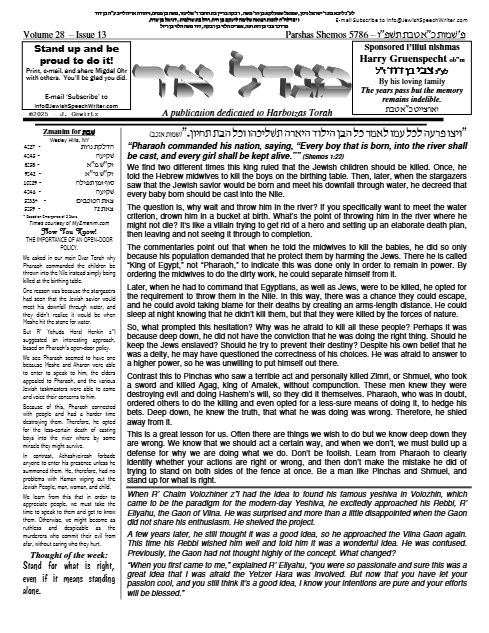
(BK:A TWMw) „.IWYXT TBH LKW WHKYLwT HRAYH DWLYH IBH LK RMAL WME LKL HERP WCYW‰
“Pharaoh commanded his nation, saying, “Every boy that is born, into the river shall be cast, and every girl shall be kept alive.”” (Shemos 1:22)

We find two different times this king ruled that the Jewish children should be killed. Once, he told the Hebrew midwives to kill the boys on the birthing table. Then, later, when the stargazers saw that the Jewish savior would be born and meet his downfall through water, he decreed that every baby born should be cast into the Nile.

The question is, why wait and throw him in the river? If you specifically want to meet the water criterion, drown him in a bucket at birth. What’s the point of throwing him in the river where he might not die? It's like a villain trying to get rid of a hero and setting up an elaborate death plan, then leaving and not seeing it through to completion.

The commentaries point out that when he told the midwives to kill the babies, he did so only because his population demanded that he protect them by harming the Jews. There he is called “King of Egypt,” not “Pharaoh,” to indicate this was done only in order to remain in power. By ordering the midwives to do the dirty work, he could separate himself from it.

Later, when he had to command that Egyptians, as well as Jews, were to be killed, he opted for the requirement to throw them in the Nile. In this way, there was a chance they could escape, and he could avoid taking blame for their deaths by creating an arms-length distance. He could sleep at night knowing that he didn’t kill them, but that they were killed by the forces of nature.

So, what prompted this hesitation? Why was he afraid to kill all these people? Perhaps it was because deep down, he did not have the conviction that he was doing the right thing. Should he keep the Jews enslaved? Should he try to prevent their destiny? Despite his own belief that he was a deity, he may have questioned the correctness of his choices. He was afraid to answer to a higher power, so he was unwilling to put himself out there.

Contrast this to Pinchas who saw a terrible act and personally killed Zimri, or Shmuel, who took a sword and killed Agag, king of Amalek, without compunction. These men knew they were destroying evil and doing Hashem’s will, so they did it themselves. Pharaoh, who was in doubt, ordered others to do the killing and even opted for a less-sure means of doing it, to hedge his bets. Deep down, he knew the truth, that what he was doing was wrong. Therefore, he shied away from it.

This is a great lesson for us. Often there are things we wish to do but we know deep down they are wrong. We know that we should act a certain way, and when we don’t, we must build up a defense for why we are doing what we do. Don’t be foolish. Learn from Pharaoh to clearly identify whether your actions are right or wrong, and then don’t make the mistake he did of trying to stand on both sides of the fence at once. Be a man like Pinchas and Shmuel, and stand up for what is right.

When R’ Chaim Volozhiner z”l had the idea to found his famous yeshiva in Volozhin, which came to be the paradigm for the modern-day Yeshiva, he excitedly approached his Rebbi, R’ Eliyahu, the Gaon of Vilna. He was surprised and more than a little disappointed when the Gaon did not share his enthusiasm. He shelved the project.

A few years later, he still thought it was a good idea, so he approached the Vilna Gaon again. This time his Rebbi wished him well and told him it was a wonderful idea. He was confused. Previously, the Gaon had not thought highly of the concept. What changed?

“When you first came to me,” explained R’ Eliyahu, “you were so passionate and sure this was a great idea that I was afraid the Yetzer Hara was involved. But now that you have let your passion cool, and you still think it’s a good idea, I know your intentions are pure and your efforts will be blessed.”

©2025 – J. Gewirtz

PDF Preview




