The Cure is Worse Than the Disease
זכרון יעקב | January 16, 2025
Print This Article
View Original PDF

The Cure is Worse Than the Disease

זכרון יעקב | June 27, 2025

This week, we fast forward to the time after the passing of the sons of Yaakov and the start of the Egyptian slavery.

Pharoah, seeing that the saviour of the Jewish people was about to the be born and that (as predicted by his soothsayers) he would perish by water, decreed that all newborn Jewish boys were to be drowned.

“A certain man of the house of Levi went and married a Levite woman.” (2:1)

The Talmud (Sotah 12a) provides us with the backstory.

Amram, the father of Moshe, was the great man of his generation. Once he saw that the wicked Pharaoh said: “Every son that is born you shall cast into the river, and every daughter you shall save alive” (1:22), he said: We are labouring for nothing by bringing children into the world to be killed. Therefore, he arose and divorced his wife. All others who saw this followed his example and arose and divorced their wives.

His daughter, Miriam, said to him: “Father, your decree is harsher for the Jewish people than that of Pharaoh, as Pharaoh decreed only with regard to the males, but you decreed both on the males and on the females. And now no children will be born. Additionally, Pharaoh decreed to kill them only in this world, but you decreed in this world and in the World-to-Come, as those not born will not enter the World-to-Come.”

Miriam continued: “Additionally, concerning Pharaoh the wicked, it is uncertain whether his decree will be fulfilled, and it is uncertain if his decree will not be fulfilled. You are a righteous person, and as such, your decrees will certainly be fulfilled...”

Amram accepted his daughter’s words and arose and remarried his wife, and all others who saw this followed his example and arose and brought back their wives.

Wasn’t Amram logically correct? Bringing children into the world just so that they could be killed seems wrong.

The Chofetz Chaim observes that when it comes to the continuity of the Jewish people, logic be damned.

Many of us lead lives of quiet desperation. We cannot see a way out of the struggles that we find ourselves. We wish we would never have made the poor decision, taken the ill-advised action or listened to the bad suggestion. If we could reverse time we would.

The story of Amram and Miriam is that no matter how awful the situation seems to be, never give up and never take actions that guarantee failure.
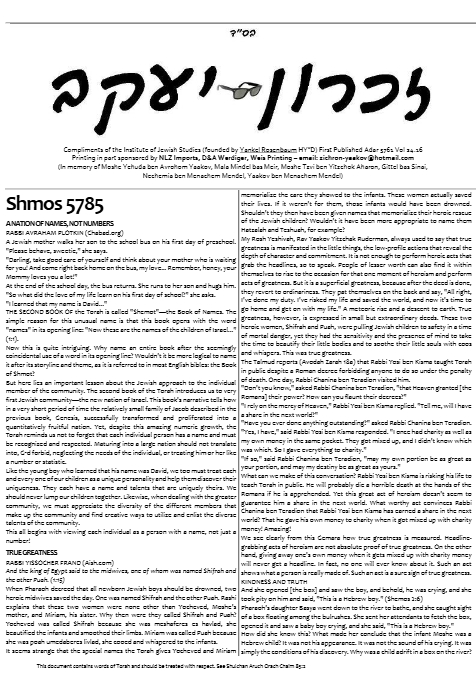
This week, we fast forward to the time after the passing of the sons of Yaakov and the start of the Egyptian slavery.

Pharoah, seeing that the saviour of the Jewish people was about to the be born and that (as predicted by his soothsayers) he would perish by water, decreed that all newborn Jewish boys were to be drowned.

“A certain man of the house of Levi went and married a Levite woman.” (2:1)

The Talmud (Sotah 12a) provides us with the backstory.

Amram, the father of Moshe, was the great man of his generation. Once he saw that the wicked Pharaoh said: “Every son that is born you shall cast into the river, and every daughter you shall save alive” (1:22), he said: We are labouring for nothing by bringing children into the world to be killed. Therefore, he arose and divorced his wife. All others who saw this followed his example and arose and divorced their wives.

His daughter, Miriam, said to him: “Father, your decree is harsher for the Jewish people than that of Pharaoh, as Pharaoh decreed only with regard to the males, but you decreed both on the males and on the females. And now no children will be born. Additionally, Pharaoh decreed to kill them only in this world, but you decreed in this world and in the World-to-Come, as those not born will not enter the World-to-Come.”

Miriam continued: “Additionally, concerning Pharaoh the wicked, it is uncertain whether his decree will be fulfilled, and it is uncertain if his decree will not be fulfilled. You are a righteous person, and as such, your decrees will certainly be fulfilled...”

Amram accepted his daughter’s words and arose and remarried his wife, and all others who saw this followed his example and arose and brought back their wives.

Wasn’t Amram logically correct? Bringing children into the world just so that they could be killed seems wrong.

The Chofetz Chaim observes that when it comes to the continuity of the Jewish people, logic be damned.

Many of us lead lives of quiet desperation. We cannot see a way out of the struggles that we find ourselves. We wish we would never have made the poor decision, taken the ill-advised action or listened to the bad suggestion. If we could reverse time we would.

The story of Amram and Miriam is that no matter how awful the situation seems to be, never give up and never take actions that guarantee failure.

PDF Preview