The Importance of Support Systems
Torah Sweets | January 09, 2026
Print This Article
View Original PDF

The Importance of Support Systems

Torah Sweets | January 09, 2026

During a support group meeting for people addicted to plastic surgery, the head of the group looked at the attendants and remarked, "I'm seeing a lot of new faces this week, and I have to say I'm pretty disappointed."

Support systems play a vital role in our lives, providing us with the necessary assistance, encouragement, and guidance during various challenges and endeavors. The American Psychological Association's 2023 Stress in America survey found two-thirds of adults felt they have lacked emotional support in their lives, with many feelings misunderstood. This week’s Parsha highlights the importance of being a shoulder to lean on for others, as Hashem teaches Moshe.

In Parshas Shemos, the Torah relates to us how the wheels were set in motion for the Geulah (redemption) from Egypt. Hashem told Moshe to go speak to the Jewish people, and this way they’ll go free. So, Hashem said clearly (Shemos 3:18): “They will heed your voice.” However, Moshe answers Hashem a few Pesukim later (ibid. 4:1): “They’re not going to believe me, they won’t listen to my voice, because they’ll say that ‘you didn’t really see Hashem.’” Hashem answered him (ibid. 4:2-5), “‘What is that in your hand?’ Moshe answered, ‘A staff.’ Hashem said, ‘Throw it on the ground.’ Moshe threw it on the ground, and it turned into a snake, and Moshe fled from it. Hashem then told Moshe, ‘Stretch out your hand and grab onto the tail of the snake.’ So, Moshe held onto the snake, and it became a stick, and once again turned into a staff in his hand, and Hashem said this is going to help them believe, ‘This is so that they will believe that Hashem - the G-d of their forefathers...appeared to you.’”

The simple understanding of this exchange is that Hashem taught Moshe a miracle of taking a stick which, upon being thrown on the ground, will turn into a snake. This would impress the people to the point that they would believe Moshe and follow his directives. Perhaps, we could offer a deeper explanation, one on a profoundly symbolic level; let’s start with a short story. At the Shiva of the Vizhnitzer Rebbe, ZT”L, a man came in and told a story involving himself. The Rebbe was in Eretz Yisrael, and he was walking along a street with a bunch of Chassidim on a Friday night.

This man was then a chiloni (an irreligious Yid) who had a tremendous hatred for the observant Jews. He saw a bunch of Jews walking with their shtreimels, and he was in his car, so he parked his car and ran over to them and said, "I drove here, and I parked here! Yes, on Shabbos!” He just got overcome by such a hatred that he just wanted to put it in their face, and the Chassidim were ready to yell at him, "chutzpah - you show up to the Rebbe like this!” The Rebbe stuck out his hand, put his hand onto him, and said with tremendous love, "My beloved brother, what's the difference how you got here? The bottom line is you're here. So now let's talk and let's dance. You're here, we can speak already." In a moment, all the hatred just left him, and like that, he became close to the Rebbe. He became a ba’al teshuvah and then turned his family around.
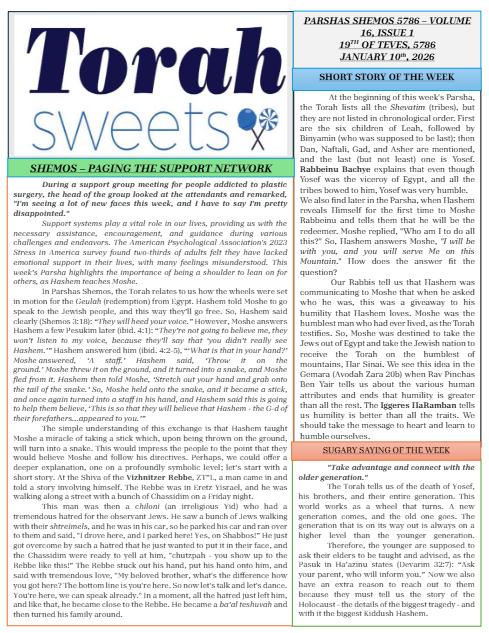
During a support group meeting for people addicted to plastic surgery, the head of the group looked at the attendants and remarked, "I'm seeing a lot of new faces this week, and I have to say I'm pretty disappointed."

Support systems play a vital role in our lives, providing us with the necessary assistance, encouragement, and guidance during various challenges and endeavors. The American Psychological Association's 2023 Stress in America survey found two-thirds of adults felt they have lacked emotional support in their lives, with many feelings misunderstood. This week’s Parsha highlights the importance of being a shoulder to lean on for others, as Hashem teaches Moshe.

In Parshas Shemos, the Torah relates to us how the wheels were set in motion for the Geulah (redemption) from Egypt. Hashem told Moshe to go speak to the Jewish people, and this way they’ll go free. So, Hashem said clearly (Shemos 3:18): “They will heed your voice.” However, Moshe answers Hashem a few Pesukim later (ibid. 4:1): “They’re not going to believe me, they won’t listen to my voice, because they’ll say that ‘you didn’t really see Hashem.’” Hashem answered him (ibid. 4:2-5), “‘What is that in your hand?’ Moshe answered, ‘A staff.’ Hashem said, ‘Throw it on the ground.’ Moshe threw it on the ground, and it turned into a snake, and Moshe fled from it. Hashem then told Moshe, ‘Stretch out your hand and grab onto the tail of the snake.’ So, Moshe held onto the snake, and it became a stick, and once again turned into a staff in his hand, and Hashem said this is going to help them believe, ‘This is so that they will believe that Hashem - the G-d of their forefathers...appeared to you.’”

The simple understanding of this exchange is that Hashem taught Moshe a miracle of taking a stick which, upon being thrown on the ground, will turn into a snake. This would impress the people to the point that they would believe Moshe and follow his directives. Perhaps, we could offer a deeper explanation, one on a profoundly symbolic level; let’s start with a short story. At the Shiva of the Vizhnitzer Rebbe, ZT”L, a man came in and told a story involving himself. The Rebbe was in Eretz Yisrael, and he was walking along a street with a bunch of Chassidim on a Friday night.

This man was then a chiloni (an irreligious Yid) who had a tremendous hatred for the observant Jews. He saw a bunch of Jews walking with their shtreimels, and he was in his car, so he parked his car and ran over to them and said, "I drove here, and I parked here! Yes, on Shabbos!” He just got overcome by such a hatred that he just wanted to put it in their face, and the Chassidim were ready to yell at him, "chutzpah - you show up to the Rebbe like this!” The Rebbe stuck out his hand, put his hand onto him, and said with tremendous love, "My beloved brother, what's the difference how you got here? The bottom line is you're here. So now let's talk and let's dance. You're here, we can speak already." In a moment, all the hatred just left him, and like that, he became close to the Rebbe. He became a ba’al teshuvah and then turned his family around.

PDF Preview