The Nature of Trust and Belief in G-d
Trust and belief
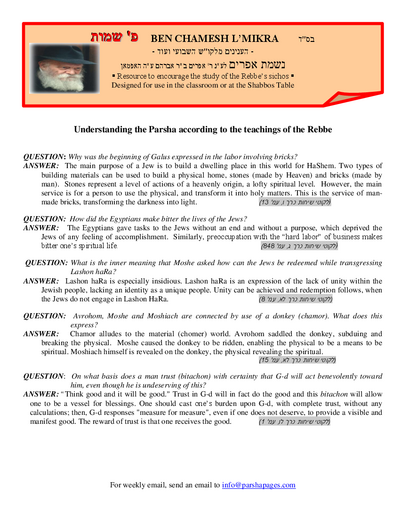
It is possible to explain that the idea of trust (bitachon) in G-d is dependent on the concept of belief (emuna) in G-d. The concept of trust in G-d hinges on the belief that all that happens in the world is orchestrated by the Almighty. Any person who believes that G-d is just, should consequently trust in Him as well. Trusting in G-d essentially means that the person believes that all which G-d does is for a good purpose.
Accordingly, the individual who trusts in G-d does not necessarily believe that G-d will deal with him in the way the individual wishes, but that no matter what G-d does to him, he trusts that it is beneficial. Even if the person is not saved from his predicament, he trusts that this too is for his good.
When a person who believes in the Almighty is in a dire situation, he knows that it is not the situation he should be fearful of, but only of G-d. Therefore, it stands to reason, that being that it is G-d who placed the individual in the circumstances in which he finds himself, he should be calm and peace. If he is worthy of G-d’s kindness, and not deserving of any suffering, G-d will obviously not put him through undue hardship, and He will surely save him even if there does not seem to be a natural means to be saved. G-d controls nature and will definitely help him if he so deserves. Conversely, if the person does not merit, he will as well be completely calm. This is so, because he knows that his situation is a result of his actions and that whatever is happening to him, comes from a kind and just G-d.
He is aware, that even if the Almighty is punishing him, it is ultimately for his own benefit. The purpose of punishment is a kindness to clean an individual’s soul from any stain that he may have dirtied it with.
What are you afraid of?
According to the above, it is understood how everyone can have complete trust in the Almighty, even when he is aware that he is less than perfect. Because he knows that all that happens is from G-d, he is not fearful of the situation, but from G-d, who placed him in the situation.
This explains the view of the second group of commentators, who expressed that Yaakov and Moshe’s fear was misplaced, in that it displayed a lack of faith. According to this view, they were not fearful that they had sinned and afraid of G-d—they were instead fearful of their predicament.
This is seen in the wording of the respective verses describing these two incidents: Concerning Yaakov, the verse said, “Yaakov became very frightened and was distressed; so he divided the people who were with him...” A basic understanding of the verse implies that he was scared of Esav and not of his sins. Regarding Moshe as well, it seems that he was scared of Og and not of his sins. The verse states: “The Lord said to Moshe, ‘Do not fear him, for I have delivered him, his people, and his land into your hand.’” From the fact that G-d told Moshe not to fear him, it is apparent that Moshe was afraid of Og himself.
These commentaries therefore entreat the individual not to learn this trait from our ancestors, and instead, to entrust their fate entirely to G-d, no matter the outcome.
It will be good
The above interpretation of trusting in the Almighty, in which the individual is confident that no matter the outcome, it is for his good, is nevertheless, not a satisfactory explanation. The concept of trust in G-d in its most basic understanding, is that one is certain that G-d will be kind to him in a perceivable manner. Trusting in G-d is not merely that one is in a constant state of calm, knowing that all is for his best. Rather, trust in G-d is the belief that G-d will be kind to him in a way that is clearly apparent.
In contrast, according to the previous explanation, the individual who has sinned is merely to trust that whatever happens is from G-d and therefore intrinsically good. This would mean that the concept of trust in G-d in its most basic form—that G-d will show him revealed kindness—is not possible by most people who have some sins! The only people who can have total trust that things will result in a manner of revealed good are perfectly righteous individuals. Only they can truly be sure that G-d will act towards them with tangible kindness. The entire foundation though for trusting in G-d is that one is confident that G-d will be kind to him in a perceivable way, whether he is deserving or not.
That the person he trusts is of the utmost generosity and kindness to those deserving and to those who are not deserving, and that his generosity and kindness is continuous, never ending and without interruption.
Chovas HaLevavos, Sha-ar Habitachon 2:7
Accordingly, everyone should trust in G-d, no matter if they possess sins or not. They should trust that G-d will be kind to them in His never-ending benevolence. This needs clarification though: Even though G-d is kind to those that are not worthy, it is also possible that the person does deserve punishment. That being the case, how can the individual be sure that G-d will show him kindness when he is not worthy?!