Think Good and It Will Be Good: The Power of Trust
Think good
The concept of trusting in the Almighty’s kindness—whether deserving or not—can be understood through a statement made by the third Lubavitcher Rebbe.
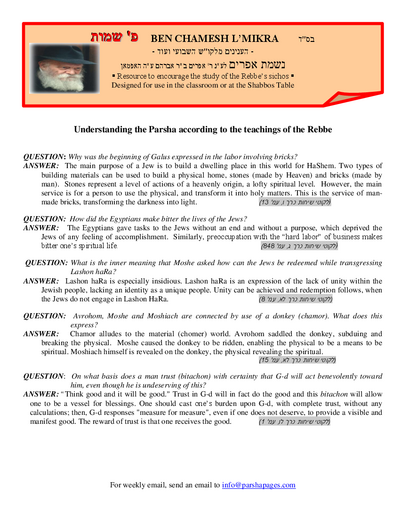
Think good, and it will be good.
Igros Kodesh, Previous Lubavitcher Rebbe, vol. 2,
This does not mean that the individual does not work within nature as well, but that he works within nature because that is how G-d wishes him to act. See Chovas HaLevavos, Sha-ar Habitachon, ch. 3, Akeida Sha-ar 26.
Trust in G-d, it is not only a derivative of faith, but it is an entirely separate notion. The concept of trusting in G-d is that a person relies entirely on the Almighty, putting his total fate into the hands of Heaven. It is not a belief the outcome will be for his best, no matter if it is perceptible to his eyes or not, but is instead, the act of letting go of his burdens and placing his complete fate in the hands of the Almighty.
Trust in G-d is a difficult feat to master. A person must push aside any doubt or worries from his mind and figuratively give them to G-d. This is expressed in the verse, “Cast your burden on the Lord, and He will bear you...”
When an individual relies on G-d, he does not look to any natural means as the source of his salvation, but is aware that it is only G-d that he should depend upon for all his needs.
This is the intent of the following explanation:
All matters of the one who trusts are entirely in the hands of the one he trusts, and no one else can hurt him, help him, benefit him, or protect him from harm, as a slave chained down in a prison is entirely in the hands of his master. If the one who trusts were in the hands of the one he trusts in this manner, it would be more fitting to trust in him.
Chovas HaLevavos, Sha-ar Habitachon, 2:3
No matter the situation, even if the deliverance seems impossible according to any logical natural means—he still relies on G-d, as his fate is only in His hands.
Trust in G-d is not a belief it is an action. It is not the belief that G-d is always kind to everyone—no matter what—it is rather the act of placing one’s entire burden on G-d. The definition of trust in G-d is that because of his trust, G-d will save him. Trust in G-d is not that one has faith in G-d’s everlasting benevolence, with the belief that since His kindness is endless, even one who transgresses will receive G-d’s kindness, irrespective of his actions. If this were the case, there would be no concept of reward and punishment. Rather, it is the merit of a person’s complete trust in G-d, which brings about G-d’s favor.
When the individual believes in G-d, no matter which logical reasons tell him otherwise, this itself is the reason that G-d will show him revealed goodness—even if he does not otherwise merit G-d’s benevolence. Because he does not rely on anything besides G-d and ignores all logic telling him he cannot be saved, that, in turn, G-d ignores the fact that he may be undeserving, and showers him with kindness.
This is the meaning of, “Think good, and it will be good.” When a person actively believes that G-d will do kindness for him, this directly causes to indeed act kindly.